Viewing as
Teaching this? The teacher view adds 2 files, the mark schemes and the model answers.
Physics · Waves
Transverse and longitudinal waves
Describe the difference between transverse and longitudinal waves and describe evidence that it is the wave, and not the medium, that travels.
Warm-up
Answer each one, then check.
-
1
What do waves transfer?
Show answerHide answer
Energy
-
2
Give an example of a wave.
Show answerHide answer
Sound, light or water ripples
-
3
What is a medium?
Show answerHide answer
The material a wave travels through
-
4
What is a vibration?
Show answerHide answer
A repeated back-and-forth movement
-
5
What do sound waves travel through?
Show answerHide answer
Solids, liquids and gases
Learning Objectives
- 1Describe the difference between transverse and longitudinal waves.
- 2Give examples of each.
- 3Describe compressions and rarefactions.
- 4Describe evidence that in ripples and sound it is the wave, not the water or air, that travels.
TWO TYPES OF WAVE
In a transverse wave the vibrations are at right angles to the direction the wave travels. In a longitudinal wave the vibrations are parallel to the direction of travel.
Waves transfer energy (and information) from one place to another without transferring matter.
Transverse and Longitudinal Waves
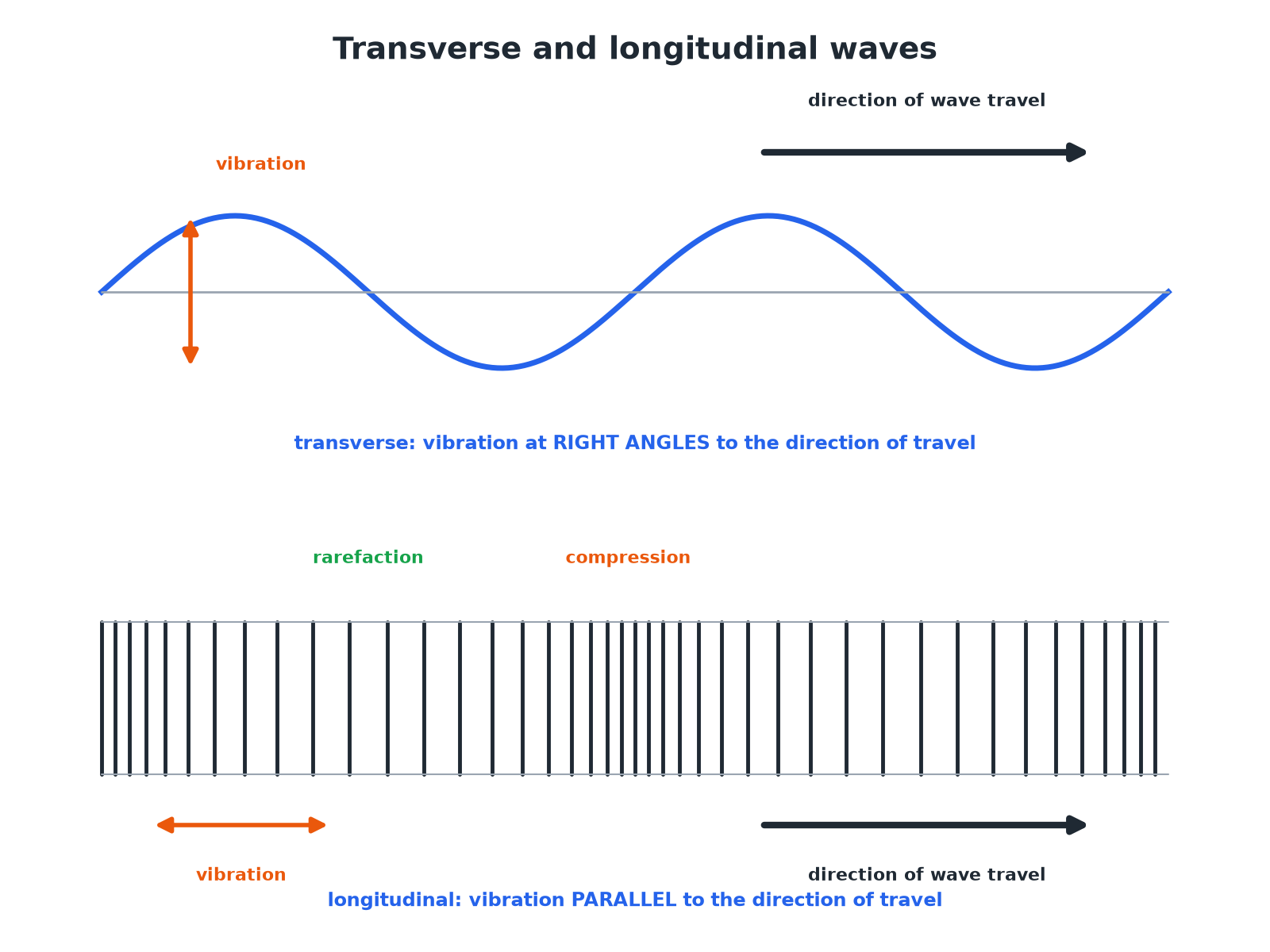
The direction of vibration compared with travel is the key difference.
Transverse or Longitudinal?
Transverse
- Vibrations are at right angles to the direction of travel.
- Examples: ripples on water, electromagnetic waves, waves on a rope.
- Have crests and troughs.
Longitudinal
- Vibrations are parallel to the direction of travel.
- Examples: sound waves, P-waves.
- Have compressions and rarefactions.
Evidence That the Wave Travels
Describe evidence that in water ripples it is the wave, and not the water, that moves.
Show the solutionHide the solution
- 1 Float a cork on a pond As ripples pass, the cork bobs up and down
- 2 Observe The cork does not travel along with the wave
- 3 Conclusion The water vibrates but does not move with the wave
AnswerThe cork moves up and down in the same place, so the water itself does not travel.
Sound in Air
Explain why sound waves are longitudinal.
Show the solutionHide the solution
- 1 Air particles Vibrate backwards and forwards in the direction the wave travels
- 2 Compressions Regions where the particles are pushed close together
- 3 Rarefactions Regions where the particles are spread out
AnswerSound is a longitudinal wave with compressions and rarefactions.
Key Points
Learn these.
-
Energy, not matter
Waves transfer energy without transferring matter.
-
Medium
Mechanical waves need a medium; electromagnetic waves do not.
-
Sound evidence
Particles in air vibrate about fixed positions; smoke in a tube just vibrates back and forth.
-
Don't say
'The water moves along'. The water just moves up and down.
Wave Types
Classify each wave as transverse or longitudinal: (a) light (b) sound in air (c) ripples on a pond (d) a wave on a rope shaken up and down.
1. Is vibration at right angles?
2. Or parallel?
A good answer shows: (a) Transverse (b) Longitudinal (c) Transverse (d) Transverse.
Can I...?
- 1Define transverse.
- 2Define longitudinal.
- 3Give examples.
- 4Name compressions and rarefactions.
- 5Describe the cork evidence.
- 6Say waves transfer energy.
- 7Explain sound in air.
- 8Draw both wave types.
Summary & Exam Focus
- Transverse: vibrations at right angles; longitudinal: parallel.
- Sound is longitudinal; ripples are transverse.
- Compressions and rarefactions in longitudinal waves.
- The wave, not the medium, travels.
Exam focus
Describe the difference between a transverse wave and a longitudinal wave. (2 marks) (2 marks)
Direction of vibration relative to the direction of travel.
Key terms
The vocabulary this lesson expects you to use. Each one is linked from the first place it appears above.
- Transverse wave
- A wave with vibrations at right angles to the direction of travel.
- Longitudinal wave
- A wave with vibrations parallel to the direction of travel.
- Compression
- A region where particles are close together.
- Rarefaction
- A region where particles are spread out.
- Medium
- The material a wave travels through.
- Oscillation
- A back-and-forth movement.
Practice questions
Have a go at each one before you open its answer.
-
Question 1 Describe 2 marks
Describe the difference between a transverse wave and a longitudinal wave.
Show answerHide answer
Model answer
In a transverse wave the vibrations are at right angles to the direction of travel of the wave. In a longitudinal wave the vibrations are parallel to the direction of travel.
Mark scheme
- Transverse: at right angles — 1 mark
- Longitudinal: parallel — 1 mark
-
Question 2 State 2 marks
Give one example of a transverse wave and one example of a longitudinal wave.
Show answerHide answer
Model answer
Transverse: ripples on water, light or other electromagnetic waves. Longitudinal: sound waves in air.
Mark scheme
- A transverse wave — 1 mark
- A longitudinal wave — 1 mark
-
Question 3 Describe 3 marks
Describe how a longitudinal wave, such as a sound wave, travels through air. Use the words compression and rarefaction.
Show answerHide answer
Model answer
The air particles vibrate back and forth parallel to the direction the wave travels. The wave consists of regions where the particles are pushed together (compressions) and regions where they are spread out (rarefactions), which move through the air.
Mark scheme
- Particles vibrate parallel to travel — 1 mark
- Compressions: particles close together — 1 mark
- Rarefactions: particles spread out — 1 mark
-
Question 4 Describe 3 marks
A cork floats on water. Ripples pass it. Describe what happens to the cork and explain what this shows about the wave.
Show answerHide answer
Model answer
The cork moves up and down but does not travel along with the wave. This shows that the wave transfers energy but the water itself does not move along.
Mark scheme
- Cork moves up and down — 1 mark
- Cork does not move along with the wave — 1 mark
- The wave, not the water, travels (energy transferred) — 1 mark
-
Question 5 Explain 3 marks
Explain why sound cannot travel through a vacuum but light can.
Show answerHide answer
Model answer
Sound is a longitudinal wave that needs particles to vibrate, so it needs a medium. Light is an electromagnetic wave and does not need a medium.
Mark scheme
- Sound needs a medium or particles — 1 mark
- No particles in a vacuum — 1 mark
- Light does not need a medium — 1 mark
Quick check
-
Sound waves are...
Show answerHide answer
B: longitudinal
Compressions and rarefactions.
-
In a transverse wave vibrations are...
Show answerHide answer
C: at right angles to the direction of travel
That defines it.
-
A compression is a region where particles are...
Show answerHide answer
D: close together
Higher pressure.
-
Waves transfer...
Show answerHide answer
A: energy
Not matter.
-
A cork on water bobs up and down. This shows the...
Show answerHide answer
B: water does not travel with the wave
Only the wave travels.
Downloads
Free to keep, print and annotate.
- Transverse and longitudinal waves.pptx Built from the lesson script on 30 September 2026. View
- Transverse and longitudinal waves - Completed Notes.docx The full notes for the lesson, to revise from. Built from the lesson script on 30 September 2026. View
- Transverse and longitudinal waves - Exam Questions.docx Built from the lesson script on 30 September 2026. View
Something here looks wrong?
Tell us what and we will go and look. It goes to whoever writes these pages, nobody else, and we do not ask who you are — so there is nothing to sign and nothing comes back to you.