Biology · Transport In and Out of Cells
Viewing as
Teacher view: every answer and mark scheme set out in full.
Osmosis
Water moves in and out of cells too, and it follows its own rule. This lesson explains osmosis, how to predict which way water will move, and what it does to plant cells and animal cells.
Learning Objectives
- 1Define osmosis, using the terms dilute solution, concentrated solution and partially permeable membrane.
- 2Predict the direction in which water will move between two solutions.
- 3Describe what happens to plant cells in dilute, concentrated and equal solutions.
- 4Describe what happens to animal cells in dilute and concentrated solutions, and explain the difference.
Retrieval practice
-
1
What is diffusion?
Show answerHide answer
The net movement of particles from a higher to a lower concentration.
-
2
What does the cell membrane do?
Show answerHide answer
It controls which substances pass into and out of the cell.
-
3
What are plant cell walls made of?
Show answerHide answer
Cellulose.
-
4
What is a concentrated solution?
Show answerHide answer
One with a large amount of dissolved substance compared with the amount of water.
Water on the move
Water is the most common substance in a cell, and it moves across cell membranes all the time. The way it moves is called osmosis. You can think of osmosis as diffusion of water, but with two rules added: it happens across a partially permeable membrane, and what matters is how dilute or concentrated the solutions on each side are. Osmosis explains why a lettuce crisps up in water, why a plant wilts, and why a red blood cell can burst.
What is osmosis?
Osmosis is the diffusion of water from a dilute solution to a concentrated solution through a partially permeable membrane.
-
Partially permeable membrane
A membrane with tiny holes that let small molecules, such as water, through but not larger ones, such as sugar. Cell membranes behave like this.
-
Dilute solution
A solution with only a little dissolved substance, so it has a lot of water for its volume.
-
Concentrated solution
A solution with a lot of dissolved substance, so it has less water for its volume.
-
The direction
Water moves from the dilute solution into the concentrated solution, until the two sides are the same, or until something stops it.
Osmosis through a membrane
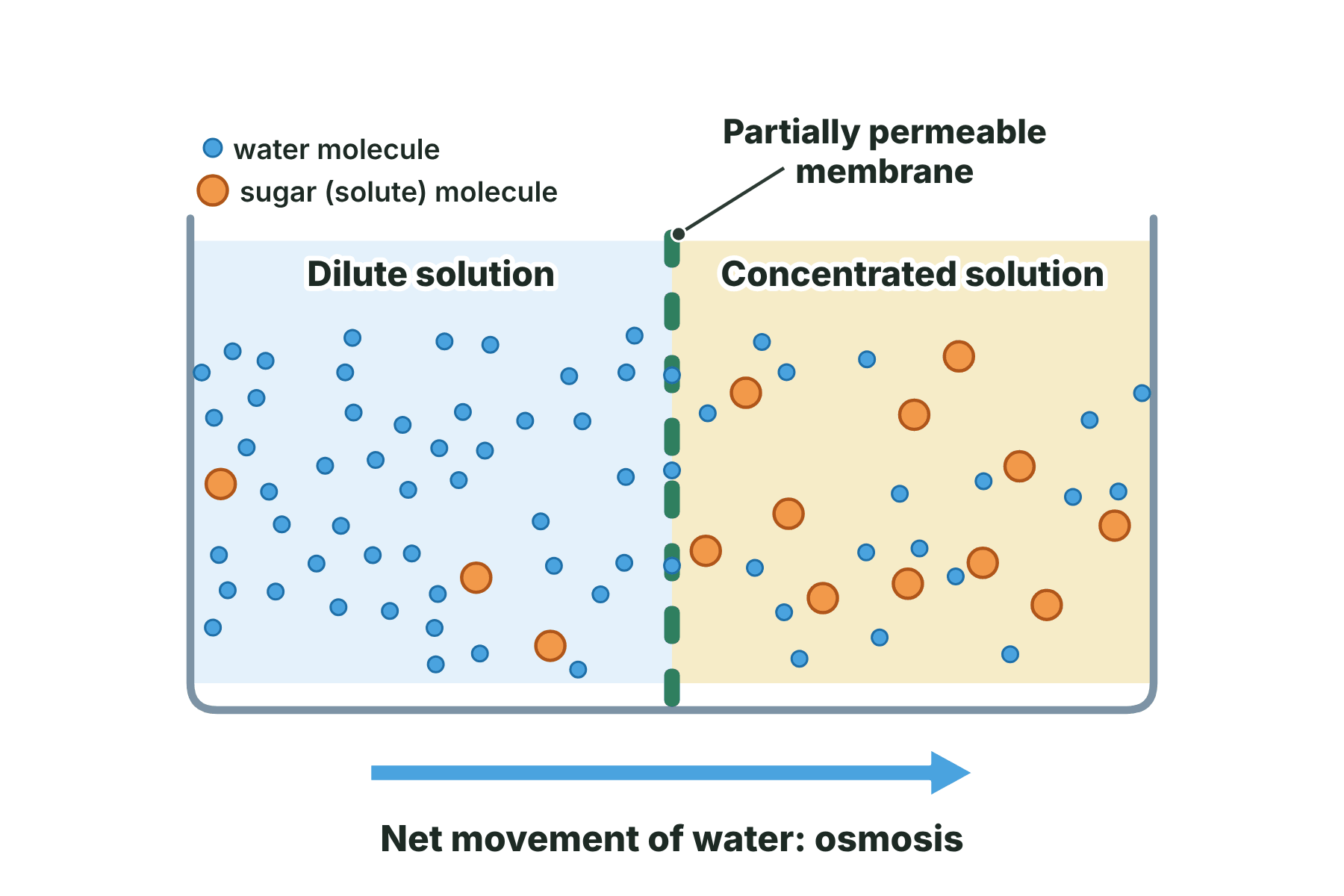
Water moves through the membrane from the dilute side to the concentrated side. The sugar molecules are too big to cross.
Predicting which way water will move
To predict the direction, compare the two solutions and find the more concentrated one.
-
Find the more concentrated solution
This is the one with more dissolved substance, such as a higher percentage of sugar or a higher number of mol/dm³.
-
Water moves towards it
The net movement of water is from the more dilute solution into the more concentrated one.
-
Equal concentrations
If the two solutions are the same concentration, there is no net movement of water, although water molecules still move both ways.
-
A common mistake
Water does not move to where there is more water. It moves from where there is more water to where there is less.
Which way does the water move?
A plant cell contains cell sap equivalent to a 0.4 mol/dm³ sugar solution. It is placed in a 0.1 mol/dm³ sugar solution. Which way does water move by osmosis, and why?
Show the solutionHide the solution
- 1 Compare the concentrations Outside is 0.1 mol/dm³ and the cell sap is 0.4 mol/dm³, so the outside solution is more dilute.
- 2 Water moves from dilute to concentrated So water moves from the solution outside into the cell.
- 3 State what happens to the cell The cell gains water, and swells until its wall stops it.
AnswerWater moves into the cell, because the solution outside is more dilute than the cell sap.
Osmosis in plant cells
A plant cell has a strong cell wall outside its membrane. The wall decides what the cell can do.
-
In a dilute solution
Water enters by osmosis and the vacuole swells. The cell is pushed hard against its wall and becomes firm, which is called turgid. The wall stops it bursting.
-
In a solution of the same concentration
There is no net movement of water, and the cell stays as it is.
-
In a concentrated solution
Water leaves by osmosis, the vacuole shrinks and the cell goes soft, which is called flaccid. If a lot of water is lost, the membrane pulls away from the wall, which is called plasmolysis.
-
Why it matters
Firm, turgid cells push against each other and hold a plant's leaves and stems up. If a plant loses water, its cells go flaccid and the plant wilts.
A plant cell in three solutions
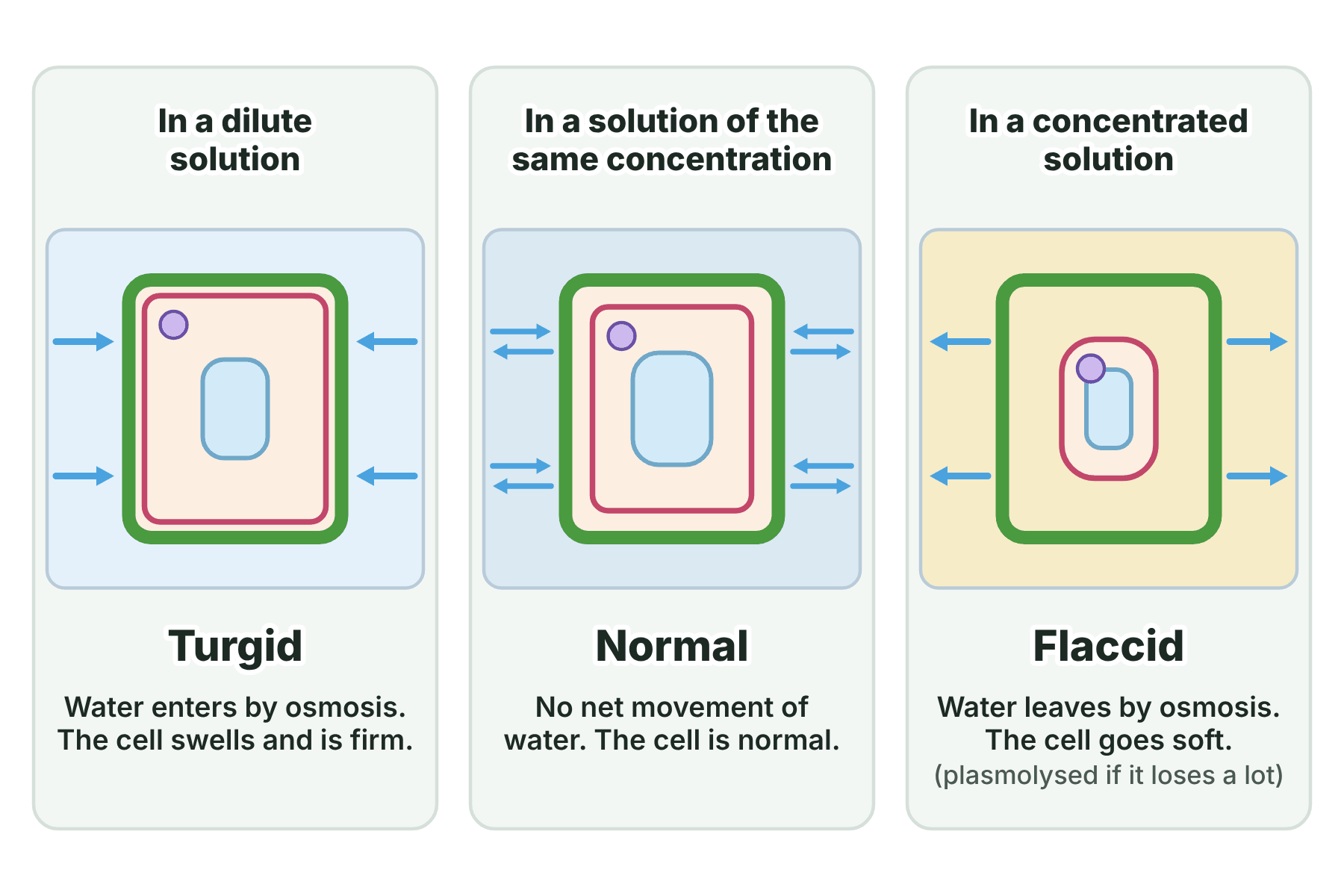
The cell wall stops a plant cell bursting, so a plant cell in a dilute solution becomes turgid instead.
Osmosis in animal cells
An animal cell has no cell wall, so it cannot resist the pressure of too much water.
-
In a dilute solution
Water enters by osmosis and the cell swells. A red blood cell may swell so much that it bursts.
-
In a solution of the same concentration
No net movement of water, so the cell keeps its normal shape.
-
In a concentrated solution
Water leaves by osmosis and the cell shrinks and shrivels.
-
Why it matters
Cells in your body have to stay in a fluid of the right concentration. Blood plasma and tissue fluid are kept at about the same concentration as the inside of the cells.
A red blood cell in three solutions
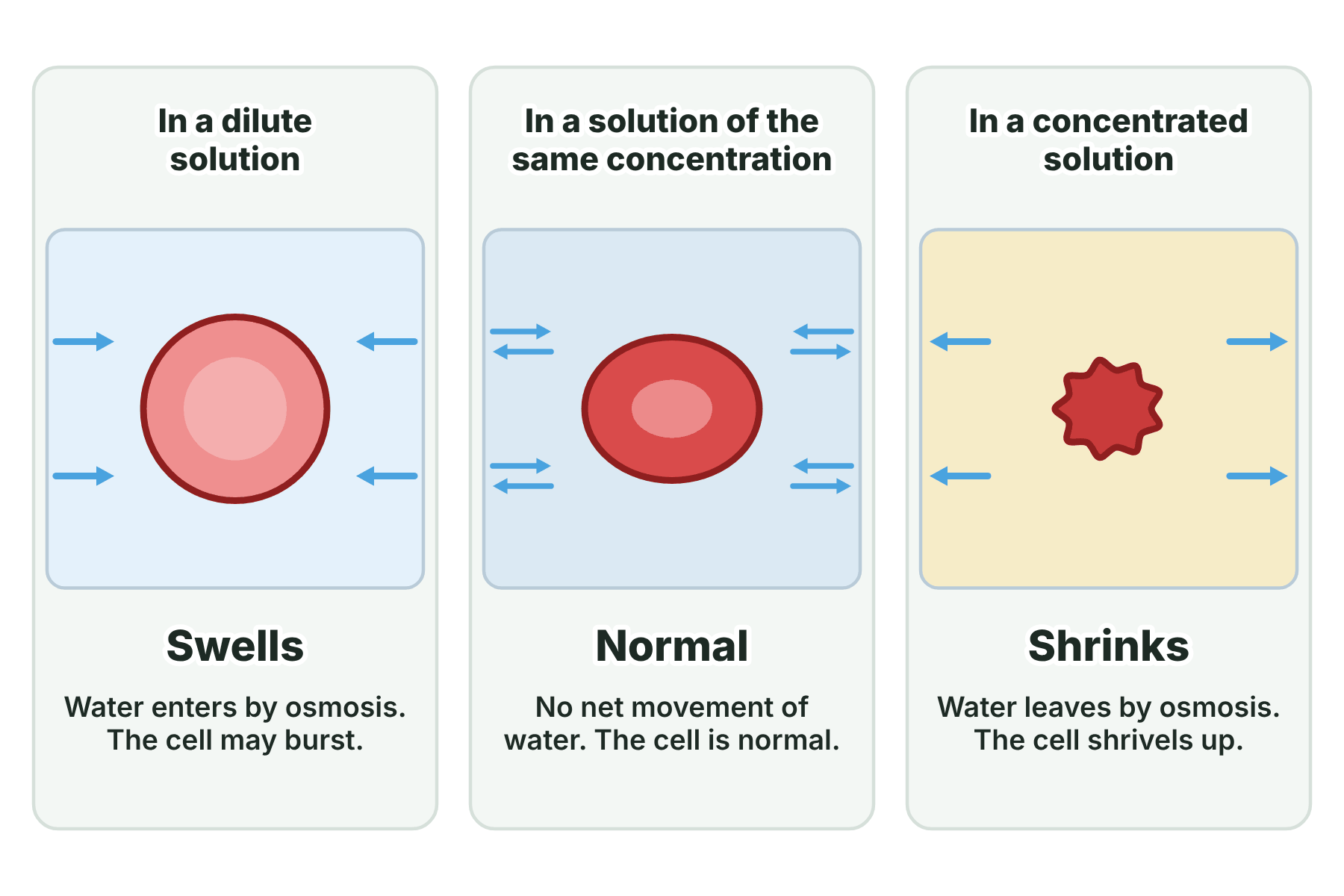
With no cell wall, an animal cell can burst in a dilute solution.
Case study
Isotonic sports drinks
During hard exercise you lose water, salts and sugar in sweat. An isotonic drink has about the same concentration of dissolved substances as your body fluids. Drinking it replaces what you have lost without making the fluids around your cells too dilute or too concentrated, so the cells do not gain or lose water by osmosis. Plain water, being very dilute, could do the opposite if you drank far too much of it.
The definition to learn
Osmosis is the diffusion of water from a dilute solution to a concentrated solution through a partially permeable membrane.
Every part matters: water, dilute to concentrated, and a partially permeable membrane.
Osmosis
Osmosis
-
Definition
- water diffuses from dilute to concentrated through a partially permeable membrane
-
Plant cells
- dilute: turgid
- concentrated: flaccid
- wall stops bursting
-
Animal cells
- dilute: swell and may burst
- concentrated: shrink
-
Predicting
- find the more concentrated solution
- water moves towards it
-
Equal
- no net movement
Summary and exam focus
- Osmosis is the diffusion of water from a dilute solution to a concentrated solution through a partially permeable membrane.
- Water moves towards the more concentrated solution.
- A plant cell in a dilute solution becomes turgid. In a concentrated solution it becomes flaccid.
- An animal cell in a dilute solution swells and may burst. In a concentrated solution it shrinks.
- If the solutions have the same concentration, there is no net movement of water.
Exam focus
Explain what happens to a plant cell and to a red blood cell when each is placed in pure water. (4 marks) (4 marks)
Name the process, give the direction and say what the cell does. Then explain the difference: the plant cell has a cell wall, so it becomes turgid, while the red blood cell has none and may burst.
Key terms
The words this lesson expects you to use. Each one is linked from the first place it appears above.
- Osmosis
- The diffusion of water from a dilute solution to a concentrated solution through a partially permeable membrane.
- Partially permeable membrane
- A membrane that lets some substances, such as water, pass through but not others, such as large dissolved molecules.
- Dilute solution
- A solution with a low concentration of dissolved substance.
- Concentrated solution
- A solution with a high concentration of dissolved substance.
- Solute
- A substance that is dissolved in a liquid, such as sugar in water.
- Turgid
- Firm and swollen with water. A turgid plant cell is pressed against its cell wall.
- Flaccid
- Soft and limp after losing water.
- Plasmolysis
- When a plant cell loses so much water that its membrane pulls away from the cell wall.
- Cell sap
- The solution inside the vacuole of a plant cell.
- Isotonic
- Having the same concentration of dissolved substances as the body's fluids.
Questions and answers
20 questions set on this lesson, with the mark schemes and model answers open.
Name the type of membrane through which osmosis takes place.
Mark scheme — 1 mark available
- Partially permeable (membrane) — 1 mark
Model answer
A partially permeable membrane.
State what is meant by osmosis.
Mark scheme — 2 marks available
- Diffusion of water from a dilute to a concentrated solution — 1 mark
- Through a partially permeable membrane — 1 mark
Model answer
The diffusion of water from a dilute solution to a concentrated solution through a partially permeable membrane.
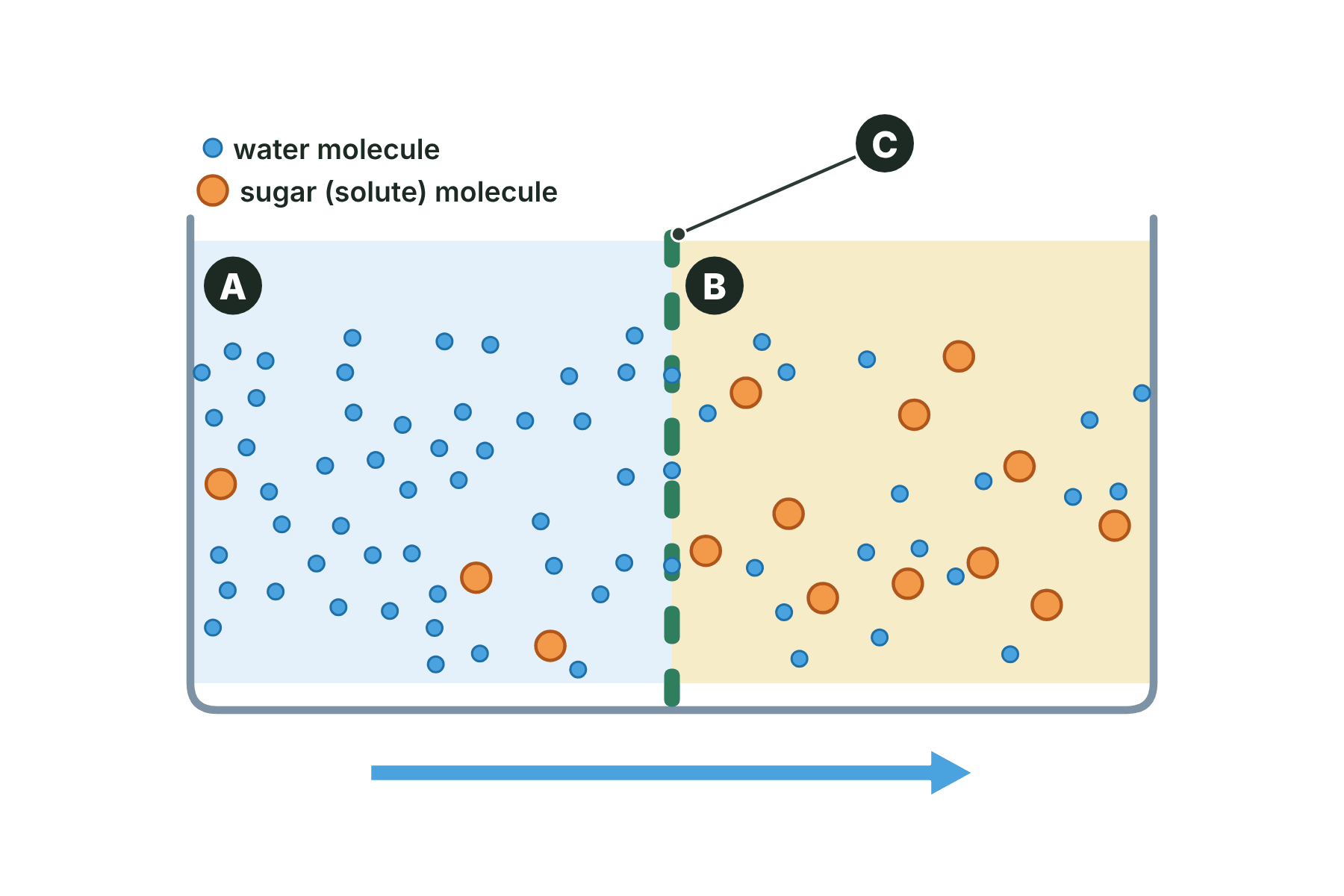
Figure 1 shows two solutions separated by a membrane. Name the parts labelled A, B and C.
Mark scheme — 3 marks available
- A: dilute solution — 1 mark
- B: concentrated solution — 1 mark
- C: partially permeable membrane — 1 mark
Model answer
A is the dilute solution. B is the concentrated solution. C is the partially permeable membrane.
In Figure 1, the sugar molecules do not move across the membrane. Explain why.
Mark scheme — 2 marks available
- Membrane is partially permeable — 1 mark
- Sugar molecules are too big to pass through — 1 mark
Model answer
The membrane is only partially permeable. The sugar molecules are too large to pass through its tiny holes, but the small water molecules can.
A plant cell is placed in pure water. Describe what happens to the cell.
Mark scheme — 2 marks available
- Water enters by osmosis — 1 mark
- Cell becomes turgid / swollen and firm — 1 mark
Model answer
Water enters the cell by osmosis, and the cell becomes turgid (swollen and firm).
Explain why a red blood cell placed in pure water may burst, but a plant cell does not.
Mark scheme — 3 marks available
- Water enters by osmosis — 1 mark
- Red blood cell has no cell wall, so it may burst — 1 mark
- Plant cell wall prevents bursting — 1 mark
Model answer
Water enters both cells by osmosis. A red blood cell has no cell wall, so nothing stops it swelling, and it may burst. A plant cell has a strong cell wall, which stops it bursting.
A plant that has not been watered for several days wilts. Use ideas about osmosis to explain why.
Mark scheme — 3 marks available
- Water leaves the cells by osmosis — 1 mark
- Cells become flaccid / lose firmness — 1 mark
- So stems and leaves are no longer supported (wilting) — 1 mark
Model answer
The soil water becomes more concentrated, so water leaves the plant cells by osmosis. The cells lose water and go flaccid, so they can no longer hold the leaves and stems up and the plant wilts.
Solution P has a concentration of 0.2 mol/dm³ and solution Q has a concentration of 0.6 mol/dm³. They are separated by a partially permeable membrane. State the direction in which water moves and explain why.
Mark scheme — 2 marks available
- From P to Q (into the more concentrated solution) — 1 mark
- Water moves from dilute to concentrated by osmosis — 1 mark
Model answer
Water moves from P to Q. P is the more dilute solution, and water moves from a dilute solution to a concentrated solution by osmosis.
A student puts a red blood cell into a very concentrated salt solution. Describe and explain what happens to the cell.
Mark scheme — 4 marks available
- Solution is more concentrated than the cell — 1 mark
- Water leaves the cell by osmosis — 1 mark
- From dilute (cell) to concentrated (outside) — 1 mark
- Cell shrinks / shrivels — 1 mark
Model answer
The salt solution is more concentrated than the cytoplasm of the red blood cell. Water leaves the cell by osmosis, moving from the more dilute cytoplasm to the more concentrated solution. The cell loses water, so it shrinks and shrivels.
Describe and explain what happens to plant cells when they are placed in (a) a dilute solution and (b) a concentrated solution.
What the examiner wants: For each solution give the direction of water movement, the process, and what happens to the cell.
Mark scheme — 6 marks available
- Dilute: water enters by osmosis — 1 mark
- Cell becomes turgid / swollen and firm — 1 mark
- Cell wall prevents bursting — 1 mark
- Concentrated: water leaves by osmosis — 1 mark
- Cell becomes flaccid / soft — 1 mark
- Reason: outside solution is more concentrated than the cell sap — 1 mark
Model answer
In a dilute solution, the solution outside is more dilute than the cell sap, so water enters the cells by osmosis. The vacuole swells and the cell becomes turgid. The cell wall stops it bursting. In a concentrated solution, the solution outside is more concentrated than the cell sap, so water leaves the cells by osmosis. The vacuole shrinks and the cell becomes flaccid. If a lot of water is lost, the membrane pulls away from the cell wall.
Osmosis is the movement of which substance?
Why: Osmosis is the diffusion of water through a partially permeable membrane.
In which direction does water move by osmosis?
Why: Water moves from a dilute solution to a concentrated solution through a partially permeable membrane.
A plant cell is placed in a very dilute solution. What happens?
Why: Water enters by osmosis and the cell becomes turgid. The cell wall stops it bursting.
What does flaccid mean?
Why: A flaccid cell has lost water and is soft and limp.
Why does a red blood cell burst in pure water, but a plant cell does not?
Why: A red blood cell has no cell wall, so it cannot resist the pressure as water enters. A plant cell has a strong cell wall.
Two solutions of 0.1 and 0.5 mol/dm³ are separated by a partially permeable membrane. Which way does water move?
Why: Water moves from the more dilute solution (0.1) to the more concentrated one (0.5).
A cell is in a solution of the same concentration as its contents. What happens to the water?
Why: There is no net movement of water. Water molecules still move both ways, but equally.
Why does a plant wilt when it is short of water?
Why: Its cells lose water by osmosis and become flaccid, so they no longer hold the plant up.
What does a partially permeable membrane do?
Why: It lets small molecules such as water through but stops larger molecules.
A student says: "Water moves by osmosis to where there is more water." What is wrong with this?
Why: Water moves from where there is more water (a dilute solution) to where there is less (a concentrated solution).