Biology · Cell Division
Viewing as
Teaching this? The teacher view opens every answer and mark scheme.
Using Stem Cells
Stem cells could be used to replace cells the body has lost, and plant stem cells are already used to make copies of useful plants. This lesson covers how, what could go wrong, and how to weigh up the arguments, which is what the exam asks you to do.
Learning Objectives
- 1Describe how stem cells may be used to treat conditions such as diabetes and paralysis.
- 2Describe therapeutic cloning, and explain why the stem cells made this way are not rejected.
- 3Evaluate the risks and the ethical or religious objections to using stem cells.
- 4Describe how stem cells from plant meristems are used to make clones of plants, and why this is useful.
Retrieval practice
-
1
What is a stem cell?
Show answerHide answer
An undifferentiated cell that can divide to make more cells and differentiate into specialised cells.
-
2
Which stem cells can become most types of human cell?
Show answerHide answer
Stem cells from human embryos.
-
3
What can adult bone marrow stem cells form?
Show answerHide answer
Many types of cell, including blood cells.
-
4
Where are the meristems in a plant?
Show answerHide answer
At the tips of the shoots and the tips of the roots.
From the laboratory to the clinic
Many diseases are caused by cells that have been lost or damaged, and the body cannot always replace them. Stem cells offer a way to make new cells of the right type. This is still being researched, so the exam wants you to describe what stem cells may be able to do, not to say that they can already cure these conditions. You are not asked how stem cell techniques are carried out. You are asked to describe the uses and to weigh up the benefits against the risks and the ethical issues.
Treating disease with stem cells
Treatment with stem cells may be able to help conditions such as diabetes and paralysis.
-
Replacing lost cells
Stem cells can be made to differentiate into the type of cell that is missing, and the new cells put into the patient to take over the work.
-
Diabetes
In type 1 diabetes the pancreas does not make enough insulin. New insulin-making cells made from stem cells could be used to replace the ones that are missing.
-
Paralysis
A spinal injury can damage nerve cells so that messages no longer pass along the spinal cord. New nerve cells made from stem cells could help to repair the damage.
-
Blood diseases
Stem cells from the bone marrow of a donor can be transplanted to replace faulty blood-forming cells.
Therapeutic cloning
A patient's body may attack cells that came from another person. Therapeutic cloning is a way to get round this.
-
An embryo with the patient's genes
In therapeutic cloning an embryo is produced with the same genes as the patient.
-
Stem cells from the embryo
Stem cells are taken from the embryo and made to differentiate into the cells the patient needs.
-
Not rejected
The stem cells have the same genes as the patient, so they are not rejected by the patient's body and may be used for medical treatment.
Therapeutic cloning
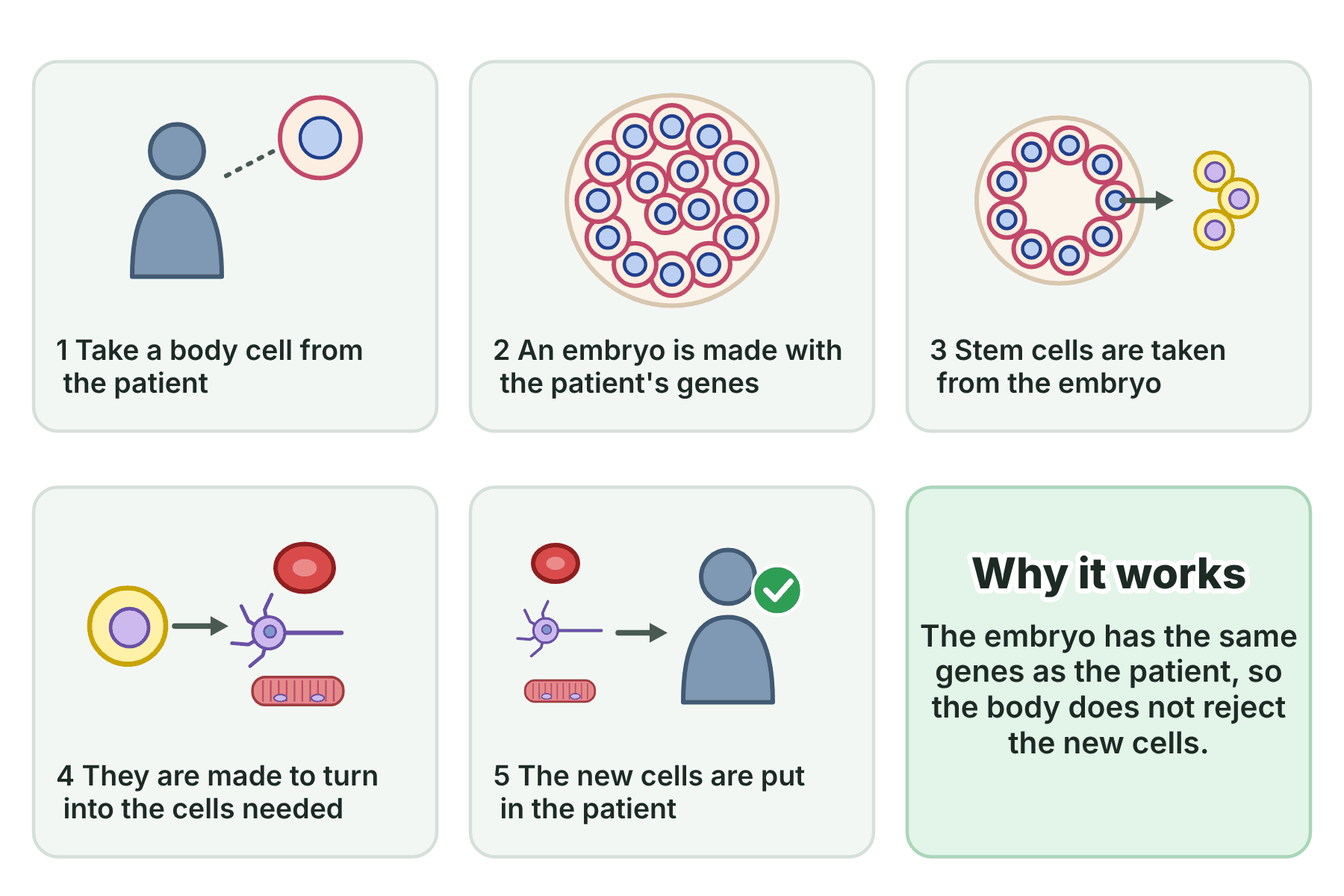
The cells are not rejected because they have the same genes as the patient.
Using stem cells: benefits and risks
Benefits
- Could replace cells lost in diabetes, paralysis and other conditions
- Therapeutic cloning gives cells that are not rejected by the patient's body
- Embryos used in research may otherwise be thrown away
- May reduce the need to wait for a donor
Risks and objections
- Risk of transferring a viral infection to the patient
- Some people have ethical or religious objections
- Many of the treatments are still being researched
- Taking stem cells from an embryo destroys the embryo
The ethical issues
Science can say what stem cells can do. It cannot decide whether people should use them. That is a question of values, and different people give different answers.
-
The case against
Some people believe that an embryo is a human life from the moment it is made, so that it is wrong to destroy it, even to help patients. Some religions teach this.
-
The case for
Others argue that an early embryo is only a ball of cells with no nervous system, that embryos made in fertility clinics which are not needed would be thrown away anyway, and that the good done for patients is greater.
-
Adult stem cells
Using adult stem cells, for example from bone marrow, avoids the objection about destroying an embryo, but they can become fewer types of cell.
-
Controls
In the UK, research that uses human embryos is regulated by law and has to be licensed.
Cloning plants with meristems
Stem cells from meristems can be used to produce clones of plants quickly and economically.
-
Quick
A small piece of meristem tissue can grow into a whole plant, and many pieces can be taken from one plant, so thousands of plants can be made in a short time.
-
Economical
Growing lots of plants from tiny pieces costs less than growing them from seed or by planting cuttings one at a time.
-
Identical
The new plants are clones of the parent, with the same genes, so they have the same useful features.
Making clones of a plant from meristem tissue
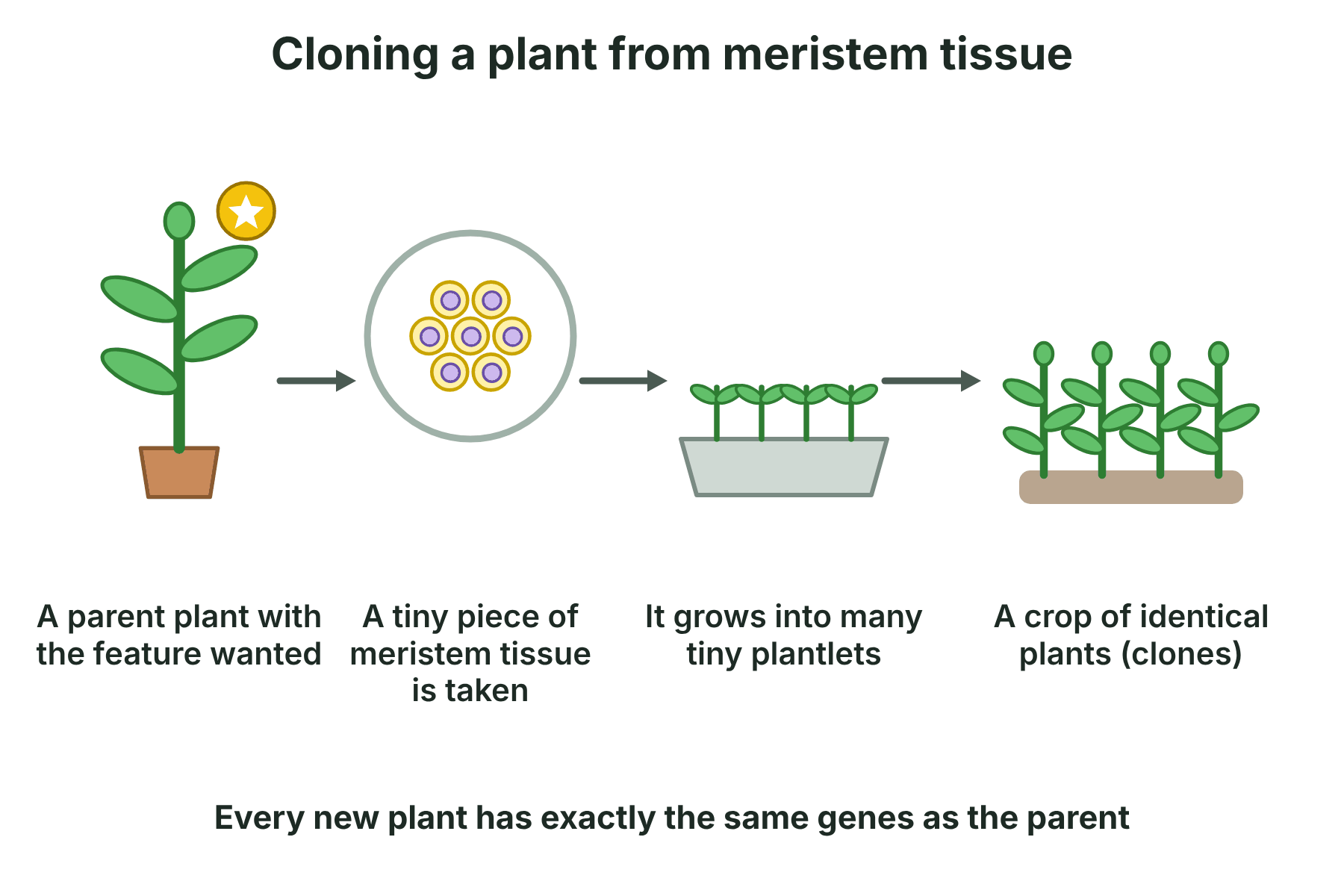
Every plant grown from the parent's meristem tissue has the same genes as the parent.
Why cloned plants are useful
Two uses are in the specification, and there is a drawback to weigh against them.
-
Protecting rare species
Rare plant species can be cloned to protect them from extinction, even when only a few plants are left.
-
Producing better crops
Crop plants with special features, such as disease resistance, can be cloned to produce large numbers of identical plants for farmers.
-
The drawback
Because clones have the same genes, one new disease could harm every plant in the crop. Variety is lost.
Case study
Saving a rare orchid
Suppose an orchid grows in only one forest and fewer than ten plants are left. Its seeds are very hard to grow. Small pieces of meristem tissue from the surviving plants can be used to grow hundreds of identical orchid plants, which can be grown on and planted back in the forest. The species is saved from extinction, but the new plants have only the genes of the few surviving parents.
How to answer an "evaluate" question
Evaluate the use of stem cells in medicine. (6 marks)
Show the solutionHide the solution
- 1 Say what stem cells could do They could replace lost or damaged cells, for example in diabetes and paralysis, and therapeutic cloning gives cells that are not rejected.
- 2 Give the risks Stem cells could transfer a viral infection to the patient, and the treatments are still being developed.
- 3 Give the ethical and religious views Some people object because making and using an embryo destroys it. Others say the benefit to patients outweighs this.
- 4 Reach a conclusion Use the word "because". For example: "On balance the benefits of adult stem cell treatments outweigh the risks, because they avoid using embryos."
AnswerA balanced answer gives benefits, risks and objections, and ends with a judgement that depends on the evidence.
Key point
Therapeutic cloning produces stem cells that the patient's body will not reject, because the embryo has the same genes as the patient.
That is the answer to "why not use cells from a donor?".
Using stem cells
Using stem cells
-
Medicine
- replace lost cells
- diabetes
- paralysis
- blood diseases
-
Therapeutic cloning
- embryo with the patient's genes
- cells not rejected
-
Risks
- viral infection
- still being researched
-
Ethics
- embryo destroyed
- religious views
- the benefit to patients
-
Plants
- meristems
- clones
- rare species
- disease-resistant crops
Summary and exam focus
- Stem cells may be used to treat conditions such as diabetes and paralysis.
- In therapeutic cloning an embryo is made with the same genes as the patient, so its stem cells are not rejected.
- Risks include transferring a viral infection. Some people have ethical or religious objections.
- Stem cells from meristems can be used to make clones of plants quickly and economically.
- Cloning can protect rare species and produce large numbers of disease-resistant crop plants.
Exam focus
Evaluate the use of stem cells in medicine. (6 marks) (6 marks)
Six-mark "evaluate" questions want both sides and a conclusion. Write two benefits, two risks or objections, and then a judgement that starts "On balance...". Do not write about how stem cell techniques are done: the specification says that is not required.
Key terms
The words this lesson expects you to use. Each one is linked from the first place it appears above.
- Therapeutic cloning
- Making an embryo with the same genes as a patient, so that its stem cells can be used in treatment without being rejected.
- Rejection
- When the body's immune system attacks cells or tissue that it recognises as foreign.
- Clone
- An organism, or cell, that is genetically identical to another.
- Diabetes
- A condition in which the body cannot control the level of glucose in the blood, because not enough insulin is made or it does not work.
- Paralysis
- Loss of the ability to move part of the body, often because nerve cells have been damaged.
- Ethical objection
- A moral argument against doing something, such as destroying an embryo.
- Viral infection
- A disease caused by a virus. Stem cell treatments risk passing one on.
- Disease resistance
- The ability of a plant to avoid or withstand a particular disease.
You've finished the notes
Check your understanding
Test yourself while it is fresh. Start with the flashcards, then try the exam questions.
Something here looks wrong?
Tell us what and we will go and look. It goes to whoever writes these pages, nobody else, and we do not ask who you are — so there is nothing to sign and nothing comes back to you.