Biology · Transport in Cells
Viewing as
Teacher view: every answer and mark scheme set out in full.
Surface Area to Volume Ratio and Exchange Surfaces
A single cell can get what it needs by diffusion through its surface, but a whole animal cannot. This lesson shows how to calculate a surface area to volume ratio, why size matters, and how exchange surfaces in animals and plants are adapted.
Learning Objectives
- 1Calculate and compare surface area to volume ratios.
- 2Explain why a single-celled organism can exchange materials across its surface.
- 3Explain why multicellular organisms need exchange surfaces and a transport system.
- 4State what makes an exchange surface effective.
- 5Explain how the small intestine, lungs, gills, roots and leaves are adapted for exchanging materials.
Retrieval practice
-
1
What three things affect the rate of diffusion?
Show answerHide answer
The concentration gradient, the temperature and the surface area of the membrane.
-
2
What is diffusion?
Show answerHide answer
The net movement of particles from a higher to a lower concentration.
-
3
Name one substance that diffuses out of respiring cells.
Show answerHide answer
Carbon dioxide.
-
4
Which waste product diffuses from cells into the blood plasma?
Show answerHide answer
Urea.
Why size matters
Last lesson you saw that diffusion is faster with a larger surface area. This lesson turns that into numbers. The key idea is that when an object gets bigger, its volume grows faster than its surface area. A tiny organism has plenty of surface for its size and can live by diffusion alone. A large one does not, and it has evolved special organs to get round the problem.
Surface area and volume
Surface area is the total area of the outside of an object. Volume is the amount of space inside it.
-
Surface area
For a cube, the area of one face is side × side, and there are six faces, so the surface area is \(6 \times \text{side}^{2}\).
-
Volume
For a cube the volume is \(\text{side} \times \text{side} \times \text{side}\), which is \(\text{side}^{3}\).
-
Surface area to volume ratio
Divide the surface area by the volume. It tells you how much surface there is for each unit of volume.
-
Bigger means smaller ratio
As an object gets larger, the surface area to volume ratio falls.
Surface area to volume ratio of a cube
A cube has sides of 2 cm. Calculate its surface area to volume ratio.
Show the solutionHide the solution
- 1 Find the area of one face \(2 \times 2 = 4\ \text{cm}^{2}\).
- 2 Multiply by 6 faces to get the surface area \(4 \times 6 = 24\ \text{cm}^{2}\).
- 3 Find the volume \(2 \times 2 \times 2 = 8\ \text{cm}^{3}\).
- 4 Divide the surface area by the volume \(24 \div 8 = 3\), so the ratio is 3 : 1.
Answer3 : 1
Bigger cubes have a smaller ratio
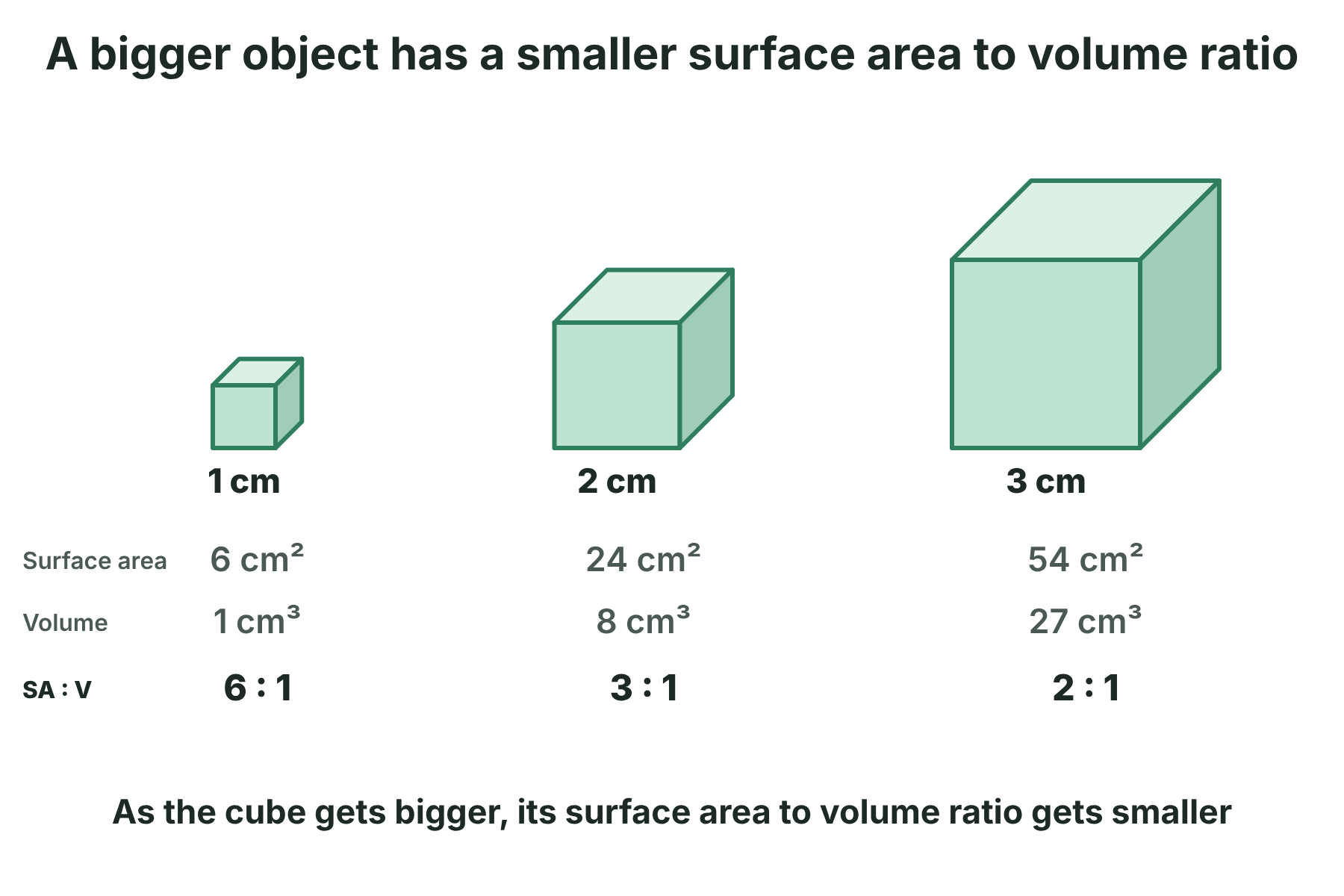
Make a cube three times as wide and its surface area to volume ratio falls from 6 : 1 to 2 : 1.
A block that is not a cube
A block measures 2 cm by 3 cm by 4 cm. Calculate its surface area to volume ratio, to one decimal place, in the form x : 1.
Show the solutionHide the solution
- 1 Find the area of each pair of faces \(2 \times 3 = 6\), \(2 \times 4 = 8\) and \(3 \times 4 = 12\) cm². Each appears twice.
- 2 Add them up, doubling each \(2 \times (6 + 8 + 12) = 52\ \text{cm}^{2}\).
- 3 Find the volume \(2 \times 3 \times 4 = 24\ \text{cm}^{3}\).
- 4 Divide to get the ratio in the form x : 1 \(52 \div 24 = 2.17\), which is 2.2 : 1 to one decimal place.
Answer2.2 : 1
Small and large organisms
What this means for living things depends on how big they are.
-
Single-celled organisms
A single cell has a relatively large surface area to volume ratio. Oxygen and food can diffuse in, and waste out, fast enough to meet the needs of the whole organism.
-
Multicellular organisms
A large organism has a much smaller surface area to volume ratio. Substances would take far too long to diffuse from the outside to the cells in the middle.
-
The answer
Large organisms have exchange surfaces, which are specialised surfaces for exchanging materials, and a transport system, such as the blood, to carry substances to and from every cell.
Why large organisms need exchange surfaces
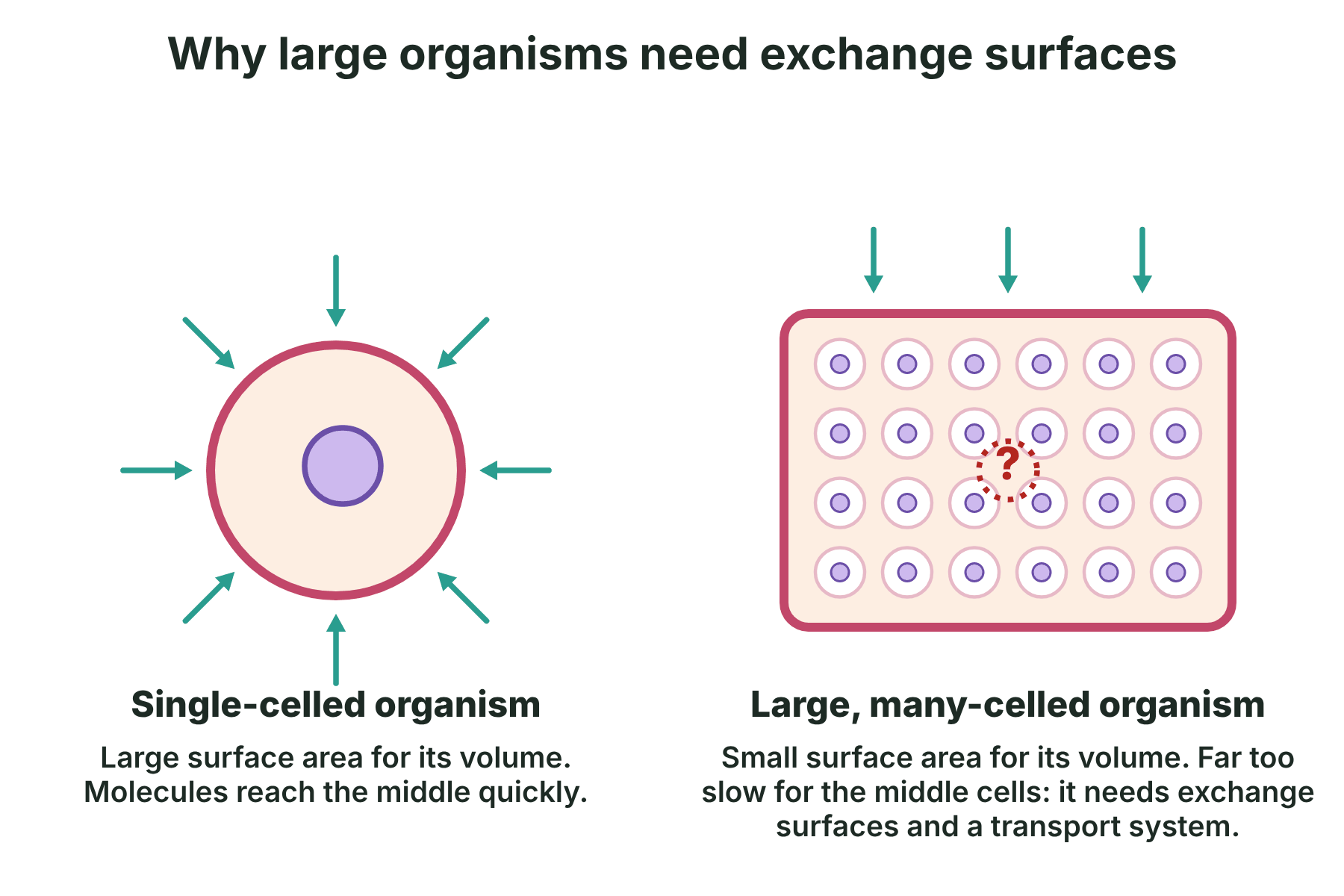
In a large organism the cells in the middle are too far from the outside for diffusion alone.
What makes an exchange surface effective
In multicellular organisms, surfaces and organ systems are specialised for exchanging materials. The effectiveness of an exchange surface is increased by four things.
-
A large surface area
More area means more particles can cross at once. Surfaces are often folded or divided into many small parts.
-
A thin membrane
A thin layer gives a short diffusion path, so particles cross quickly.
-
An efficient blood supply (animals)
Blood carries substances away, so the concentration on that side stays low and the gradient stays steep.
-
Being ventilated (animals, for gas exchange)
Moving air or water keeps the concentration of the gas high on the outside of the surface.
Exchange surfaces in animals
Each of these organs has the features above. The names are worth learning.
-
Small intestine
The inside wall is covered in villi, tiny finger-like folds that give a very large surface area. Each villus has a wall one cell thick and a network of capillaries, so digested food is absorbed quickly into the blood.
-
Lungs
The air passages end in millions of tiny air sacs called alveoli, which give a large surface area. Each alveolus has a wall one cell thick and is wrapped in capillaries. Breathing ventilates the lungs.
-
Gills (fish)
A gill is made of many thin filaments that give a large surface area. Each has a thin surface and a rich blood supply. Water flows over the gills all the time, which ventilates them.
Exchange surfaces in plants
Plants have exchange surfaces too. They are not ventilated or supplied with blood, but the other features are the same.
-
Roots
Root hair cells have a long, thin extension that gives a large surface area for taking up water and mineral ions from the soil.
-
Leaves
A leaf is flat, which gives a large surface area, and thin, which gives a short diffusion path. It has air spaces inside it and tiny pores called stomata on the underside, so carbon dioxide can diffuse in and oxygen can diffuse out.
Exchange surfaces in animals and plants
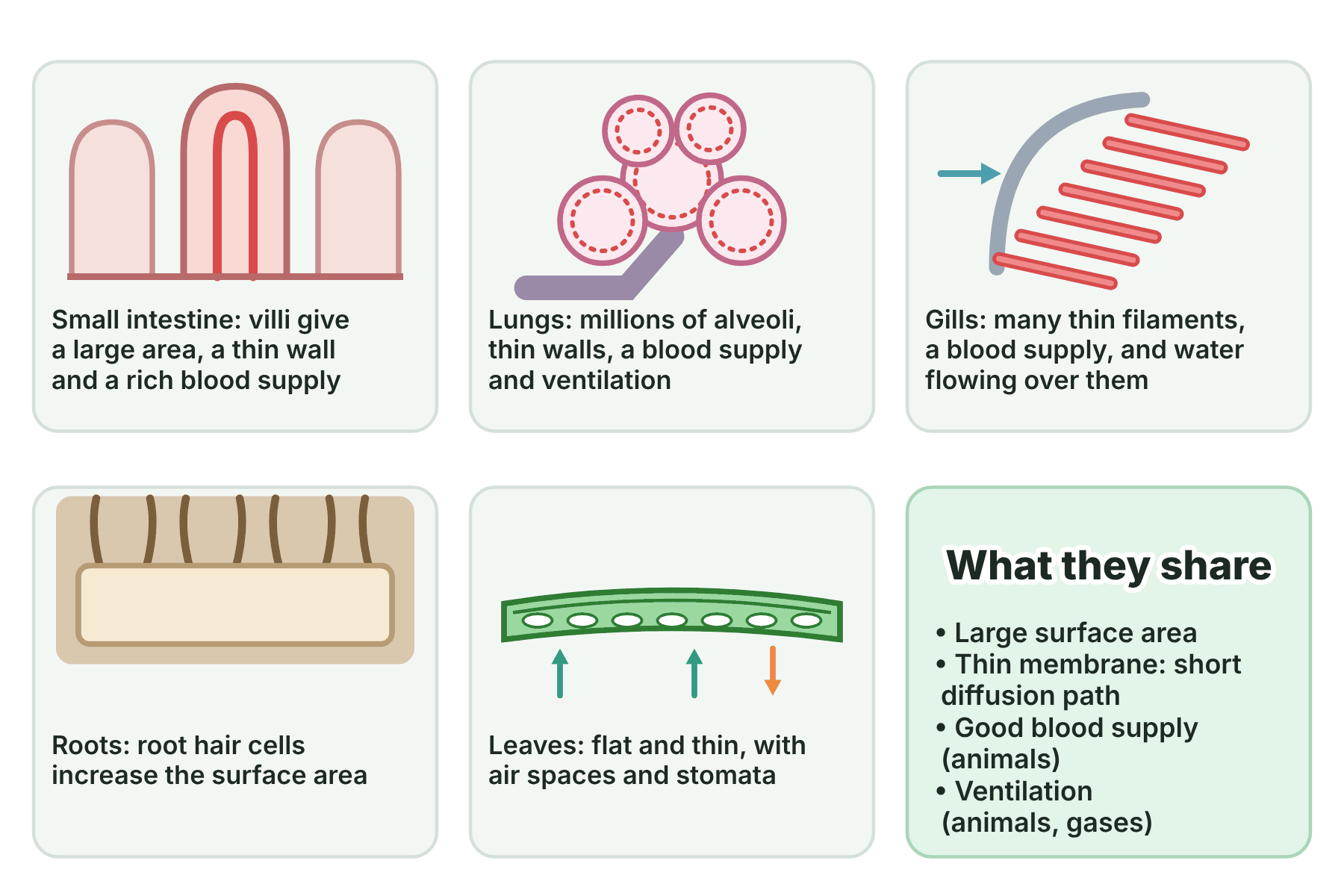
Five exchange surfaces, and the features they share.
Case study
The lining of the small intestine
If the inside of the small intestine were smooth, only a little of your food could be absorbed. It is a tube several metres long, and its lining is folded into millions of villi, so the area that touches the digested food is far larger than the area of a smooth tube would be. Each villus has a wall one cell thick, and the blood in its capillaries carries the absorbed food away, which keeps the concentration gradient steep.
Why exchange surfaces exist
The bigger the organism, the smaller its surface area compared with its volume.
So large organisms cannot rely on diffusion across their outer surface and need specialised exchange surfaces.
Surface area to volume ratio
Surface area to volume ratio
-
Calculating
- surface area ÷ volume
- cube = 6 × side² ÷ side³
-
Bigger object
- smaller ratio
-
Single cell
- large ratio
- diffusion across the surface is enough
-
Large organism
- small ratio
- needs exchange surfaces and a transport system
-
Exchange surfaces
- large area
- thin
- blood supply
- ventilation
Summary and exam focus
- Surface area to volume ratio is surface area divided by volume. It gets smaller as an object gets bigger.
- A single-celled organism has a large ratio, so diffusion across its surface meets its needs.
- A multicellular organism has a small ratio, so it needs exchange surfaces and a transport system.
- Effective exchange surfaces have a large surface area and a thin membrane, and in animals a good blood supply and ventilation.
- The small intestine, lungs, gills, roots and leaves are all adapted this way.
Exam focus
Explain why a large multicellular organism needs an exchange surface and a transport system, but a single-celled organism does not. (4 marks) (4 marks)
Use the phrase "surface area to volume ratio" and compare the two organisms. Link small ratio to the slow diffusion of substances to the middle cells.
Key terms
The words this lesson expects you to use. Each one is linked from the first place it appears above.
- Surface area to volume ratio
- The surface area of an object divided by its volume.
- Exchange surface
- A specialised surface through which substances are exchanged between an organism and its surroundings.
- Transport system
- A system, such as the blood and blood vessels, that carries substances around a large organism.
- Diffusion path
- The distance particles have to travel to cross an exchange surface.
- Villi
- Tiny finger-like folds in the lining of the small intestine that increase its surface area.
- Alveoli
- The tiny air sacs at the ends of the airways in the lungs, where gas exchange takes place.
- Gill
- The organ a fish uses to take oxygen from water, made of many thin filaments.
- Root hair cell
- A cell in the root with a long thin extension that increases the surface area for taking up water and ions.
- Stomata
- Tiny pores in the surface of a leaf that let gases in and out.
- Ventilation
- Moving air or water over an exchange surface so that the concentration gradient stays steep.
Questions and answers
20 questions set on this lesson, with the mark schemes and model answers open.
Name the tiny air sacs in the lungs where gas exchange takes place.
Mark scheme — 1 mark available
- Alveoli — 1 mark
Model answer
Alveoli.
Figure 1 shows three cubes. Calculate the surface area to volume ratio of the cube with 2 cm sides. Show your working.
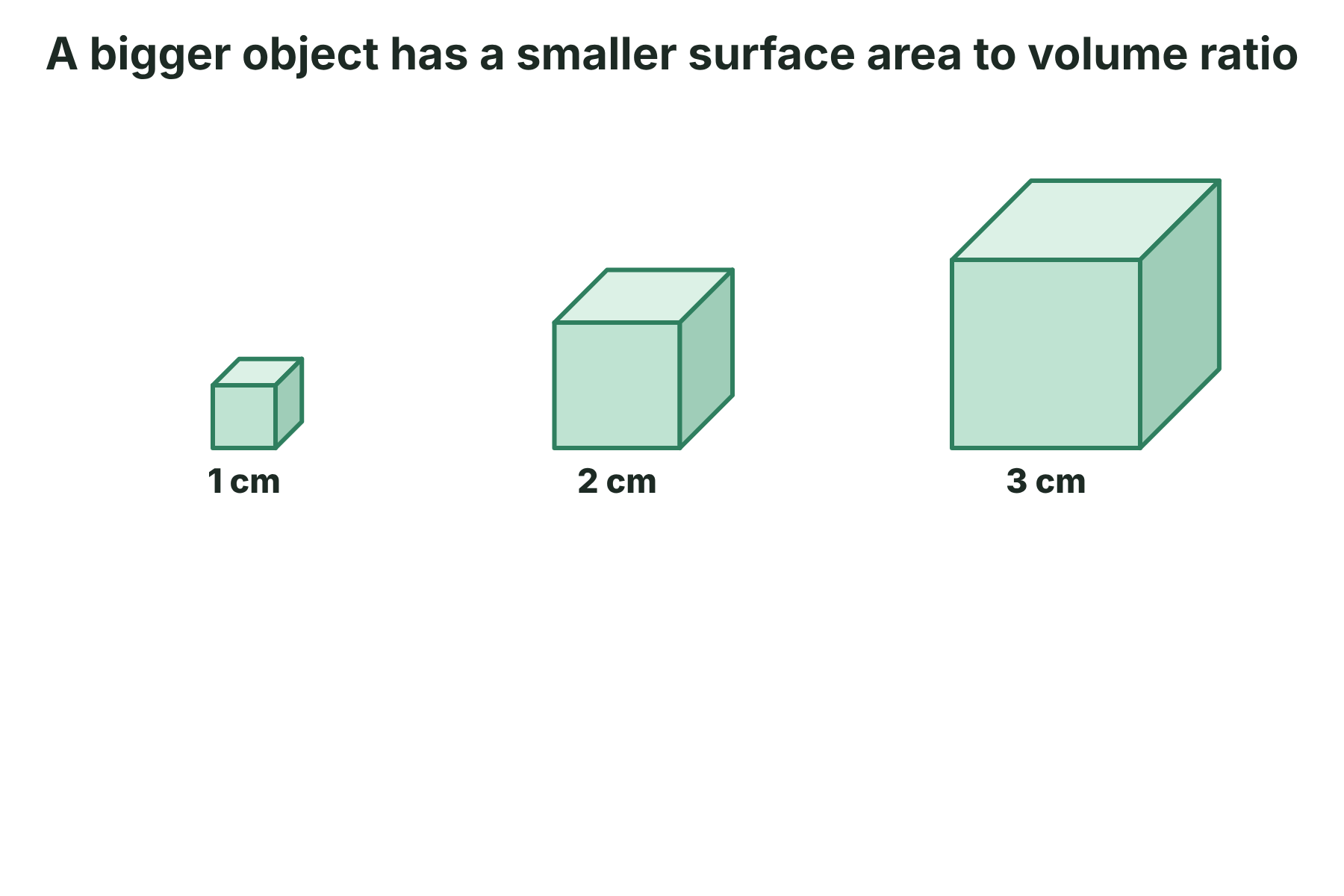
Mark scheme — 3 marks available
- Surface area = 24 cm² — 1 mark
- Volume = 8 cm³ — 1 mark
- 24 ÷ 8 = 3 : 1 — 1 mark
Model answer
Surface area = 6 × 2 × 2 = 24 cm². Volume = 2 × 2 × 2 = 8 cm³. Ratio = 24 ÷ 8 = 3, so 3 : 1.
Explain why a single-celled organism can get all the oxygen it needs by diffusion across its cell membrane.
Mark scheme — 2 marks available
- Large surface area to volume ratio — 1 mark
- So enough oxygen can diffuse in to meet the needs of the cell — 1 mark
Model answer
A single-celled organism has a large surface area to volume ratio. So oxygen can diffuse across the membrane fast enough to meet the needs of the whole cell.
Explain why a large multicellular organism needs exchange surfaces and a transport system.
Mark scheme — 3 marks available
- Small surface area to volume ratio — 1 mark
- Diffusion from the outside is too slow for cells in the middle — 1 mark
- Exchange surface and transport system get substances to all cells — 1 mark
Model answer
A large organism has a small surface area to volume ratio. So diffusion across its outer surface would be too slow to supply the cells in the middle. Exchange surfaces increase the area for exchange, and a transport system carries substances to and from every cell.
State four features that make an exchange surface effective.
Mark scheme — 4 marks available
- Large surface area — 1 mark
- Thin membrane / short diffusion path — 1 mark
- Efficient blood supply — 1 mark
- Ventilation — 1 mark
Model answer
A large surface area; a thin membrane (short diffusion path); (in animals) an efficient blood supply; (in animals, for gas exchange) being ventilated.
Describe how the villi in the small intestine are adapted for absorbing digested food.
Mark scheme — 3 marks available
- Large surface area — 1 mark
- Thin wall / short diffusion path — 1 mark
- Good blood supply (capillaries) — 1 mark
Model answer
Villi give the small intestine a large surface area. Each has a wall that is one cell thick, giving a short diffusion path. Each has a network of capillaries, which carries absorbed food away and keeps the concentration gradient steep.
Describe how the gills of a fish are adapted for gas exchange.
Mark scheme — 3 marks available
- Many filaments give a large surface area — 1 mark
- Thin surface and a good blood supply — 1 mark
- Water flowing over them (ventilation) — 1 mark
Model answer
The gills are made of many thin filaments, which give a large surface area and a short diffusion path. They have a good blood supply. Water flows over them all the time, which ventilates them and keeps the gradient steep.
Describe how a leaf is adapted for the exchange of gases.
Mark scheme — 3 marks available
- Flat, with a large surface area — 1 mark
- Thin, with a short diffusion path — 1 mark
- Stomata and air spaces — 1 mark
Model answer
The leaf is flat, which gives a large surface area, and thin, which gives a short diffusion path. It has stomata in the surface and air spaces inside, so carbon dioxide can diffuse in and oxygen can diffuse out.
A block of tissue measures 1 cm by 2 cm by 3 cm. Calculate its surface area to volume ratio, in the form x : 1.
Mark scheme — 3 marks available
- Surface area = 22 cm² — 1 mark
- Volume = 6 cm³ — 1 mark
- 22 ÷ 6 = 3.7 : 1 — 1 mark
Model answer
Surface area = 2 × (1×2 + 1×3 + 2×3) = 2 × 11 = 22 cm². Volume = 1 × 2 × 3 = 6 cm³. Ratio = 22 ÷ 6 = 3.7, so 3.7 : 1.
Use ideas about surface area to volume ratio to explain why a single-celled organism does not need an exchange organ, but a large animal does.
What the examiner wants: Compare the two organisms and finish with what the large animal has instead.
Mark scheme — 6 marks available
- Single cell: large surface area to volume ratio — 1 mark
- So diffusion across its surface is fast enough — 1 mark
- Large animal: small surface area to volume ratio — 1 mark
- Cells in the middle are too far from the surface for diffusion alone — 1 mark
- Exchange surface with a large area, thin walls, blood supply — 1 mark
- Transport system carries substances to the cells — 1 mark
Model answer
A single-celled organism has a large surface area to volume ratio. Every part of the cell is close to the surface, so oxygen and food can diffuse in, and waste can diffuse out, fast enough to meet its needs. A large animal has a much smaller surface area to volume ratio. The cells in the middle are a long way from the surface, so diffusion across the outside would be too slow. It therefore has exchange organs such as lungs, which have a large surface area, thin walls and a good blood supply, and a transport system, the blood, to carry oxygen to the cells.
What is the surface area of a cube with sides of 1 cm?
Why: A cube has 6 faces, each 1 cm × 1 cm, so the surface area is 6 cm².
As an object gets bigger, what happens to its surface area to volume ratio?
Why: Volume increases faster than surface area, so the ratio falls.
A cube has a surface area of 24 cm² and a volume of 8 cm³. What is its ratio?
Why: 24 ÷ 8 = 3, so the ratio is 3 : 1.
Why do large animals need a transport system?
Why: They have a small surface area to volume ratio, so diffusion alone is too slow to supply all the cells. The blood carries substances around.
Which is NOT a feature of an effective exchange surface?
Why: Exchange surfaces are thin, to give a short diffusion path. A thick membrane would slow diffusion down.
What are villi?
Why: Villi are finger-like folds in the lining of the small intestine that give a large surface area for absorption.
How are the gills of a fish ventilated?
Why: Water flows over the gills all the time, which brings fresh oxygen and keeps the gradient steep.
Why do root hair cells have a long thin extension?
Why: The extension increases the surface area, so more water and mineral ions can be taken up from the soil.
Where does gas exchange take place in the lungs?
Why: Oxygen and carbon dioxide are exchanged across the thin walls of the alveoli.
One cube has sides of 4 cm. Another has sides of 2 cm. Which statement is correct?
Why: The 2 cm cube has the larger ratio (3 : 1 compared with 1.5 : 1), because the smaller an object, the larger its surface area compared with its volume.