Viewing as
Teacher view: planning notes, the answers to every question, and the teacher copies of the files.
Business · Putting a business idea into practice
Business aims and objectives
Every business sets out to achieve something. Some aims are financial - survival, profit, sales, market share and financial security - and some are not, such as social objectives, personal satisfaction, challenge, independence and control.
Teacher resources
The teacher copies: slides with the questions built in, the answers, and anything else attached to this lesson for whoever is teaching it.
- Business aims and objectives - Teacher Slides.pptx Teacher The lesson slides with the teacher's notes on each slide, and every question and mark scheme built in. Built from the lesson script on 25 September 2026. View
- Business aims and objectives - Teacher Notes.docx Teacher The complete notes with the teacher's notes and every model answer in full. Built from the lesson script on 25 September 2026. View
Student handouts
The same files the students see, to print or hand out.
- Business aims and objectives.pptx Built from the lesson script on 25 September 2026. View
- Business aims and objectives - Completed Notes.docx The full notes for the lesson, to revise from. Built from the lesson script on 25 September 2026. View
- Business aims and objectives - Exam Questions.docx Built from the lesson script on 25 September 2026. View
Last Chapter
Answer from memory before the answers appear.
-
Name the four customer needs.
Price, quality, choice and convenience.
-
What is the difference between primary and secondary research?
Primary is new, first-hand information; secondary already exists.
-
Name the five ways to segment a market.
Location, demographics, lifestyle, income and age.
-
Give one limitation of a market map.
A gap may have no demand, only two features are shown, or positions are based on opinion.
Learning Objectives
- 1Explain the difference between business aims and objectives.
- 2Explain the financial aims and objectives of a business: survival, profit, sales, market share and financial security.
- 3Explain the non-financial aims and objectives: social objectives, personal satisfaction, challenge, independence and control.
- 4Explain why aims and objectives differ between businesses.
Aims and Objectives
An aim says where a business wants to go; its objectives are the steps that get it there.
-
Aim
A general, long-term goal the business wants to achieve, for example "to become the most popular café in town".
-
Objective
A specific, measurable target that helps achieve the aim, for example "to increase sales by 10% within 12 months".
-
SMART objectives
Good objectives are Specific, Measurable, Achievable, Realistic and Time-bound, so the owner can tell whether they have been met.
-
Why set them
Aims and objectives give the business a direction, motivate staff, help with decisions and let the owner measure success.
Setting the Direction
Before a business opens its doors, its owner has to decide what it is for. Is the first goal simply to survive the first year? To make as much profit as possible? To help the local community? The answer shapes every decision that follows.

Aims and objectives turn a business idea into a plan.
Financial Aims and Objectives
-
Survival
Staying in business, especially in the first year or two when many new businesses fail.
-
Profit
Making revenue greater than costs - the reward for the owner's risk.
-
Sales
Increasing the number of products sold, or the value of sales (revenue).
-
Market share
Increasing the business's percentage of the total sales in its market.
-
Financial security
Having enough money to cover costs and unexpected problems, so the owner is not worried about paying bills.
Understanding the Financial Aims
Which financial aim matters most depends on the business's situation.
-
Survival first
A brand-new business, or one facing a new competitor or a recession, may simply aim to survive.
-
Profit
Once it is established, most owners want profit - to reward themselves and to reinvest.
-
Sales and market share
A business may aim to grow sales even at the expense of short-term profit, to beat competitors and become well known.
-
Market share formula
Market share (%) = (the business's sales ÷ total market sales) × 100.
-
Financial security
Building up savings and cash so the business, and the owner's income, are safe from surprises.
Non-financial Aims and Objectives
-
Social objectives
Doing good for society or the environment, such as helping the local community or reducing waste.
-
Personal satisfaction
The pride and enjoyment of doing something worthwhile and doing it well.
-
Challenge
Testing yourself by building something new and overcoming problems.
-
Independence and control
Being your own boss and making your own decisions.
Business With a Purpose
Some businesses are set up mainly for social objectives. A social enterprise sells products like any other business, but uses its profits to help people or the environment - for example by training young people who struggle to find work.
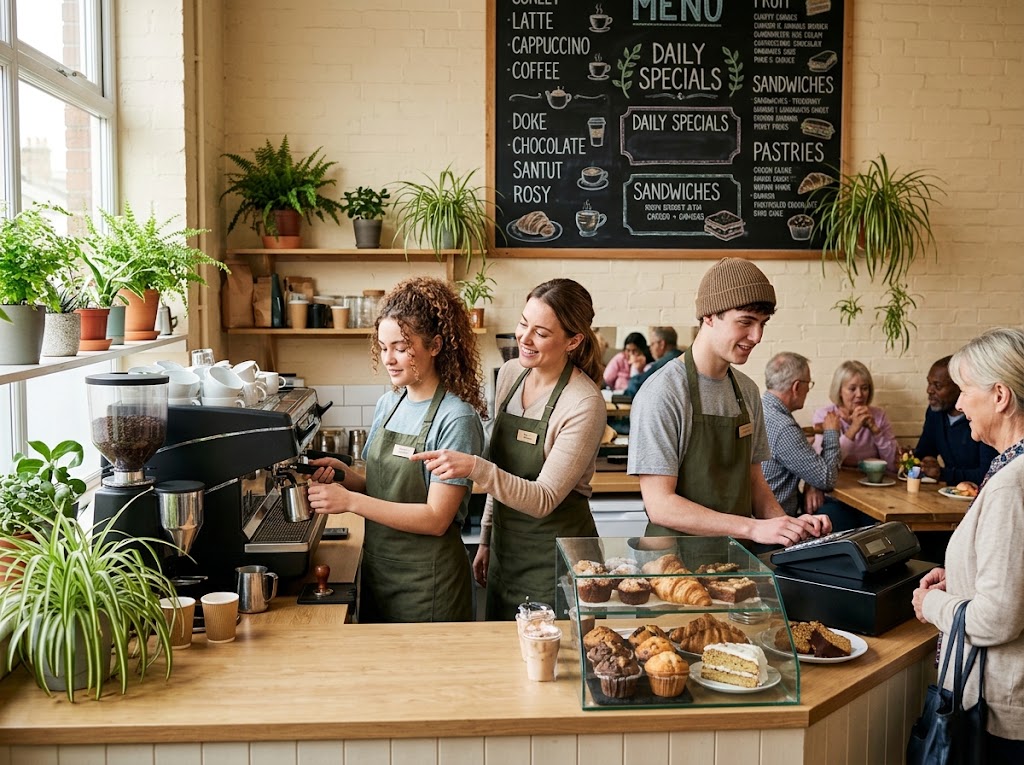
A social enterprise: a business run to help people, not only to make money.
Case study
The Big Issue: A Social Objective
The Big Issue was launched in 1991 by John Bird and Gordon Roddick to help people who were homeless earn a legitimate income. Vendors buy copies of the magazine and sell them on the street at the cover price, keeping the difference. The business still needs to cover its costs, but its main aim is social: giving people a way to work their way out of poverty.
Why Aims and Objectives Differ
No two businesses have exactly the same aims.
-
Size
A small business may aim to survive or give its owner independence; a large one may aim for market share.
-
Age
A new business usually aims to survive; an established one aims for growth and profit.
-
The owner's priorities
Some owners want to make as much money as possible; others want a good work-life balance or to help their community.
-
Type of business
A social enterprise puts social objectives first; a company owned by shareholders puts profit first.
-
Competition
A business in a fiercely competitive market may have to focus on survival or keeping its market share.
Financial or Non-financial?
Financial aims
- Survival.
- Profit.
- Sales.
- Market share.
- Financial security.
Non-financial aims
- Social objectives.
- Personal satisfaction.
- Challenge.
- Independence and control.
Whose Aims Are These?
For each business, decide on its most likely main aim and explain why - a market stall that opened last month; a café run by a charity that trains young people; a gym chain with 200 branches; a freelance web designer who left a stressful office job.
1. Name the most likely main aim.
2. Say whether it is financial or non-financial.
3. Explain why it suits that business.
A good answer shows: A named aim for each business, with a reason linked to its size, age, type or owner.
Can I...?
- 1Explain the difference between an aim and an objective.
- 2Explain the five financial aims.
- 3Explain the four non-financial aims.
- 4Calculate market share.
- 5Explain why aims differ between businesses.
Summary & Exam Focus
- Aims are long-term goals; objectives are specific, measurable targets.
- Financial aims: survival, profit, sales, market share and financial security.
- Non-financial aims: social objectives, personal satisfaction, challenge, independence and control.
- Aims differ with the size, age and type of business and the owner's priorities.
Exam focus
Explain one reason why the aims of a new business might be different from the aims of an established business. (3 marks) (3 marks)
Name the difference, then explain why the business's situation causes it - a new business has few customers and little cash, so survival comes first.
Key terms
The vocabulary this lesson expects you to use. Each one is linked from the first place it appears above.
- Aim
- A general, long-term goal a business wants to achieve.
- Objective
- A specific, measurable target that helps a business achieve its aim.
- Survival
- Continuing to trade rather than closing down.
- Financial security
- Having enough money to cover costs and deal with unexpected problems.
- Social objective
- An aim to help society or the environment.
- Social enterprise
- A business whose main aim is social, using its profits to do good.
Questions and answers
9 questions set on this lesson, with the mark schemes and model answers open.
State one non-financial aim of a business.
Mark scheme — 1 mark available
- Any one of: social objectives; personal satisfaction; challenge; independence; control — 1 mark
Model answer
Independence.
Define the term 'market share'.
Mark scheme — 1 mark available
- A business's sales as a percentage / proportion of total market sales — 1 mark
Model answer
The percentage of total sales in a market that is made by one business.
A bakery's sales last year were £180,000. Total sales in its local market were £1,200,000. Calculate the bakery's market share. You are advised to show your working.
Mark scheme — 2 marks available
- Correct method: (180,000 ÷ 1,200,000) × 100 — 1 mark
- Correct answer: 15% — 1 mark (award 2 marks for the correct answer with no working)
Model answer
(£180,000 ÷ £1,200,000) × 100 = 15%
Outline one financial aim a new business might have.
Mark scheme — 2 marks available
- A financial aim identified: survival / profit / sales / market share / financial security — 1 mark
- Developed: why a new business might have it — 1 mark
Model answer
Survival (1), because many new businesses fail in their first year, so the owner's first goal is to cover costs and keep trading (1).
Explain one reason why the aims of a new business might be different from the aims of an established business.
Mark scheme — 3 marks available
- A reason identified, e.g. new businesses aim to survive / established ones aim for growth or profit — 1 mark
- First linked point of explanation — 1 mark
- Second linked point of explanation — 1 mark
Model answer
A new business is more likely to aim for survival (1). It has few customers and little money set aside, so it may struggle to cover its costs in the first months (1). An established business already has loyal customers and a steady income, so it can aim for profit or growth in market share instead (1).
Which one of the following is a financial aim?
Why: Market share is measured in sales, so it is a financial aim. The others are non-financial.
"To increase sales by 10% within the next 12 months." What is this?
Why: It is specific, measurable and time-bound, so it is an objective rather than a general aim.
A business sells £50,000 of goods in a market worth £250,000. What is its market share?
Why: (50,000 ÷ 250,000) × 100 = 20%.
Why is survival often the main aim of a new business?
Why: New businesses have few customers and little cash, so staying open comes before profit or growth.