Viewing as
Teacher view: planning notes, the answers to every question, and the teacher copies of the files.
Business · Understanding external influences on business
Business stakeholders
A stakeholder is anyone affected by a business - owners, employees, customers, managers, suppliers, the local community, pressure groups and the government. Each wants something different, and what they want does not always agree.
Teacher resources
The teacher copies: slides with the questions built in, the answers, and anything else attached to this lesson for whoever is teaching it.
- Business stakeholders - Teacher Slides.pptx Teacher The lesson slides with the teacher's notes on each slide, and every question and mark scheme built in. Built from the lesson script on 25 September 2026. View
- Business stakeholders - Teacher Notes.docx Teacher The complete notes with the teacher's notes and every model answer in full. Built from the lesson script on 25 September 2026. View
Student handouts
The same files the students see, to print or hand out.
- Business stakeholders.pptx Built from the lesson script on 25 September 2026. View
- Business stakeholders - Completed Notes.docx The full notes for the lesson, to revise from. Built from the lesson script on 25 September 2026. View
- Business stakeholders - Exam Questions.docx Built from the lesson script on 25 September 2026. View
Last Chapter
Answer from memory before the answers appear.
-
What is limited liability?
The owners can only lose the money they invested in the business.
-
Name the four location factors.
Proximity to the market, labour, materials and competitors.
-
Name the four Ps.
Product, price, promotion and place.
-
Give two reasons for writing a business plan.
To minimise risk and to obtain finance.
Learning Objectives
- 1Explain who a business's stakeholders are.
- 2Explain the different objectives of each stakeholder group.
- 3Explain how stakeholders are affected by, and can affect, business activity.
- 4Explain why stakeholders' objectives can conflict.
What Is a Stakeholder?
A stakeholder is any person or group with an interest in a business, because they affect it or are affected by it.
-
Not just the owners
Customers, staff, suppliers, neighbours and the government all have a "stake" in what the business does.
-
Internal stakeholders
People inside the business: the owners, managers and employees.
-
External stakeholders
People outside the business: customers, suppliers, the local community, pressure groups and the government.
-
Why they matter
A small business needs the support of its stakeholders - without customers, staff and suppliers it cannot operate at all.
A small business's stakeholders
A small business's stakeholders
-
Owners (shareholders)
- profit
- the business surviving and growing
- the value of their investment
-
Employees
- fair pay
- job security
- good working conditions
-
Managers
- a good salary
- responsibility
- the business succeeding
-
Customers
- good quality
- low prices
- good service and choice
-
Suppliers
- regular orders
- being paid on time
- a long relationship
-
Local community
- jobs
- little noise, litter or traffic
- support for local causes
-
Pressure groups
- the business changing how it behaves on the issue they campaign about
-
The government
- taxes paid
- laws followed
- jobs created
The People Inside the Business
In a small business the owner and employees work side by side every day. They both want the business to succeed - but the owner wants profit, and the employees want good pay, and every pound spent on one is a pound less for the other.

Owners and employees: internal stakeholders who want different things from the same business.
Stakeholders and Their Objectives
-
Owners (shareholders)
Who they are: The people who own the business. What they want: Profit, survival and growth
-
Employees
Who they are: People who work for the business. What they want: Good pay, job security, safe conditions
-
Managers
Who they are: Employees who run parts of the business. What they want: Good salary, responsibility, success
-
Customers
Who they are: People who buy the products. What they want: Quality, low prices, good service
-
Suppliers
Who they are: Businesses that sell materials or stock to it. What they want: Regular orders and prompt payment
-
Local community
Who they are: People living near the business. What they want: Jobs, little disruption, local support
-
Pressure groups
Who they are: Groups campaigning on an issue. What they want: The business changing its behaviour
-
The government
Who they are: National and local government. What they want: Taxes, jobs, following the law
A Two-Way Relationship
How business activity affects stakeholders
- A new café creates jobs for local people.
- Raising prices costs customers more.
- Paying suppliers late causes them cash-flow problems.
- Late-night opening may disturb neighbours.
- Profits pay the owner and taxes pay for public services.
How stakeholders affect the business
- Customers decide whether to buy - they decide sales.
- Employees' skill and effort decide the quality of service.
- Suppliers can refuse trade credit or raise prices.
- The local council can refuse planning permission.
- Pressure groups can organise protests and bad publicity.
When the Community Pushes Back
Even a small business can find itself in conflict with its neighbours. Residents worried about noise, litter or traffic can object to planning applications, complain to the council or campaign on social media - and a business that ignores them risks losing both its permission and its reputation.
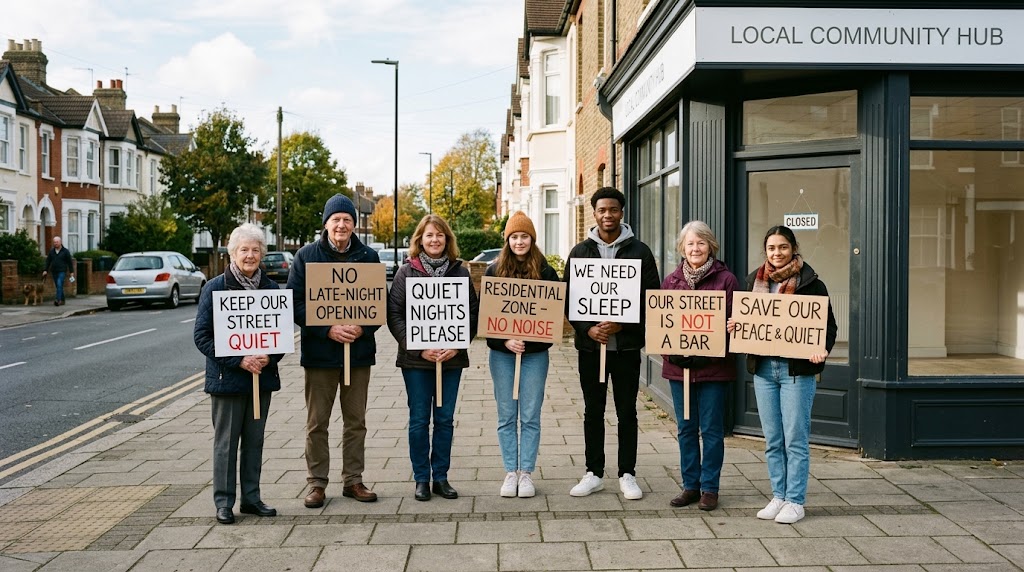
The local community and pressure groups can change a business's plans.
Pressure Groups
A pressure group is an organised group that tries to change what businesses or the government do.
-
What they want
Change on one issue, such as animal welfare, pollution, plastic waste or protecting a local area.
-
How they act
Campaigns on social media, protests, petitions, boycotts and contacting the local council or newspapers.
-
Impact on a small business
Bad publicity can put customers off, so the business may change its plans.
-
Local groups
Many pressure groups are small and local, formed to fight one decision - such as a new takeaway on a quiet street.
Conflicts Between Stakeholders
-
Owners and employees
One wants...: Lower wage costs to raise profit. The other wants...: Higher pay
-
Owners and customers
One wants...: Higher prices to raise profit. The other wants...: Lower prices
-
Customers and local community
One wants...: Late opening for convenience. The other wants...: Quiet evenings and no litter
-
Owners and suppliers
One wants...: Lower prices and longer to pay. The other wants...: Higher prices and prompt payment
-
Owners and pressure groups
One wants...: The cheapest packaging. The other wants...: Plastic-free packaging, which costs more
Dealing With Conflict
A business cannot please everyone, so it has to make choices.
-
Prioritise
Most small businesses put customers and owners first, because without sales and profit the business cannot survive.
-
Compromise
A café might open late on weekends only, to keep customers happy without annoying neighbours every night.
-
Communicate
Explaining decisions to staff, customers and neighbours can reduce complaints.
-
Long term
Treating employees, suppliers and the community well often pays off in loyalty and reputation.
The New Takeaway
A new pizza takeaway plans to open until 2am on a street of houses near a town centre. Choose four stakeholders. For each one, say whether they will support or oppose the plan and why. Then identify the biggest conflict and suggest a compromise.
1. Choose four stakeholders.
2. Support or oppose? Explain why.
3. Name the biggest conflict.
4. Suggest a compromise.
A good answer shows: Four stakeholders with clear objectives linked to the plan, one conflict explained, and a realistic compromise such as earlier closing on weeknights.
Can I...?
- 1Explain what a stakeholder is.
- 2Name the eight stakeholder groups.
- 3Explain the objectives of each group.
- 4Explain how a business affects its stakeholders.
- 5Explain how stakeholders affect a business.
- 6Explain what a pressure group does.
- 7Explain a conflict between two stakeholders.
- 8Suggest how a business could deal with a conflict.
Summary & Exam Focus
- Stakeholders are anyone affected by, or who affects, a business.
- Owners, employees, managers, customers, suppliers, the local community, pressure groups and the government all have different objectives.
- Business activity affects stakeholders, and stakeholders affect the business.
- Stakeholders' objectives often conflict, so a business has to prioritise or compromise.
Exam focus
Explain one possible conflict between the owners and the employees of a small business. (3 marks) (3 marks)
Name both stakeholders and what each one wants, then explain why the business cannot fully give both what they want at the same time.
Key terms
The vocabulary this lesson expects you to use. Each one is linked from the first place it appears above.
- Stakeholder
- Any person or group with an interest in a business, who affects it or is affected by it.
- Internal stakeholder
- A stakeholder inside the business: owners, managers and employees.
- External stakeholder
- A stakeholder outside the business, such as customers, suppliers and the community.
- Pressure group
- An organised group that tries to change the behaviour of businesses or the government.
- Local community
- The people who live and work near a business.
Questions and answers
9 questions set on this lesson, with the mark schemes and model answers open.
Define the term 'stakeholder'.
Mark scheme — 1 mark available
- A person / group with an interest in / affected by a business — 1 mark
Model answer
Any person or group who has an interest in a business, because they affect it or are affected by it.
State one objective that customers might have.
Mark scheme — 1 mark available
- Any valid objective, e.g. low prices; good quality; good customer service; choice — 1 mark
Model answer
Low prices.
Outline one way the local community could be affected by a new business opening.
Mark scheme — 2 marks available
- An effect identified, e.g. jobs / noise / litter / traffic / more choice of shops — 1 mark
- Developed: the impact on the community — 1 mark
Model answer
It could create jobs for local people (1), giving them an income close to home and money to spend in other local businesses (1).
Explain one possible conflict between the owners and the employees of a small business.
Mark scheme — 3 marks available
- A conflict identified, e.g. pay vs profit / hours / job security — 1 mark
- First linked point of explanation — 1 mark
- Second linked point of explanation — 1 mark
Model answer
The employees may want higher pay, while the owners want to keep costs low (1). Paying higher wages increases the business's costs (1). This means the owners' profit falls, so the owners may refuse the pay rise, leaving employees unhappy (1).
Source: Nadia owns a small café on a quiet residential street. To increase sales, she plans to stay open until 11pm and sell alcohol in the evenings. She would need to hire two extra staff for the evening shifts. Analyse the impact of Nadia's plan on two of her stakeholders.
Mark scheme — 6 marks available
- AO2 (Application, 3 marks): uses the context - the quiet residential street, 11pm opening, alcohol, two extra staff — Level 1-3
- AO3a (Analysis, 3 marks): chains of reasoning showing the impact on each of two stakeholders — Level 1-3
Model answer
Nadia's plan would benefit her employees and people looking for work. She needs two extra staff for evening shifts, which creates jobs, and her existing staff may get extra hours and so earn more money. This could make them more loyal to the café. However, the plan could have a negative impact on the local community. Because the café is on a quiet residential street, customers drinking until 11pm could cause noise when neighbours are trying to sleep. This means residents may complain to the council when Nadia applies for her alcohol licence, which could stop the plan going ahead or damage the café's reputation with local customers.
Which one of the following is an internal stakeholder?
Why: Employees work inside the business, so they are internal stakeholders.
Which stakeholder is most likely to want the business to pay its invoices on time?
Why: Suppliers want regular orders and prompt payment.
What is a pressure group?
Why: A pressure group campaigns to change how businesses or the government behave on a particular issue.
A business raises its prices to increase profit. Which two stakeholders' objectives conflict?
Why: Owners want higher profit; customers want lower prices - raising prices helps one and hurts the other.