Viewing as
Teacher view: planning notes, the answers to every question, and the teacher copies of the files.
Business · Making marketing decisions
Price
Businesses choose a pricing strategy - penetration, skimming, cost-plus, competitive or promotional - depending on their costs, their competitors, their target market, technology and where the product is in its life cycle.
Teacher resources
The teacher copies: slides with the questions built in, the answers, and anything else attached to this lesson for whoever is teaching it.
- Price - Teacher Slides.pptx Teacher The lesson slides with the teacher's notes on each slide, and every question and mark scheme built in. Built from the lesson script on 28 September 2026. View
- Price - Teacher Notes.docx Teacher The complete notes with the teacher's notes and every model answer in full. Built from the lesson script on 28 September 2026. View
Student handouts
The same files the students see, to print or hand out.
Last Lesson
Answer from memory before the answers appear.
-
Name the three parts of the design mix.
Function, aesthetics and cost.
-
Name the five stages of the product life cycle.
Development, introduction, growth, maturity and decline.
-
Give one extension strategy.
New features, new markets, repackaging, advertising or price cuts.
-
What is product differentiation?
Making a product different from competitors' products.
Learning Objectives
- 1Explain the pricing strategies: penetration, skimming, cost-plus, competitive and promotional.
- 2Calculate a price using cost-plus pricing.
- 3Explain the factors that influence pricing: technology, competition, market segments and the product life cycle.
Penetration Pricing
Setting a low price when a product is launched, to attract customers and gain market share quickly.
-
How it works
A low price persuades customers to try the product and switch from rivals. Once the product is established, the price rises.
-
Advantages
Quickly builds sales and market share; discourages competitors from entering.
-
Disadvantages
Low profit at first; customers may leave when the price rises.
-
Used for
New products entering competitive markets, such as streaming services and new snacks.
Price Skimming
Setting a high price when a product is launched, then lowering it over time.
-
How it works
Early adopters who want the product first will pay a high price. As demand from them falls, the price is cut to attract more customers.
-
Advantages
High profit on each early sale, helping recover development costs; creates a premium image.
-
Disadvantages
Low sales at first; high profits attract competitors.
-
Used for
New technology with a strong brand or a unique feature, such as new phones and games consoles.
Cost-plus Pricing
Adding a percentage mark-up to the cost of making the product.
-
How it works
Price = cost per unit + a percentage of that cost as profit.
-
Advantages
Simple, and ensures every sale covers its costs.
-
Disadvantages
Ignores what competitors charge and what customers will pay.
-
Used for
Businesses such as builders and manufacturers who need every job to cover its costs.
Calculating a Cost-plus Price
Find the mark-up, then add it to the cost.
A candle costs £8 to make. The business adds a 50% mark-up. Calculate the selling price.
- 1 Find the mark-up 50% of £8 = £8 × 0.5 = £4
- 2 Add it to the cost £8 + £4 = £12
AnswerSelling price = £12
Competitive Pricing
Setting a price similar to competitors' prices.
-
How it works
The business looks at what rivals charge and sets a similar price, or just below.
-
Advantages
Avoids losing customers to cheaper rivals.
-
Disadvantages
Profit depends on costs being as low as competitors'; can lead to a price war.
-
Used for
Products that are very similar to rivals', such as petrol, bread and basic groceries.
Promotional Pricing
Temporarily reducing prices to boost sales.
-
How it works
Discounts, sales, "buy one get one free" and special offers for a limited time.
-
Advantages
Quickly boosts sales, clears old stock and attracts new customers.
-
Disadvantages
Lower profit per item; customers may wait for the next offer rather than pay full price.
-
Used for
Seasonal stock, new products and slow-selling lines.
Price as a Promotion
A sale is promotional pricing at its simplest: a temporary cut in price to bring customers in. It works - but a business that runs sales too often trains its customers never to pay full price.
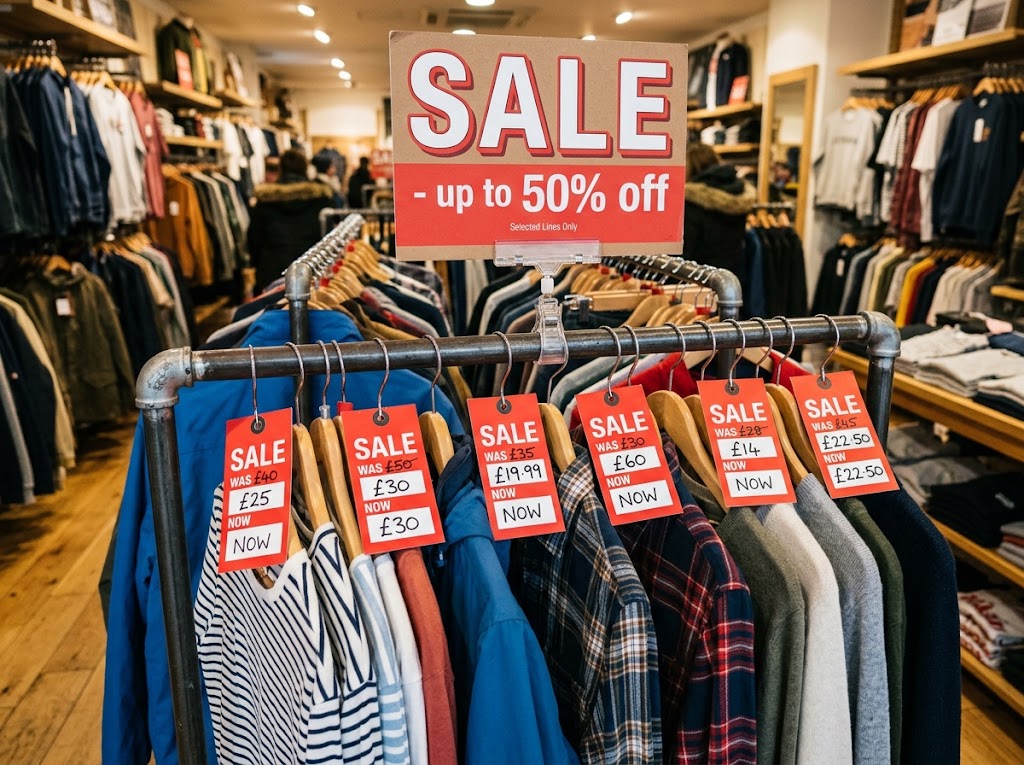
Promotional pricing: a temporary price cut to boost sales and clear stock.
Influences on Pricing Strategies
-
Technology
Price comparison websites make customers more price-sensitive; new technology can cut costs, allowing lower prices.
-
Competition
In a competitive market prices must stay close to rivals'; with few competitors, prices can be higher.
-
Market segments
Different segments will pay different prices - students want low prices; luxury buyers accept high ones.
-
Product life cycle
Launch may use penetration or skimming; maturity uses competitive pricing; decline may use promotional pricing.
Which Strategy When?
-
A new snack entering a crowded market
Likely strategy: Penetration
-
A new, unique games console
Likely strategy: Skimming
-
A builder quoting for a new kitchen
Likely strategy: Cost-plus
-
A petrol station with rivals on the same road
Likely strategy: Competitive
-
A shop clearing summer stock in September
Likely strategy: Promotional
Case study
Apple: Skimming the New iPhone
Each year Apple launches new iPhone models at high prices. Loyal customers who want the latest technology are willing to pay, giving Apple a high profit on each early sale. When the next models arrive, Apple cuts the price of the older ones or keeps them on sale at a lower price, reaching customers who would not pay the launch price. Apple's strong brand and loyal customers make price skimming possible - a new business with an unknown brand could not do the same.
Price It
Recommend a pricing strategy for each product and justify it: a new energy drink from an unknown brand; the first ever folding smartphone from a famous brand; a local plumber's call-out charge; a supermarket's own-brand milk; last season's football shirts. Then calculate the price of a product costing £15 with a 40% mark-up.
1. Choose a strategy for each product.
2. Justify each choice.
3. Calculate the cost-plus price.
A good answer shows: A suitable strategy for each with a reason linked to competition, brand, costs or life cycle stage; cost-plus price £21.
Can I...?
- 1Explain penetration pricing.
- 2Explain price skimming.
- 3Explain cost-plus pricing.
- 4Calculate a cost-plus price.
- 5Explain competitive pricing.
- 6Explain promotional pricing.
- 7Explain the influences on pricing.
Summary & Exam Focus
- Penetration: low launch price for market share. Skimming: high launch price, lowered later.
- Cost-plus: cost + mark-up. Competitive: match rivals. Promotional: temporary discounts.
- Influences: technology, competition, market segments and the product life cycle.
Exam focus
Explain one disadvantage of price skimming for a business launching a new product. (3 marks) (3 marks)
Strategy questions need context: say why the strategy suits (or does not suit) this product and this market.
Key terms
The vocabulary this lesson expects you to use. Each one is linked from the first place it appears above.
- Pricing strategy
- The method a business uses to set the price of a product.
- Penetration pricing
- A low launch price to gain market share quickly.
- Price skimming
- A high launch price that is lowered over time.
- Cost-plus pricing
- Adding a percentage mark-up to the cost of a product.
- Competitive pricing
- Setting a price similar to competitors'.
- Promotional pricing
- Temporarily reducing prices to boost sales.
- Mark-up
- The percentage added to cost to set the price.
Questions and answers
7 questions set on this lesson, with the mark schemes and model answers open.
Define the term 'penetration pricing'.
Mark scheme — 1 mark available
- Low launch price / to gain market share — 1 mark
Model answer
Setting a low price when a product is launched to attract customers and gain market share quickly.
A business makes garden benches for £60 each and uses cost-plus pricing with a 35% mark-up. Calculate the selling price of a bench. You are advised to show your working.
Mark scheme — 2 marks available
- Correct method: cost + (cost × 35%) — 1 mark
- Correct answer: £81 — 1 mark (award 2 marks for the correct answer with no working)
Model answer
£60 × 0.35 = £21. £60 + £21 = £81
Explain one disadvantage of price skimming for a business launching a new product.
Mark scheme — 3 marks available
- A disadvantage identified, e.g. low sales / attracts competitors / needs strong brand — 1 mark
- First linked point of explanation — 1 mark
- Second linked point of explanation — 1 mark
Model answer
Sales may be low at first (1). Only early adopters are willing to pay the high launch price (1). This means the business may take longer to build market share, and the high profits may encourage competitors to launch cheaper rivals (1).
Source: SnapFit Ltd has developed a new fitness tracker watch. It has a unique feature: it measures hydration levels, which no competitor can do. The market for fitness trackers is large and competitive, dominated by well-known brands. SnapFit is a new and unknown brand. Option 1: Use price skimming, launching at £249. Option 2: Use penetration pricing, launching at £99. Justify which one of these two options SnapFit Ltd should choose.
Mark scheme — 9 marks available
- AO2 (Application, 3 marks): uses the context - the hydration feature, unknown brand, competitive market, £249 and £99 — Level 1-3
- AO3a (Analysis, 3 marks): chains of reasoning about each strategy — Level 1-3
- AO3b (Evaluation, 3 marks): a justified choice with a supported judgement — Level 1-3
Model answer
Option 1, skimming, suits a product with a unique feature: SnapFit's hydration sensor gives early adopters a reason to pay £249, and the high profit per sale would help recover its development costs. However, SnapFit is an unknown brand in a market dominated by famous names, and customers may not trust a new brand at a premium price, so sales could be very low. Option 2, penetration, would encourage customers to try an unknown brand, quickly building sales and market share and making SnapFit well known. But £99 gives a much lower profit per watch, and it may be hard to raise the price later. On balance SnapFit should choose Option 2, because as an unknown brand its biggest challenge is persuading customers to try it at all, and a low price combined with its unique feature gives them a strong reason to switch. This depends on whether £99 still covers its costs.
Which pricing strategy sets a HIGH price at launch?
Why: Skimming charges a high launch price to early adopters, then lowers it.
A product costs £20 to make and has a 25% mark-up. What is its price?
Why: 25% of £20 = £5; £20 + £5 = £25.
How have price comparison websites influenced pricing?
Why: Customers can instantly see the cheapest price, so businesses must price competitively.