Viewing as
Teaching this? The teacher view adds 2 files, the mark schemes and the model answers.
Business · Making marketing decisions
Product
A successful product balances its function, its looks and its cost. Every product also goes through a life cycle - and businesses use extension strategies and differentiation to keep it selling.
From Topic 1
Answer from memory before the answers appear.
-
Name the four Ps of the marketing mix.
Product, price, promotion and place.
-
What is a unique selling point?
A feature that makes a product different from all its competitors.
-
What is an integrated marketing mix?
One where the four Ps fit together for the target market.
-
Name two ways to add value.
Any two of: convenience, branding, quality, design, USP.
Learning Objectives
- 1Explain the design mix: function, aesthetics and cost.
- 2Explain the stages of the product life cycle.
- 3Explain extension strategies.
- 4Explain the importance of differentiating a product.
The Design Mix
-
Function
How well the product works and does its job - its features, reliability and ease of use.
-
Aesthetics
How the product looks, feels, smells, sounds or tastes - its appeal to the senses.
-
Cost
How cheaply it can be made, so it can be sold at a price customers will pay and still make a profit.
Balancing the Design Mix
No product can be the best at everything, so businesses decide which element matters most.
-
Function first
Safety equipment and medical products must work perfectly, whatever they look like.
-
Aesthetics first
Fashion, jewellery and luxury goods sell mainly on how they look.
-
Cost first
Supermarket own-brand basics are designed to be as cheap as possible to make.
-
Target market
The balance depends on what the target customers value and are willing to pay for.
From Idea to Shelf
Design decides the balance of function, aesthetics and cost before a product is made.

Design: balancing how it works, looks and costs.

The finished product, ready to sell.
The Product Life Cycle
The product life cycle shows how a product's sales change over time. Knowing which stage a product is in helps a business decide how to price and promote it - and when to try to extend its life.
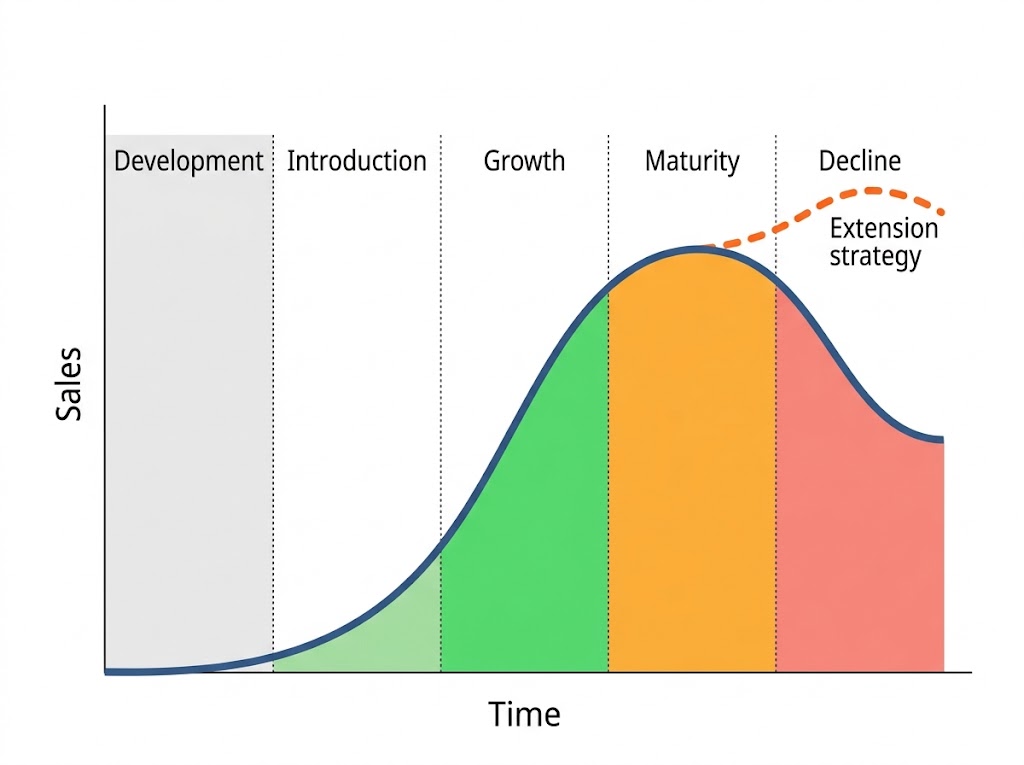
Sales rise, peak and fall - unless an extension strategy lifts them again.
The Five Stages
-
Development
Sales: None. Profit: Negative: R&D costs. What the business does: Researches, designs and tests the product
-
Introduction
Sales: Low, rising slowly. Profit: Usually a loss. What the business does: Heavy promotion to make customers aware
-
Growth
Sales: Rising fast. Profit: Profit begins. What the business does: Increases distribution; competitors may appear
-
Maturity
Sales: At their peak, levelling off. Profit: Highest. What the business does: Defends market share; considers extension strategies
-
Decline
Sales: Falling. Profit: Falling. What the business does: Uses extension strategies or withdraws the product
Extension Strategies
An extension strategy is an action taken to make a product last longer before it declines.
-
New features
Adding improvements or new versions - new flavours, sizes or technology.
-
New markets
Selling to a new target market or in new countries.
-
Repackaging and rebranding
Giving the product a fresh look or a new image.
-
Advertising and price cuts
A new promotional campaign or a lower price to win back customers.
The Importance of Differentiation
Product differentiation means making a product different from competitors' products.
-
How
Through design, features, quality, branding, packaging or a unique selling point.
-
Why it matters
A differentiated product gives customers a reason to choose it over rivals.
-
Higher prices
Customers will often pay more for a product they see as better or unique.
-
Loyalty
A distinctive product and brand builds customer loyalty and repeat sales.
Case study
Lucozade: A Second Life
Lucozade was created in 1927 by a Newcastle chemist as a drink to give energy to people recovering from illness, and for decades it was sold in chemists wrapped in orange cellophane. By the late 1970s sales were falling, as the product had reached decline. In the 1980s its owners used an extension strategy: they repositioned Lucozade as an energy drink for sport, with new packaging and adverts featuring Olympic athlete Daley Thompson. The new target market - active young people - gave the product a whole new life.
Save the Product
A brand of fizzy orange drink has been sold for 30 years, and sales have been falling for three years. Identify which stage of the life cycle it is in, then suggest three different extension strategies and say which you would choose and why.
1. Identify the stage.
2. Suggest three extension strategies.
3. Choose one and justify it.
A good answer shows: Decline identified, three distinct extension strategies (e.g. sugar-free version, new packaging, new market), and a justified choice.
Can I...?
- 1Explain the design mix.
- 2Explain how the design mix is balanced.
- 3Name the five stages of the product life cycle.
- 4Describe sales and profit at each stage.
- 5Explain extension strategies.
- 6Explain the importance of differentiation.
Summary & Exam Focus
- The design mix balances function, aesthetics and cost.
- The product life cycle: development, introduction, growth, maturity and decline.
- Extension strategies: new features, new markets, repackaging, advertising and price cuts.
- Differentiation gives customers a reason to choose the product over rivals.
Exam focus
Explain one extension strategy a business could use for a product in decline. (3 marks) (3 marks)
Name the strategy, explain how it attracts customers again, and link it to sales rising and the product lasting longer.
Key terms
The vocabulary this lesson expects you to use. Each one is linked from the first place it appears above.
- Design mix
- The balance of function, aesthetics and cost in a product's design.
- Function
- How well a product works.
- Aesthetics
- How a product appeals to the senses.
- Product life cycle
- The stages a product goes through: development, introduction, growth, maturity and decline.
- Extension strategy
- An action taken to extend the life of a product before it declines.
- Product differentiation
- Making a product different from competitors' products.
Downloads
Free to keep, print and annotate.
Something here looks wrong?
Tell us what and we will go and look. It goes to whoever writes these pages, nobody else, and we do not ask who you are — so there is nothing to sign and nothing comes back to you.