Viewing as
Teacher view: planning notes, the answers to every question, and the teacher copies of the files.
Business · Making marketing decisions
Using the marketing mix to make business decisions
The four Ps are not separate decisions. A change in one affects the others, and when they work together they give a business a competitive advantage its rivals find hard to copy.
Teacher resources
The teacher copies: slides with the questions built in, the answers, and anything else attached to this lesson for whoever is teaching it.
- Using the marketing mix to make business decisions - Teacher Slides.pptx Teacher The lesson slides with the teacher's notes on each slide, and every question and mark scheme built in. Built from the lesson script on 28 September 2026. View
- Using the marketing mix to make business decisions - Teacher Notes.docx Teacher The complete notes with the teacher's notes and every model answer in full. Built from the lesson script on 28 September 2026. View
Student handouts
The same files the students see, to print or hand out.
- Using the marketing mix to make business decisions.pptx Built from the lesson script on 28 September 2026. View
- Using the marketing mix to make business decisions - Completed Notes.docx The full notes for the lesson, to revise from. Built from the lesson script on 28 September 2026. View
- Using the marketing mix to make business decisions - Exam Questions.docx Built from the lesson script on 28 September 2026. View
Last Lesson
Answer from memory before the answers appear.
-
What is a distribution channel?
The route a product takes from producer to customer.
-
What does a wholesaler do?
Buys in bulk from producers and sells smaller quantities to retailers.
-
What is multi-channel distribution?
Selling through several channels at once.
-
Give one advantage of an e-tailer over a shop.
Lower costs, wider reach or 24-hour opening.
Learning Objectives
- 1Explain how each element of the marketing mix influences the others.
- 2Explain how to use the marketing mix to build competitive advantage.
- 3Explain how an integrated marketing mix influences competitive advantage.
- 4Use the marketing mix to make and justify business decisions.
Each P Affects the Others
Change one element of the mix, and the others usually have to change too.
-
Product affects price
A higher-quality product costs more to make and can justify a higher price.
-
Price affects promotion
A low price may be the main message of the promotion; a premium price needs promotion that builds a premium image.
-
Promotion affects place
Promoting nationally only works if the product is available nationally.
-
Place affects price
Selling through intermediaries adds costs, so the price rises; selling direct online can lower it.
One Change, Four Effects
-
Launch a premium range
Product: Better ingredients and packaging. Price: Higher. Promotion: Stylish, aspirational adverts. Place: Upmarket stores and own website
-
Target students
Product: Smaller, simpler versions. Price: Lower, with student discounts. Promotion: Social media and campus events. Place: Near universities and online
-
Enter a new country
Product: Adapted to local tastes. Price: Set for local incomes and rivals. Promotion: In the local language and media. Place: Local retailers or a local website
Competitive Advantage
Competitive advantage is anything that makes a business more attractive to customers than its rivals.
-
Through product
A better, unique or more reliable product that rivals cannot match.
-
Through price
Lower costs that allow lower prices, or a premium brand that allows higher ones.
-
Through promotion
A strong, trusted brand that customers recognise and choose.
-
Through place
Being easier to buy from - more locations, faster delivery, better online shopping.
An Integrated Mix Builds Advantage
When all four Ps work together, the advantage is hard for rivals to copy.
-
Consistency
Every element sends the same message to the same target market.
-
Hard to copy
A rival can copy a price, but not a whole mix built over years.
-
Clear positioning
Customers know exactly what the business stands for.
-
A weak link
One element that does not fit - a cheap-looking advert for a luxury product - damages the whole mix.
A Mix That Fits
Every element of this launch says the same thing: premium. The packaging, the price, the display and the store all match - and that consistency is what convinces customers the product is worth paying more for.
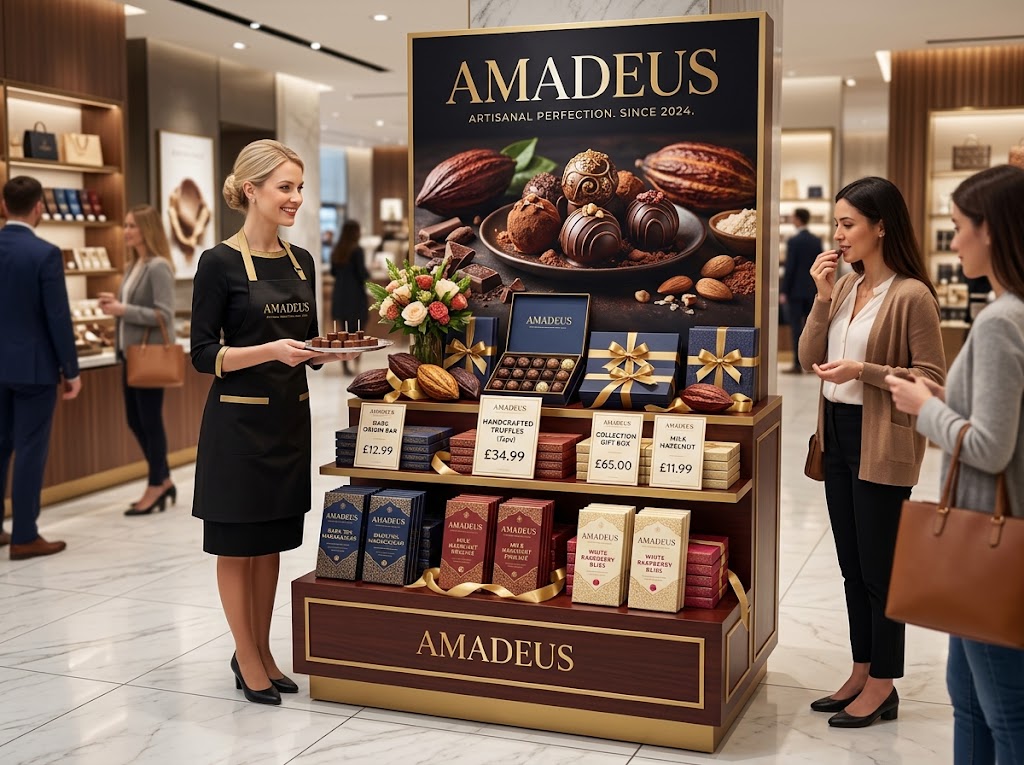
Premium product, premium price, stylish promotion, upmarket place: an integrated mix.
Case study
Primark: A Low-Cost Mix
Primark sells fashionable clothing at very low prices, and every element of its marketing mix supports that. Its product is on-trend but simple and made in huge quantities to keep costs down. Its prices are among the lowest on the high street. For most of its history it spent very little on traditional advertising, relying on social media, word of mouth and customers sharing their purchases online. And it sold mainly through large stores in busy locations rather than online, avoiding the costs of delivery and returns. The integrated low-cost mix is hard for rivals to copy.
Build the Mix
A bakery chain wants to launch a new range of gluten-free cakes. Choose a target market, then decide all four Ps so that they fit together. Finally, explain what gives your range a competitive advantage.
1. Choose a target market.
2. Decide the product, price, promotion and place.
3. Check they fit together.
4. Explain the competitive advantage.
A good answer shows: A clear target market with all four Ps consistent with it, and a competitive advantage linked to at least one P.
Can I...?
- 1Explain how each P influences the others.
- 2Explain competitive advantage.
- 3Explain how an integrated mix creates competitive advantage.
- 4Use the mix to make and justify a business decision.
Summary & Exam Focus
- Each element of the marketing mix affects the others.
- Competitive advantage can come from product, price, promotion or place.
- An integrated mix is consistent, clear and hard for rivals to copy.
Exam focus
Explain one way a business could use its marketing mix to gain a competitive advantage. (3 marks) (3 marks)
In mix questions, show the knock-on effect: a change to one P should lead you to explain how at least one other P changes too.
Key terms
The vocabulary this lesson expects you to use. Each one is linked from the first place it appears above.
- Marketing mix
- The combination of product, price, promotion and place.
- Integrated marketing mix
- A mix where all four Ps fit together for the same target market.
- Competitive advantage
- Anything that makes a business more attractive to customers than its rivals.
- Positioning
- How a business wants customers to see its product compared with competitors'.
Questions and answers
7 questions set on this lesson, with the mark schemes and model answers open.
Define the term 'competitive advantage'.
Mark scheme — 1 mark available
- An advantage over competitors that attracts customers — 1 mark
Model answer
Something that makes a business more attractive to customers than its competitors.
Outline one way that a change in product could affect the price element of the marketing mix.
Mark scheme — 2 marks available
- A way identified — 1 mark
- Developed — 1 mark
Model answer
Improving the quality of the product increases its costs (1), so the business may need to raise the price - which customers may accept because the product is better (1).
Explain one way a business could use its marketing mix to gain a competitive advantage.
Mark scheme — 3 marks available
- A way identified, linked to one or more Ps — 1 mark
- First linked point of explanation — 1 mark
- Second linked point of explanation — 1 mark
Model answer
It could make its product different from competitors' through a unique feature (1). This gives customers a reason to choose it over rivals (1). As a result, the business can win market share and may be able to charge a higher price, increasing its profit (1).
Source: Bloom Coffee PLC owns 120 coffee shops across the UK, charging slightly higher prices than its rivals. It promotes itself mainly through a loyalty app. Over the past year its sales have fallen by 8% as two large competitors have opened shops near many of its locations and started heavy TV advertising. Evaluate whether Bloom Coffee PLC should respond to the competition by cutting its prices.
Mark scheme — 12 marks available
- AO2 (Application, 4 marks): uses the context - 120 shops, higher prices, loyalty app, 8% fall, rivals' TV adverts — Level 1-4
- AO3a (Analysis, 4 marks): chains of reasoning about price and the rest of the mix — Level 1-4
- AO3b (Evaluation, 4 marks): a supported judgement, with "it depends on" — Level 1-4
Model answer
Cutting prices could win back price-sensitive customers who have switched to the new competitors, and could stop the 8% fall in sales. Combined with offers on its loyalty app, lower prices might encourage customers to return regularly. However, Bloom already charges more than its rivals, which suggests customers see it as higher quality. Cutting prices could damage that image and start a price war with two large competitors who may be able to cut further, reducing Bloom's profit on every cup. Instead, Bloom could use its other Ps: improving its product, using its app to reward loyal customers, or promoting what makes it different. A price cut alone does not make its mix more competitive. Overall, Bloom should not rely on cutting prices across the board, because its competitive advantage is quality, not price. It depends on why customers are leaving: if research shows price is the main reason, targeted app discounts may be better than a general price cut.
A business improves the quality of its product. Which other P is most likely to change as a direct result?
Why: Better quality usually costs more, so the price is likely to rise.
Why is an integrated marketing mix hard for rivals to copy?
Why: A rival can copy one element, such as price, but not a whole consistent mix built over time.
A luxury perfume is sold in a discount supermarket. What is the main risk?
Why: The place does not fit the premium product and price, damaging the brand's luxury image.