Exam questions · Biology · Transport in Cells
Diffusion
- 9 exam questions
- 24 marks
- 10 quick checks
-
1 Name [1 mark]
Name the waste product that diffuses from cells into the blood plasma, to be excreted by the kidneys.
Show answerHide answer
Model answer
Urea.
Mark scheme
- Urea — 1 mark
-
2 Describe [2 marks]
Describe what is meant by diffusion.
Show answerHide answer
Model answer
The spreading out of particles (of a gas or of a substance in solution), resulting in a net movement from an area of higher concentration to an area of lower concentration.
Mark scheme
- Particles spread out / move randomly — 1 mark
- Net movement from higher to lower concentration — 1 mark
-
3 Name [3 marks]
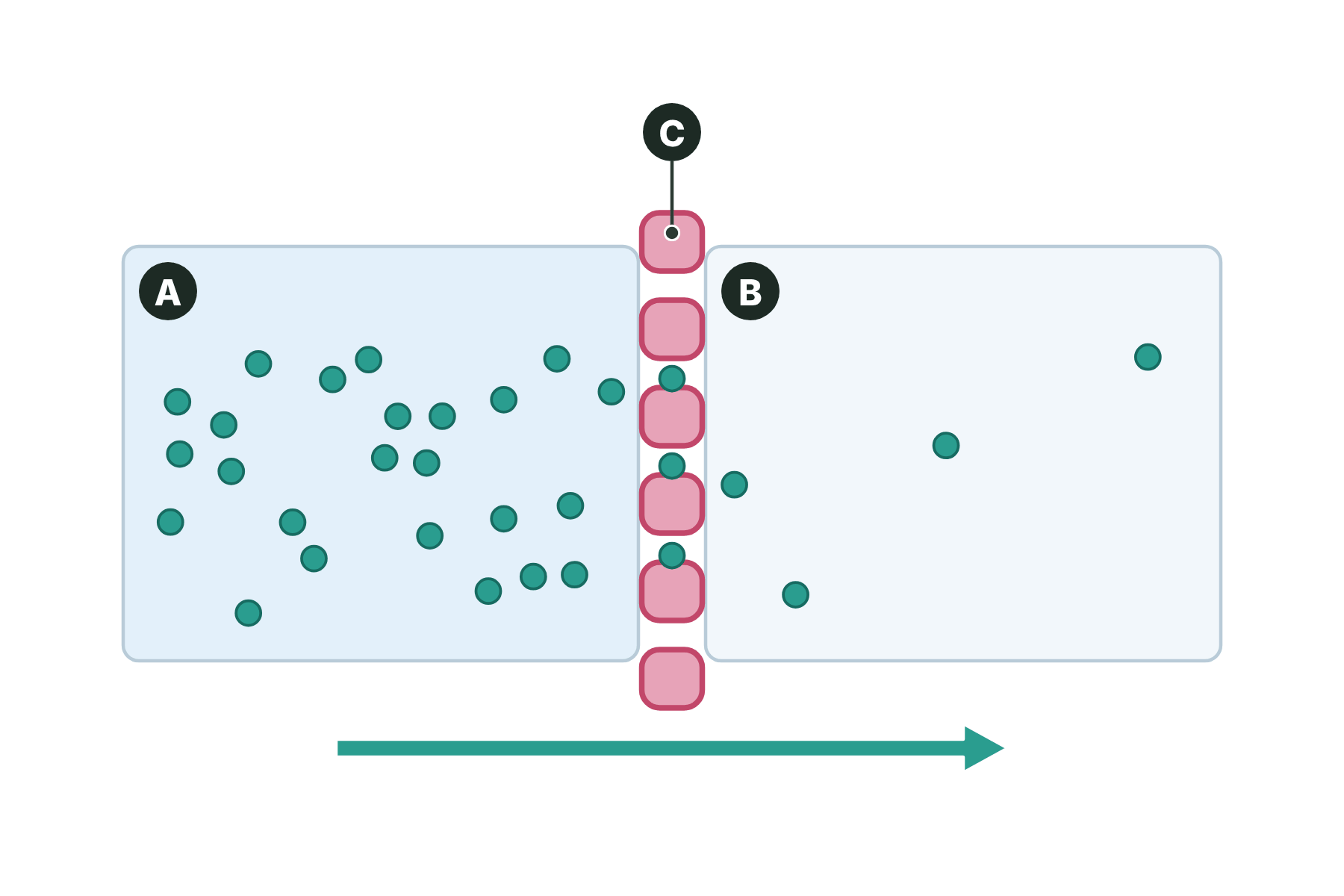
Figure 1 shows particles on both sides of a cell membrane. Name the parts labelled A, B and C.
Show answerHide answer
Model answer
A is the region of higher concentration. B is the region of lower concentration. C is the cell membrane.
Mark scheme
- A: higher concentration — 1 mark
- B: lower concentration — 1 mark
- C: (cell) membrane — 1 mark
-
4 Give [2 marks]
Give two substances that move into or out of cells by diffusion.
Show answerHide answer
Model answer
Any two from: oxygen, carbon dioxide, urea.
Mark scheme
- Oxygen — 1 mark
- Carbon dioxide — 1 mark
- Urea — 1 mark
-
5 State [3 marks]
State three factors that affect the rate of diffusion.
Show answerHide answer
Model answer
The concentration gradient (difference in concentration); the temperature; the surface area of the membrane.
Mark scheme
- Concentration gradient — 1 mark
- Temperature — 1 mark
- Surface area (of the membrane) — 1 mark
-
6 Explain [2 marks]
Explain why diffusion is faster at a higher temperature.
Show answerHide answer
Model answer
At a higher temperature the particles have more energy, so they move faster and spread out more quickly.
Mark scheme
- Particles have more energy — 1 mark
- So they move faster / spread out faster — 1 mark
-
7 Calculate [2 marks]
A cell takes in 36 micrograms of a substance by diffusion in 9 minutes. Calculate the mean rate of uptake, in micrograms per minute.
Show answerHide answer
Model answer
36 ÷ 9 = 4 micrograms per minute.
Mark scheme
- 36 ÷ 9 — 1 mark
- 4 micrograms per minute (unit needed) — 1 mark
-
8 Explain [3 marks]
Explain why oxygen diffuses from the air in the alveoli into the blood.
Show answerHide answer
Model answer
The concentration of oxygen is higher in the air in the alveoli than in the blood. So there is a net movement of oxygen from the alveoli into the blood, down the concentration gradient.
Mark scheme
- Higher concentration of oxygen in the alveoli — 1 mark
- Lower concentration of oxygen in the blood — 1 mark
- Net movement down the concentration gradient — 1 mark
-
9 Explain [6 marks]
Explain how the concentration gradient, the temperature and the surface area of the membrane each affect the rate of diffusion.
Show answerHide answer
Model answer
The greater the concentration difference between the two sides, the faster the rate of diffusion, because more particles move down the gradient than back against it. The higher the temperature, the faster the rate of diffusion, because the particles have more energy and move faster. The larger the surface area of the membrane, the faster the rate of diffusion, because more particles can cross at the same time.
Mark scheme
- Bigger concentration difference gives faster diffusion — 1 mark
- Because more particles move down the gradient — 1 mark
- Higher temperature gives faster diffusion — 1 mark
- Because particles have more energy / move faster — 1 mark
- Larger surface area gives faster diffusion — 1 mark
- Because more particles can cross at once — 1 mark
Quick check
-
1
Which statement describes diffusion?
Show answerHide answer
C: Net movement of particles from high to low concentration
Diffusion is the net movement of particles from a region of higher concentration to a region of lower concentration.
-
2
Which of these moves into cells by diffusion?
Show answerHide answer
B: Oxygen
Oxygen diffuses into respiring cells. Urea and carbon dioxide diffuse out of them.
-
3
What happens to the rate of diffusion if the temperature is increased?
Show answerHide answer
A: It increases
The particles have more energy and move faster, so diffusion is faster.
-
4
Which change would make diffusion across a membrane slower?
Show answerHide answer
D: A smaller membrane
A smaller surface area lets fewer particles cross at once, so the rate falls.
-
5
A cell takes in 50 units of a substance in 10 minutes. What is the rate of uptake?
Show answerHide answer
B: 5 units per minute
Rate = 50 ÷ 10 = 5 units per minute.
-
6
Where does urea diffuse to from the cells?
Show answerHide answer
C: Into the blood plasma
Urea diffuses from the cells into the blood plasma, and the kidneys then excrete it.
-
7
Does diffusion need energy from respiration?
Show answerHide answer
A: No
No. The particles move on their own, so the cell does not have to use energy.
-
8
Why does carbon dioxide diffuse out of respiring cells?
Show answerHide answer
D: Its concentration is higher inside the cell
Respiration makes carbon dioxide, so its concentration is higher inside the cell than outside, and it moves down the gradient.
-
9
What does a steeper concentration gradient do to the rate of diffusion?
Show answerHide answer
B: It makes it faster
A bigger difference in concentration means more particles move down the gradient, so diffusion is faster.
-
10
Once the particles are evenly spread out, what is true?
Show answerHide answer
C: There is no net movement
The particles are still moving, but as many move one way as the other, so there is no net movement.