Slides · PPTX · 261 KB · 32 slides
Newtons Second Law - Teacher Slides.pptx
The lesson slides with the teacher's notes on each slide, and every question and mark scheme built in. Built from the lesson script on 1 October 2026.
AQA GCSE PHYSICS · PAPER 2 · FOUNDATION & HIGHER

Newton's Second Law
Forces
Lesson 15 of 20
openrevise.com
AQA GCSE PHYSICS · PAPER 2 · FOUNDATION & HIGHER

Warm-up
Forces
Lesson 15 of 20
Answer each one, then check.
1
What is a resultant force?
2
What is acceleration?
3
What is the unit of force?
4
What is proportional?
5
What does inversely proportional mean?
openrevise.com
AQA GCSE PHYSICS · PAPER 2 · FOUNDATION & HIGHER

Warm-up - Answers
Forces
Lesson 15 of 20
1
What is a resultant force?
The single force with the same effect as all the forces
2
What is acceleration?
Rate of change of velocity
3
What is the unit of force?
Newton
4
What is proportional?
Doubling one doubles the other
5
What does inversely proportional mean?
Doubling one halves the other
openrevise.com
AQA GCSE PHYSICS · PAPER 2 · FOUNDATION & HIGHER

Learning Objectives
Forces
Lesson 15 of 20
1
State Newton's Second Law.
2
Recall and apply F = ma.
3
Describe how to investigate the effect of force and mass on acceleration (Required Practical 7).
4
Explain inertial mass (Higher tier).
openrevise.com
AQA GCSE PHYSICS · PAPER 2 · FOUNDATION & HIGHER
Forces
Lesson 15 of 20

NEWTON'S SECOND LAW
resultant force = mass × acceleration F = ma
The acceleration of an object is proportional to the resultant force and inversely proportional to its mass: a ∝ F and a ∝ 1/m.
openrevise.com
AQA GCSE PHYSICS · PAPER 2 · FOUNDATION & HIGHER

Required Practical 7: Force, Mass and Acceleration
Forces
Lesson 15 of 20
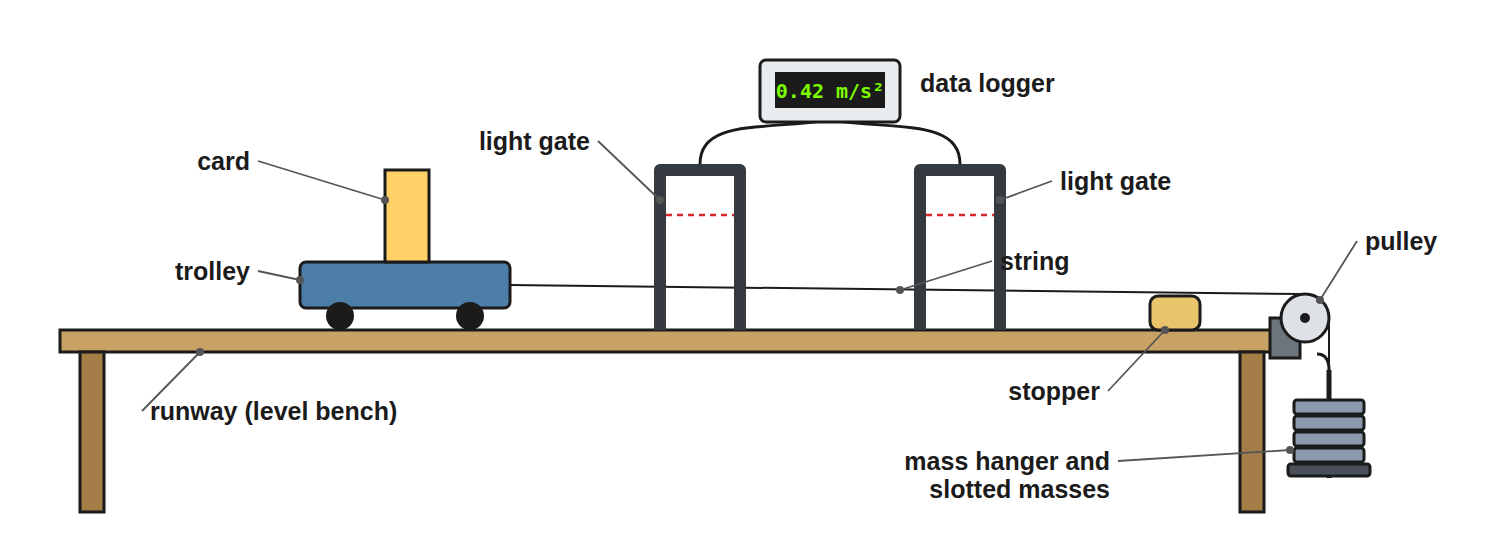
The weight of the hanging masses provides the force.
openrevise.com
AQA GCSE PHYSICS · PAPER 2 · FOUNDATION & HIGHER

Required Practical 7: Method
Forces
Lesson 15 of 20
Two investigations.
1
Force varied
Keep the total mass constant by moving masses from the trolley to the hanger; the force is the weight of the hanging masses.
2
Measure acceleration
From the light gates: a = (v − u) ÷ t.
3
Plot
Acceleration against force: a straight line through the origin.
4
Mass varied
Keep the force constant and add masses to the trolley.
5
Plot
Acceleration against mass (a curve) or against 1/mass (a straight line).
6
Repeat
Take repeat readings and compensate for friction by slightly tilting the runway.
openrevise.com
AQA GCSE PHYSICS · PAPER 2 · FOUNDATION & HIGHER

Finding Acceleration
Forces
Lesson 15 of 20
A car of mass 1200 kg has a resultant force of 3000 N. Calculate its acceleration.
1
Rearrange
a = F ÷ m
2
Substitute
a = 3000 ÷ 1200
3
Answer
a = 2.5 m/s²
ANSWER
2.5 m/s²
openrevise.com
AQA GCSE PHYSICS · PAPER 2 · FOUNDATION & HIGHER

Finding the Force
Forces
Lesson 15 of 20
A 0.50 kg trolley accelerates at 4.0 m/s². Calculate the resultant force.
1
Write the equation
F = ma
2
Substitute
F = 0.50 × 4.0
3
Answer
F = 2.0 N
ANSWER
2.0 N
openrevise.com
AQA GCSE PHYSICS · PAPER 2 · FOUNDATION & HIGHER

Using a Graph
Forces
Lesson 15 of 20
A graph of acceleration against force for a trolley is a straight line through (2.0 N, 1.0 m/s²). Find the mass.
1
Gradient
a ÷ F = 1.0 ÷ 2.0 = 0.50 kg⁻¹
2
Since a = F ÷ m
Gradient = 1 ÷ m
3
Mass
m = 1 ÷ 0.50 = 2.0 kg
ANSWER
2.0 kg
openrevise.com
AQA GCSE PHYSICS · PAPER 2 · FOUNDATION & HIGHER

Inertial Mass (Higher)
Forces
Lesson 15 of 20
Explain what is meant by inertial mass.
1
Definition
The ratio of force to acceleration
2
Meaning
A measure of how difficult it is to change the velocity of an object
ANSWER
Inertial mass = force ÷ acceleration: how hard it is to change an object's velocity.
openrevise.com
AQA GCSE PHYSICS · PAPER 2 · FOUNDATION & HIGHER

Estimating
Forces
Lesson 15 of 20
Use sensible values.
Everyday values
A car accelerating from 0 to 27 m/s (60 mph) in 10 s has a ≈ 2.7 m/s².
Force
For a 1000 kg car: F = 1000 × 2.7 ≈ 2700 N.
Symbol ~
Means approximately.
Units
Mass in kg, a in m/s², F in N.
openrevise.com
AQA GCSE PHYSICS · PAPER 2 · FOUNDATION & HIGHER

Required Practical 7: Variables
Forces
Lesson 15 of 20
Know which is which for each investigation.
Investigation
Independent
Dependent
Control
Effect of force
Force (weight on the hanger)
Acceleration
Total mass of trolley and hanger
Effect of mass
Mass of the trolley
Acceleration
The accelerating force
openrevise.com
AQA GCSE PHYSICS · PAPER 2 · FOUNDATION & HIGHER

Errors and Improvements
Forces
Lesson 15 of 20
Where the practical goes wrong and how to fix it.
Friction
Friction reduces the resultant force. Tilting the runway slightly until the trolley rolls at a steady speed compensates for it.
Timing
Stopwatches add human reaction time. Light gates and a data logger measure times far more precisely.
Keeping mass constant
When varying force, take masses off the trolley and put them on the hanger, so the total mass being accelerated stays the same.
openrevise.com
AQA GCSE PHYSICS · PAPER 2 · FOUNDATION & HIGHER

Higher
Inertia and Inertial Mass
Forces
Lesson 15 of 20
Mass resists changes in motion.
Inertia
The tendency of any object to stay at rest or keep moving at a constant velocity.
Inertial mass
Defined as force ÷ acceleration: the bigger it is, the harder it is to change the object's velocity.
Example
A loaded lorry needs a much larger force than a car to reach the same acceleration, because its inertial mass is larger.
openrevise.com
AQA GCSE PHYSICS · PAPER 2 · FOUNDATION & HIGHER

Key Terms
Forces
Lesson 15 of 20
Resultant force
The net force acting on an object.
Acceleration
Rate of change of velocity.
Inertial mass
Force divided by acceleration.
Proportional
Increasing by the same factor.
Inversely proportional
One quantity halves as the other doubles.
Light gate
A sensor that times how long a card takes to pass.
openrevise.com
AQA GCSE PHYSICS · PAPER 2 · FOUNDATION & HIGHER

Key Terms (cont.)
Forces
Lesson 15 of 20
Independent variable
The variable you change in an experiment.
Dependent variable
The variable you measure in an experiment.
openrevise.com
AQA GCSE PHYSICS · PAPER 2 · FOUNDATION & HIGHER
Forces
Lesson 15 of 20

YOUR TASK
Predict the Acceleration
10 minutes
A trolley has a mass of 1.0 kg and accelerates at 2.0 m/s² under a resultant force. What acceleration would the same force give a 2.0 kg trolley? What force is needed for 2.0 kg to accelerate at 2.0 m/s²?
1
Use F = ma.
2
Compare the masses.
WHAT A GOOD ANSWER SHOWS
Half the acceleration: 1.0 m/s². Force = 2.0 × 2.0 = 4.0 N.
openrevise.com
AQA GCSE PHYSICS · PAPER 2 · FOUNDATION & HIGHER

Can I...?
Forces
Lesson 15 of 20
State Newton's second law.
Recall F = ma.
Rearrange for a or m.
Describe Required Practical 7.
Interpret a force–acceleration graph.
Explain inertial mass.
Estimate forces on a car.
Use units.
openrevise.com
AQA GCSE PHYSICS · PAPER 2 · FOUNDATION & HIGHER
Summary & Exam Focus
F = ma.
Acceleration ∝ force; ∝ 1/mass.
Inertial mass = force ÷ acceleration.
Use light gates to measure acceleration.
Compensate for friction by tilting the runway.
EXAM FOCUS
A 1200 kg car has a resultant force of 3000 N. Calculate its acceleration. (2 marks)
Rearrange F = ma to a = F ÷ m, substitute 3000 ÷ 1200 and give 2.5 m/s². Use the resultant force, not just the driving force.
openrevise.com
AQA GCSE PHYSICS · PAPER 2 · FOUNDATION & HIGHER

Exam Practice: Newton's Second Law
Forces
Lesson 15 of 20
Answer all questions. Use the mark allocation as a guide to how much to write. · 17 minutes
Question 1 · 2 marks · Calculate
A car has a mass of 1200 kg. The resultant force on the car is 3000 N. Calculate the acceleration of the car. Use the equation: resultant…
Question 2 · 2 marks · Calculate
A trolley of mass 0.50 kg accelerates at 4.0 m/s². Calculate the resultant force on the trolley.
Question 3 · 4 marks · Use the graph
A student investigates how the acceleration of a trolley depends on the resultant force. The graph shows the results. (a) Describe the…
openrevise.com
AQA GCSE PHYSICS · PAPER 2 · FOUNDATION & HIGHER

Exam Practice: Newton's Second Law (cont.)
Forces
Lesson 15 of 20
Question 4 · 6 marks · Describe
Describe an investigation to show how the acceleration of a trolley depends on the resultant force acting on it. Your answer should include…
Question 5 · 2 marks · Explain
Explain what is meant by the inertial mass of an object.
openrevise.com
AQA GCSE PHYSICS · PAPER 2 · FOUNDATION & HIGHER

Question 1 · 2 marks · Calculate
Forces
Lesson 15 of 20
“
A car has a mass of 1200 kg. The resultant force on the car is 3000 N. Calculate the acceleration of the car. Use the equation: resultant force = mass × acceleration
HOW TO ANSWER IT
Command word: Calculate. Worth 2 marks, so plan before writing.
openrevise.com
AQA GCSE PHYSICS · PAPER 2 · FOUNDATION & HIGHER

Question 1 · mark scheme
Forces
Lesson 15 of 20
2 marks available. Award a mark for each point made.
Rearranges to a = F ÷ m
1 mark
2.5 m/s²
1 mark
openrevise.com
AQA GCSE PHYSICS · PAPER 2 · FOUNDATION & HIGHER

Question 2 · 2 marks · Calculate
Forces
Lesson 15 of 20
“
A trolley of mass 0.50 kg accelerates at 4.0 m/s². Calculate the resultant force on the trolley.
HOW TO ANSWER IT
Command word: Calculate. Worth 2 marks, so plan before writing.
openrevise.com
AQA GCSE PHYSICS · PAPER 2 · FOUNDATION & HIGHER

Question 2 · mark scheme
Forces
Lesson 15 of 20
2 marks available. Award a mark for each point made.
Correct substitution
1 mark
2.0 N
1 mark
openrevise.com
AQA GCSE PHYSICS · PAPER 2 · FOUNDATION & HIGHER

Question 3 · 4 marks · Use the graph
Forces
Lesson 15 of 20
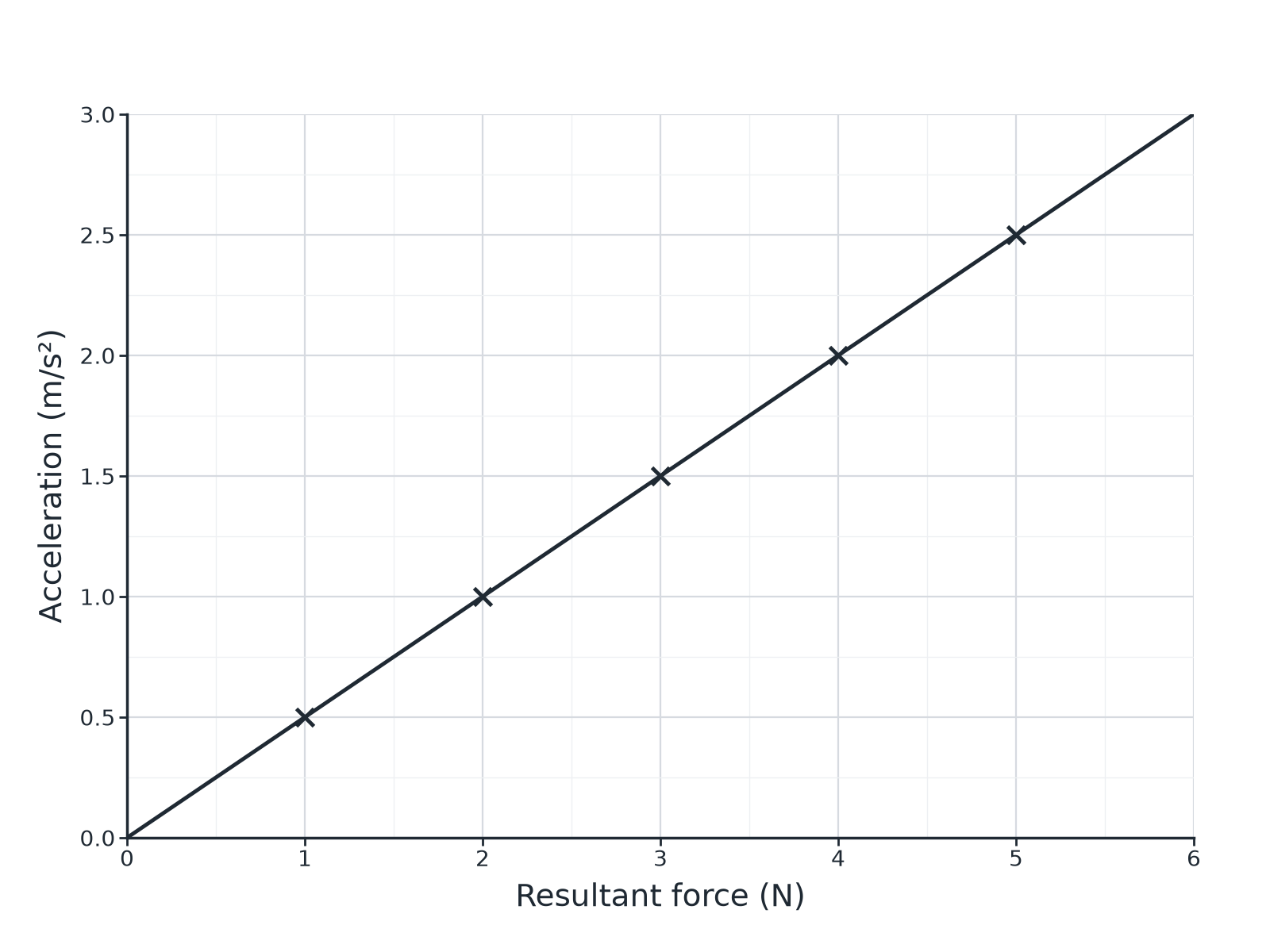
A student investigates how the acceleration of a trolley depends on the resultant force. The graph shows the results. (a) Describe the relationship. (b) Use the graph to calculate the mass of the trolley. (4 marks)
openrevise.com
AQA GCSE PHYSICS · PAPER 2 · FOUNDATION & HIGHER

Question 3 · mark scheme
Forces
Lesson 15 of 20
4 marks available. Award a mark for each point made.
Straight line through the origin / directly proportional
1 mark
Uses the gradient
1 mark
Gradient = 1/m
1 mark
2.0 kg
1 mark
openrevise.com
AQA GCSE PHYSICS · PAPER 2 · FOUNDATION & HIGHER

Question 4 · 6 marks · Describe
Forces
Lesson 15 of 20
“
Describe an investigation to show how the acceleration of a trolley depends on the resultant force acting on it. Your answer should include the apparatus, the measurements and how you would use the results.
HOW TO ANSWER IT
Command word: Describe. Worth 6 marks, so plan before writing.
openrevise.com
AQA GCSE PHYSICS · PAPER 2 · FOUNDATION & HIGHER

Question 4 · mark scheme
Forces
Lesson 15 of 20
6 marks available. Award a mark for each point made.
Level 3 (5 to 6 marks): a complete method (trolley, runway, pulley, hanging masses, light gates or ticker timer), keeping total mass constant, measuring acceleration for several forces, plotting acceleration against force and describing the expected straight line, with a precaution or repeat
5 to 6 marks
Level 2 (3 to 4 marks): a method with most apparatus and measurements but with gaps
3 to 4 marks
Level 1 (1 to 2 marks): simple statements about pulling a trolley
1 to 2 marks
openrevise.com
AQA GCSE PHYSICS · PAPER 2 · FOUNDATION & HIGHER

Question 5 · 2 marks · Explain
Forces
Lesson 15 of 20
“
Explain what is meant by the inertial mass of an object.
HOW TO ANSWER IT
Command word: Explain. Worth 2 marks, so plan before writing.
openrevise.com
AQA GCSE PHYSICS · PAPER 2 · FOUNDATION & HIGHER

Question 5 · mark scheme
Forces
Lesson 15 of 20
2 marks available. Award a mark for each point made.
How difficult it is to change velocity
1 mark
Force divided by acceleration
1 mark
openrevise.com
← → to move, F to present full screen, G for every slide at once.