4.1 The photosynthesis reaction
What photosynthesis is, its word and symbol equations, why it is endothermic, the role of chlorophyll and chloroplasts, and (OCR) the two stages of photosynthesis.
AQA
Edexcel
OCR
1 min read
What photosynthesis is
Key terms
- Photosynthesis: the process in which plants and algae use light energy to make glucose from carbon dioxide and water.
- Chlorophyll: the green pigment in chloroplasts that absorbs light.
- Endothermic reaction: a reaction that takes in energy from the surroundings.
- Producer: an organism that makes its own food by photosynthesis.
Green plants and algae are producers. They make their own food, and the glucose they make is the starting point of almost every food chain. This is how energy and biomass enter ecosystems.
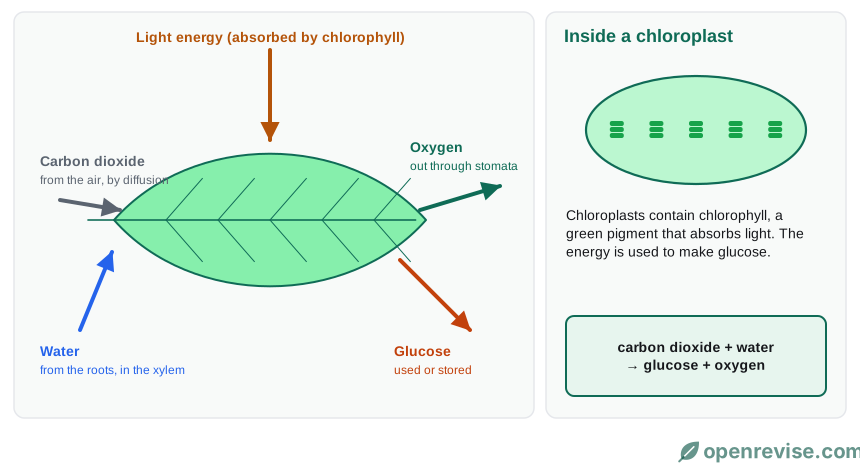
The equation
carbon dioxide + water → glucose + oxygen
6CO_2 + 6H_2O → C_6H_12O_6 + 6O_2
- Carbon dioxide diffuses into the leaf from the air through the stomata.
- Water is taken up by the roots and carried to the leaf in the xylem.
- Light is absorbed by chlorophyll in the chloroplasts.
- Oxygen is released as a waste product, or used in respiration.
- Glucose is used in respiration or turned into other substances.
An endothermic reaction
Photosynthesis is endothermic: energy is transferred from the environment (as light) to the chloroplasts. The energy ends up stored in the glucose.
Two stages (OCR)
Photosynthesis happens in two stages, both in the chloroplast:
- Light-dependent stage: light energy is used to split water molecules, releasing oxygen.
- Light-independent stage: the hydrogen from water is combined with carbon dioxide to make glucose. This stage needs enzymes, so it is affected by temperature.
Test yourself on this lesson
6 exam questions · 11 marks · with mark schemes and model answers
Found a mistake?