1.8 Culturing microorganisms
How bacteria multiply by binary fission, how to calculate numbers after n divisions, how to grow an uncontaminated culture using aseptic technique, and how to find the area of a colony or clear zone.
Growing bacteria
Key terms
- Binary fission: cell division in bacteria, in which one cell splits into two identical cells.
- Culture medium: a liquid or jelly that supplies the nutrients microorganisms need to grow.
- Agar: a jelly made from seaweed, used as a solid culture medium in Petri dishes.
- Colony: a visible group of bacteria, all grown from one original cell.
- Aseptic technique: methods that stop unwanted microorganisms contaminating a culture.
- Sterile: free from living microorganisms.
Bacteria reproduce by binary fission: a bacterium copies its DNA, gets longer, and then splits into two identical cells. With plenty of nutrients and a suitable temperature, a bacterium can divide as often as once every 20 minutes.
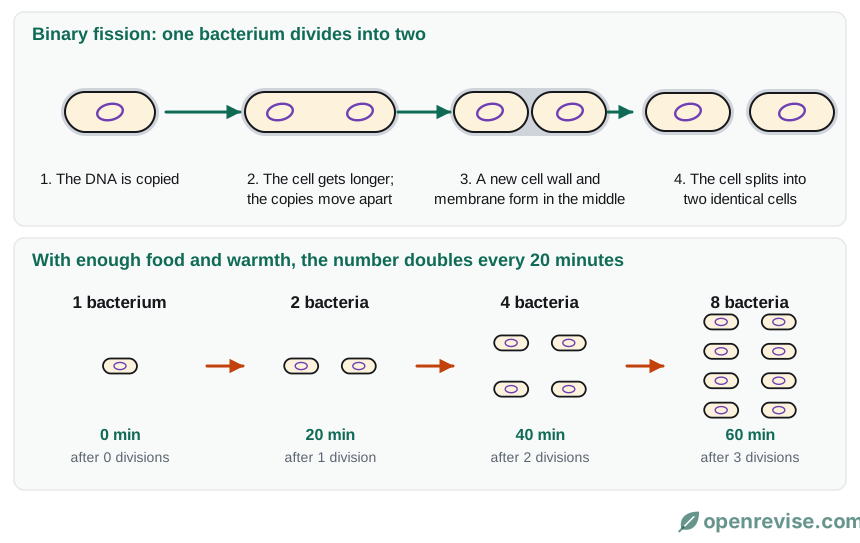
The number doubles with every division, so after n divisions, one bacterium has become 2n bacteria.
Worked example. A bacterium divides every 20 minutes. How many bacteria will there be after 2 hours, starting from one?
2 hours = 120 minutes, and 120 ÷ 20 = 6 divisions, so the number is 26 = 64.
If there were 50 bacteria at the start, there would be 50 × 26 = 3200. After 8 hours there are 24 divisions, and 224 is about 1.7 × 10⁷ (17 million) from a single cell. Bacteria can make a population grow very fast, which is why infections can spread quickly.
Culturing bacteria
In a laboratory, bacteria are grown in a nutrient broth (a liquid) or on agar in a Petri dish. They need nutrients, such as carbohydrates, proteins and minerals, as well as warmth and oxygen. On agar, each bacterium multiplies to form a visible colony.
Aseptic technique
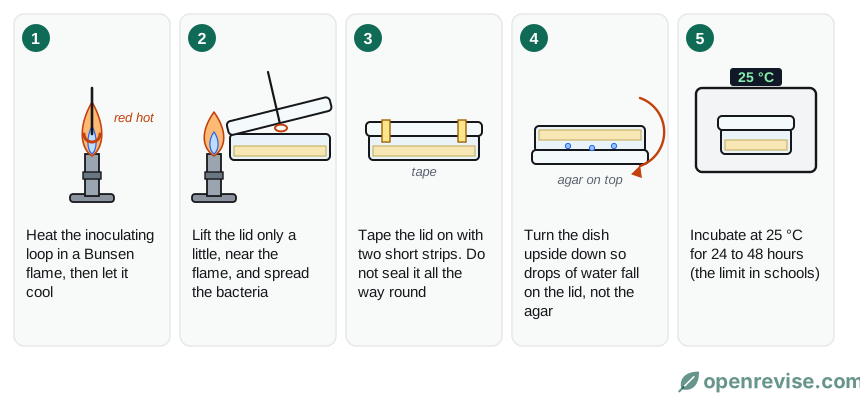
An uncontaminated culture contains only the bacteria that you meant to grow. To keep out other microorganisms from the air, the skin and the bench, you use aseptic technique:
| Step | Reason |
|---|---|
| Sterilise the Petri dishes and agar before use (in an autoclave: very hot steam under pressure) | Kills any microorganisms already there |
| Wash your hands and disinfect the bench | Removes microorganisms that could get into the dish |
| Pass the inoculating loop through a Bunsen flame, then let it cool | Kills microorganisms on the loop; a hot loop would kill the bacteria you want to transfer |
| Open the lid only a little, and work near a flame | Keeps airborne microorganisms out; warm air rises from the flame and carries them away from the dish |
| Tape the lid on with two short strips, not all the way round | Stops microorganisms getting in, but still lets oxygen in, so harmful anaerobic bacteria cannot grow |
| Store the dish upside down | Water that condenses drips onto the lid, not the agar |
| Incubate at 25 °C in school | Higher temperatures, closer to body temperature, would encourage the growth of pathogens that are harmful to humans |
At the end, the plates are disinfected or autoclaved before disposal, and you wash your hands.
Measuring a colony
A colony or a clear zone on a plate is roughly a circle, so you can work out its area with:
Example. A colony is 8 mm across. The radius is 8 ÷ 2 = 4 mm, so area = 3.14 × 42 = 50.2 mm2.
Test yourself on this lesson
7 exam questions · 18 marks · with mark schemes and model answers
Found a mistake?