1.13 Diffusion
What diffusion is, why it needs no energy, examples in the body (oxygen, carbon dioxide, urea), and the factors that change the rate: concentration gradient, temperature and surface area.
What is diffusion?
Key terms
- Diffusion: the spreading out of particles, resulting in a net movement from a region of higher concentration to a region of lower concentration.
- Concentration gradient: the difference in concentration between two regions.
- Net movement: the overall movement of particles in one direction, once those moving the other way are taken into account.
- Partially permeable membrane: a membrane that lets some substances through but not others.
- Passive: a process that does not need energy from respiration.
The particles in a gas, or in a solution, are always moving about at random. This makes them spread out. In diffusion there is a net movement of particles from where they are in a higher concentration to where they are in a lower concentration. We say they move down a concentration gradient.
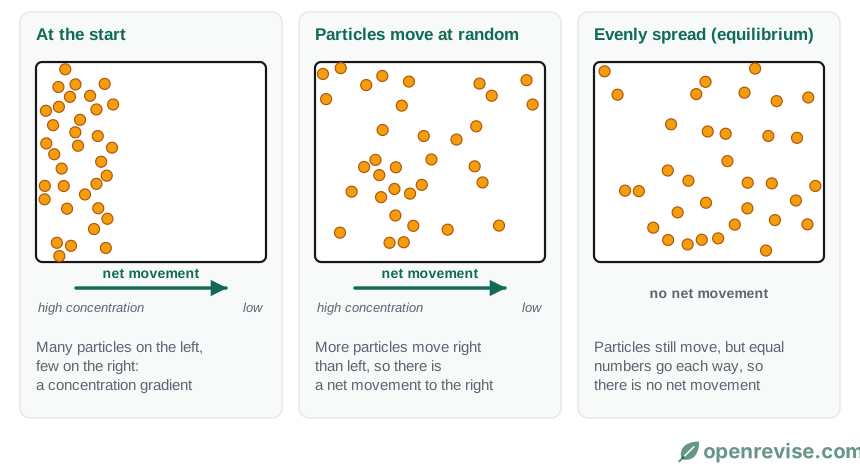
- Diffusion is passive. It does not need energy from respiration, because the particles move on their own.
- When the particles are evenly spread out, there is no concentration gradient. The particles still move at random, but the same number go each way, so there is no net movement.
Diffusion in living things
Substances move into and out of cells by diffusion across the cell membrane. The membrane is partially permeable: small molecules such as oxygen, carbon dioxide, water and urea can pass through, but large molecules such as starch and proteins cannot.
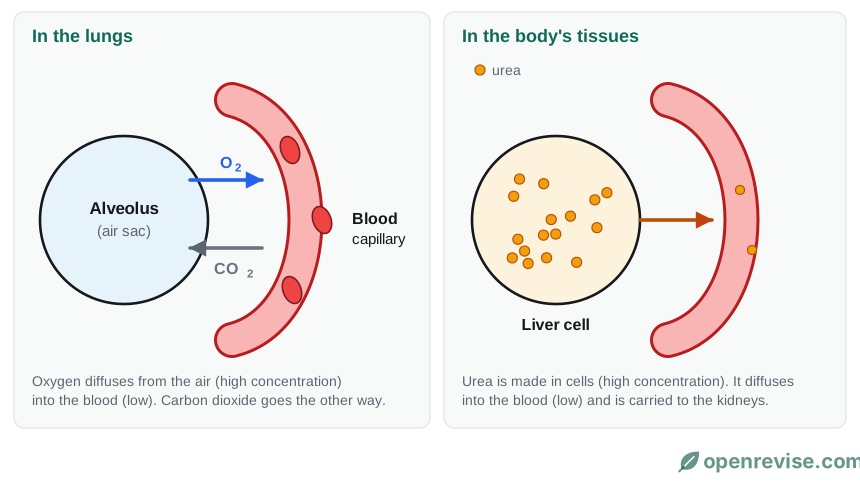
- Oxygen diffuses from the air in the alveoli, where its concentration is high, into the blood, where it is low. It then diffuses from the blood into body cells that are using it for respiration.
- Carbon dioxide diffuses the other way: from respiring cells into the blood, and from the blood into the alveoli, to be breathed out.
- Urea is a waste product made in the liver. It diffuses from liver cells into the blood plasma and is carried to the kidneys to be removed in urine.
Factors that affect the rate of diffusion
| Factor | Effect on the rate | Why |
|---|---|---|
| Concentration gradient | A bigger difference in concentration makes diffusion faster | More particles move down the gradient than move back |
| Temperature | A higher temperature makes diffusion faster | The particles have more energy, so they move faster |
| Surface area | A bigger surface area makes diffusion faster | More particles can cross the membrane at once |
A thinner membrane, which gives a shorter distance to travel, also speeds up diffusion. You meet this idea again in Fick's law.
Investigating diffusion
A common investigation uses cubes of agar jelly that contain an alkali and an indicator, so they are pink. Put cubes of different sizes in dilute acid. As the acid diffuses in, the pink colour disappears. You can then measure how long each cube takes to turn colourless and compare the rates of diffusion.
rate of diffusion = distance moved ÷ time taken
Test yourself on this lesson
7 exam questions · 16 marks · with mark schemes and model answers
Found a mistake?