1.14 Surface area to volume ratio and exchange surfaces
How to calculate surface area to volume ratio, why large organisms need exchange surfaces and transport systems, and how the small intestine, lungs, gills, roots and leaves are adapted for exchange.
Surface area to volume ratio
Key terms
- Surface area: the total area of the outside of an object.
- Surface area to volume ratio: how big an object's surface area is compared with its volume (surface area ÷ volume).
- Exchange surface: a part of an organism where substances are exchanged with the environment, such as the lungs.
- Diffusion distance: how far a substance has to travel by diffusion.
Substances such as oxygen and glucose must reach every cell in an organism, and waste such as carbon dioxide must leave. Whether this can happen by diffusion across the outside surface depends on the organism's surface area to volume ratio (SA:V).
For a cube with sides of length l, the surface area is 6 × l2 (six faces) and the volume is l3.
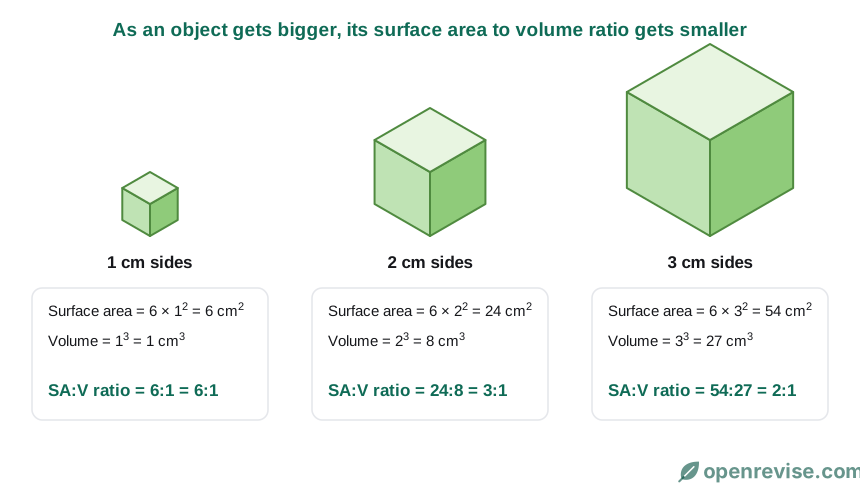
Worked example. A cube has sides of 2 cm.
- surface area = 6 × 22 = 24 cm2
- volume = 23 = 8 cm3
- SA:V = 24 : 8 = 3 : 1
Worked example. A cuboid is 4 cm long, 2 cm wide and 1 cm high. Surface area = 2 × (4×2 + 4×1 + 2×1) = 28 cm2. Volume = 4 × 2 × 1 = 8 cm3. SA:V = 28 : 8 = 3.5 : 1.
As an object gets bigger, its volume increases faster than its surface area, so its SA:V gets smaller.
Why large organisms need exchange surfaces
- A single-celled organism is tiny, so it has a large SA:V. Substances can diffuse across its surface into the cell, and wastes out, quickly enough to meet its needs.
- A multicellular organism is much bigger, so it has a small SA:V. Its outside surface is too small for enough substances to diffuse in, and the distance to the cells in the middle is too far. It needs exchange surfaces, with a very large surface area, and a transport system, such as the blood, to carry substances to and from its cells.
Surface area to volume ratio also affects heat loss. A small animal such as a mouse has a large SA:V, so it loses heat quickly for its size and has to eat a lot. A large animal such as an elephant has a small SA:V and loses heat more slowly.
Adaptations of exchange surfaces
An efficient exchange surface has:
- a large surface area, often from folding, so lots of particles can cross at once;
- a thin membrane, so there is a short diffusion distance;
- (in animals) a good blood supply, to carry substances away and keep the concentration gradient steep;
- (for gas exchange) ventilation, which keeps fresh air or water moving past the surface.
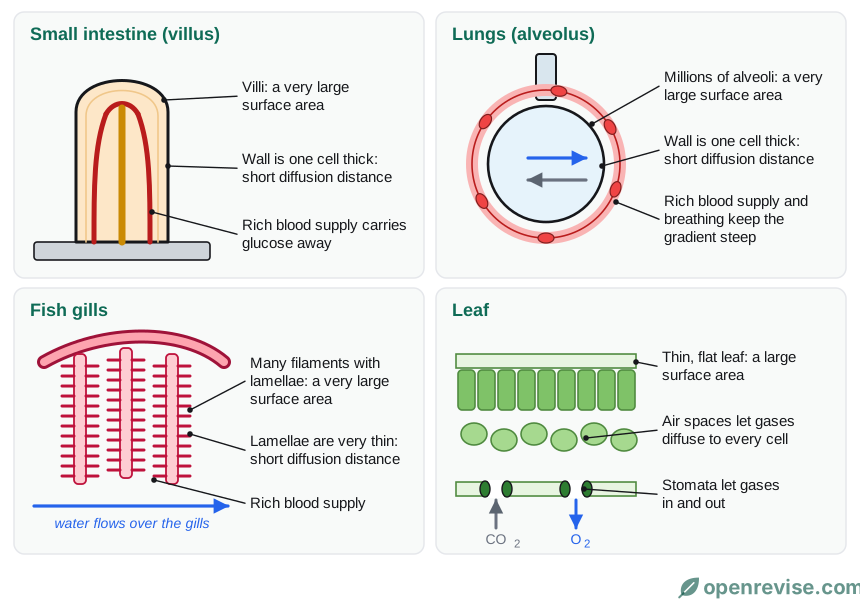
| Exchange surface | What is exchanged | Adaptations |
|---|---|---|
| Small intestine | Digested food (such as glucose) into the blood | Villi give a very large surface area; the wall is one cell thick; a rich blood supply carries food away |
| Lungs | Oxygen into the blood; carbon dioxide out | Millions of alveoli give a very large surface area; walls one cell thick; many capillaries; breathing moves air in and out |
| Gills (fish) | Oxygen into the blood; carbon dioxide out | Many gill filaments with thin lamellae give a large surface area; a rich blood supply; water flows over them |
| Root hair cells | Water and mineral ions into the root | The long, thin hair gives a large surface area |
| Leaves | Carbon dioxide in, oxygen out | Flat and thin, so a large surface area and a short diffusion distance; air spaces inside; stomata that open and close |
Test yourself on this lesson
7 exam questions · 20 marks · with mark schemes and model answers
Found a mistake?