1.15 Fick's law
Fick's law: the rate of diffusion is proportional to surface area times concentration difference, divided by the thickness of the membrane, and how it explains the adaptations of alveoli, villi and gills.
Fick's law
Key terms
- Fick's law: the rate of diffusion is proportional to the surface area multiplied by the concentration difference, divided by the thickness of the membrane.
- Concentration difference: how much higher the concentration is on one side of a membrane than on the other.
- Proportional: when one quantity doubles, the other doubles too.
Three things control how fast a substance diffuses across a membrane. Fick's law puts them together:
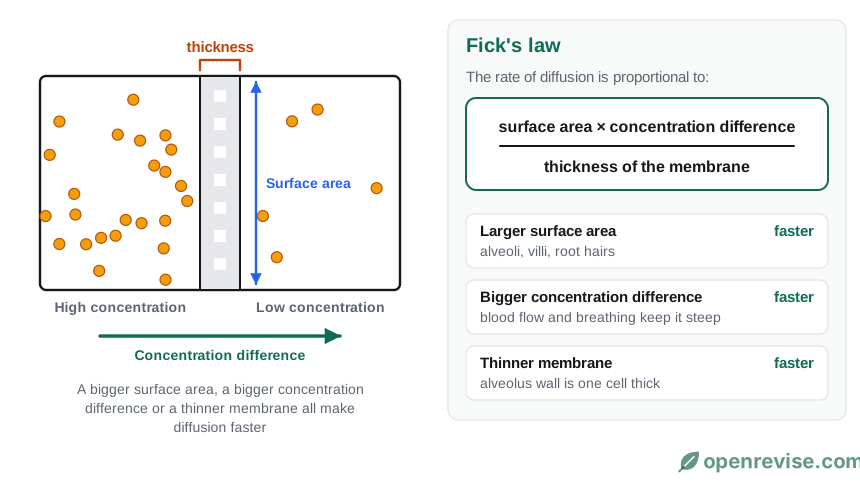
- A larger surface area gives a faster rate, because more particles can cross at once.
- A bigger concentration difference gives a faster rate, because more particles move down the gradient.
- A thinner membrane gives a faster rate, because the particles have a shorter distance to travel.
Because the rate is proportional to the top line, doubling the surface area doubles the rate. Because the thickness is on the bottom, halving the thickness also doubles the rate.
Using the law
You can compare rates with numbers. The values below have no units, because we are only comparing.
| Change | Surface area | Concentration difference | Thickness | Relative rate |
|---|---|---|---|---|
| Starting values | 20 | 6 | 2 | 60 |
| Surface area doubles | 40 | 6 | 2 | 120 |
| Membrane thickness halves | 20 | 6 | 1 | 120 |
| Concentration difference halves | 20 | 3 | 2 | 30 |
For the starting values: (20 × 6) ÷ 2 = 60.
Fick's law in the body
Exchange surfaces in animals are adapted so that all three factors give the fastest possible diffusion.
| Exchange surface | Large surface area | Thin membrane | Steep concentration gradient kept by |
|---|---|---|---|
| Alveoli (lungs) | Millions of alveoli | Wall one cell thick | Breathing brings in fresh air; blood flow carries oxygen away |
| Villi (small intestine) | Folded into millions of villi | Wall one cell thick | Blood flow carries away the absorbed food |
| Gills (fish) | Many filaments and lamellae | Lamellae are very thin | Water flows over the gills; blood flows through them |
In the lung disease emphysema, the walls of the alveoli break down. The surface area falls, so less oxygen can diffuse into the blood and the person is short of breath.
Test yourself on this lesson
6 exam questions · 15 marks · with mark schemes and model answers
Found a mistake?