1.16 Osmosis
What osmosis is, its effects on animal and plant cells (swelling, bursting, turgid, flaccid, plasmolysed), how to calculate percentage change in mass, and water potential (OCR).
What is osmosis?
Key terms
- Osmosis: the diffusion of water from a dilute solution to a more concentrated solution, through a partially permeable membrane.
- Partially permeable membrane: a membrane with tiny pores that lets small molecules, such as water, pass through but not larger ones.
- Turgid: a plant cell that is firm because it is full of water and is pushing against its cell wall.
- Flaccid: a plant cell that is limp because it has lost some water.
- Plasmolysis: when a plant cell has lost so much water that its cytoplasm shrinks and pulls away from the cell wall.
- Water potential: a measure of the tendency of water to move from one place to another. Pure water has the highest water potential, and a more concentrated solution has a lower one.
Osmosis is a special kind of diffusion. It is the diffusion of water from a dilute solution (where there is a high concentration of water) to a concentrated solution (where there is a lower concentration of water), through a partially permeable membrane.
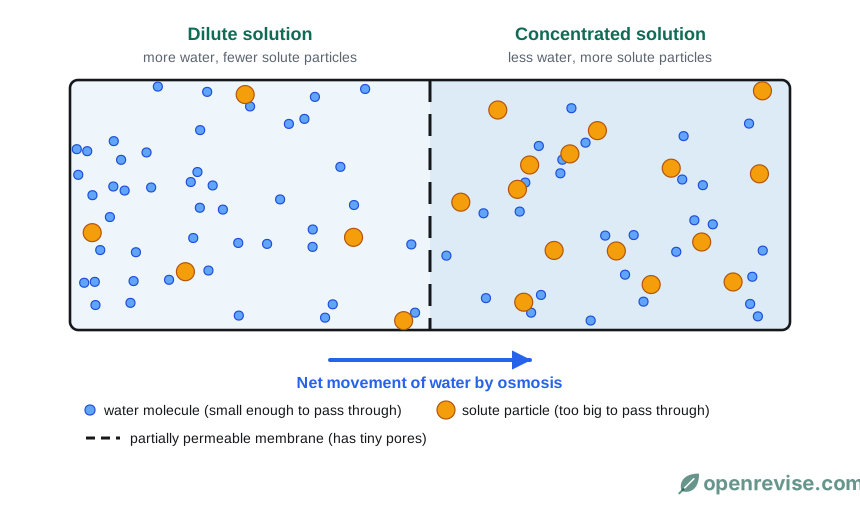
The membrane lets the small water molecules through but not the larger solute particles. Water molecules move at random in both directions, but more move from the dilute side than from the concentrated side, so there is a net movement of water towards the concentrated solution. Like diffusion, osmosis does not need energy from respiration.
OCR uses water potential. Water moves from a region of higher water potential (the dilute solution) to a region of lower water potential (the concentrated solution), through a partially permeable membrane. You do not need to do calculations with water potential.
Osmosis in animal cells
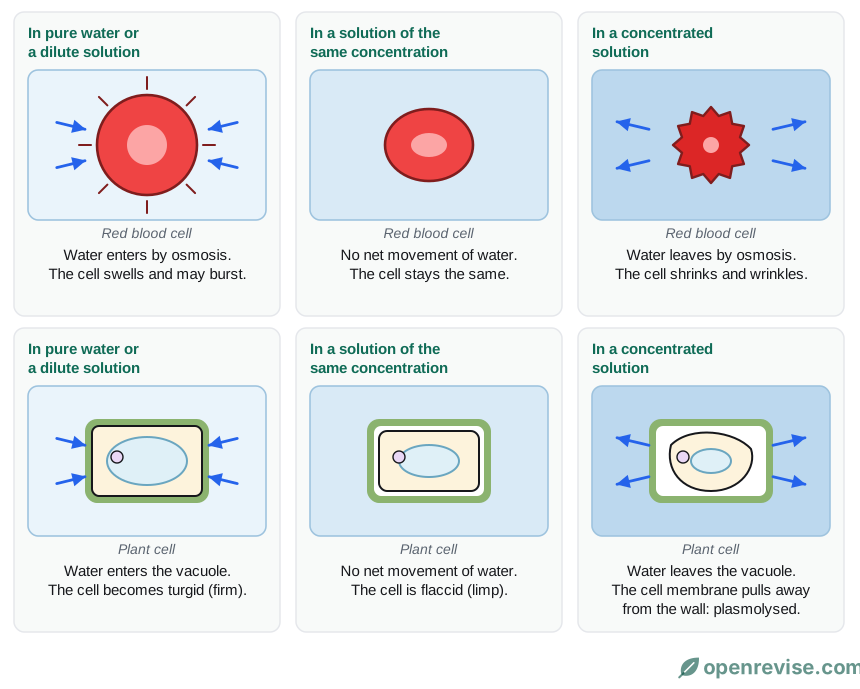
An animal cell has a cell membrane but no cell wall, so the amount of water in it matters a great deal. Think of a red blood cell:
- in pure water or a dilute solution, water enters the cell by osmosis. The cell swells and may burst;
- in a solution with the same concentration as the cytoplasm, there is no net movement of water, and the cell stays the same;
- in a concentrated solution, water leaves the cell by osmosis, and the cell shrinks and wrinkles.
This is one reason why the body keeps the concentration of the blood and tissue fluid constant.
Osmosis in plant cells
A plant cell has a strong cell wall, which stops it bursting.
- In a dilute solution, water enters the vacuole by osmosis. The cell swells and pushes against the cell wall, so it becomes turgid (firm). Turgid cells support the plant.
- In a solution with the same concentration, there is no net movement, and the cell is flaccid (limp).
- In a concentrated solution, water leaves the vacuole. The cell becomes flaccid and, if it loses enough water, the cell membrane pulls away from the cell wall. This is called plasmolysis. A plant with flaccid cells wilts.
Percentage change in mass
You can measure the effect of osmosis by finding the change in mass of a piece of plant tissue, such as a potato cylinder, after it has been in a solution.
Example. A potato cylinder has a mass of 5.0 g before and 5.6 g after being in a solution.
percentage change = (5.6 − 5.0) ÷ 5.0 × 100 = +12%
- A positive change means the tissue gained water: the solution was more dilute than the cells.
- A negative change means the tissue lost water: the solution was more concentrated than the cells.
- No change means the solution has the same concentration as the cells.
Test yourself on this lesson
7 exam questions · 18 marks · with mark schemes and model answers
Found a mistake?