7.13 Global warming and living things
How global warming, caused by rising carbon dioxide and methane, affects living things: loss of habitat, changes in the distribution of species, changes in migration patterns and reduced biodiversity, and (OCR Higher) evaluating evidence for these changes.
Global warming
Key terms
- Global warming: the rise in the average temperature of the Earth, caused by increasing levels of greenhouse gases such as carbon dioxide and methane.
- Distribution: where a species is found.
- Migration: the seasonal movement of animals from one place to another.
Levels of carbon dioxide and methane in the atmosphere are increasing, mainly because of burning fossil fuels, deforestation and farming. These gases trap more heat, causing global warming. Most scientists agree that this is changing the climate.
Effects on living things
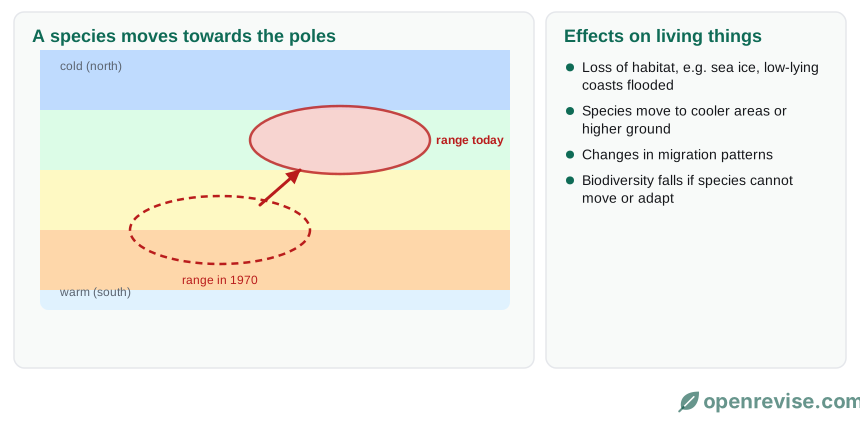
- Loss of habitat: rising sea levels flood low-lying land; melting sea ice removes habitat for polar bears and seals.
- Changes in the distribution of species: as areas warm, species move to cooler areas, nearer the poles or higher up mountains. Species that need warmth may spread into new areas, such as insects that carry diseases.
- Changes in migration patterns: birds may migrate earlier or later, or not at all.
- Reduced biodiversity: species that cannot move or adapt quickly enough may die out.
- Changes in rainfall cause droughts in some places and floods in others.
Evaluating evidence (OCR Higher)
Scientists collect data on changes in the distribution of species alongside data on temperature, rainfall, water availability and atmospheric gases. When evaluating this evidence, ask:
- Is the data collected over a long time and a large area?
- Is there a correlation between the environmental change and the species' distribution, and is there a mechanism that explains it?
- Could other factors, such as habitat loss or new predators, explain the change?
Test yourself on this lesson
5 exam questions · 10 marks · with mark schemes and model answers
Found a mistake?