7.12 Land use, deforestation and peat bogs
How humans reduce the land available for other animals and plants (building, quarrying, farming, waste), the destruction of peat bogs for compost, and large-scale tropical deforestation, with their effects on carbon dioxide and biodiversity.
Land use
Key terms
- Deforestation: the cutting down of large areas of forest.
- Peat bog: a wetland where plants only partly decay, because conditions are acidic and waterlogged, so carbon is stored in peat.
Humans reduce the amount of land available for other animals and plants by building, quarrying, farming and dumping waste.
Peat bogs
Peat bogs form over thousands of years, as plant material builds up without fully decaying (there is too little oxygen and it is too acidic). They store a lot of carbon. The destruction of peat bogs and other areas of peat to produce garden compost:
- reduces the area of this habitat, and the variety of plants, animals and microorganisms that live there
- releases carbon dioxide into the atmosphere when the peat is burned or decays as microorganisms respire.
Gardeners can help by using peat-free compost.
Tropical deforestation
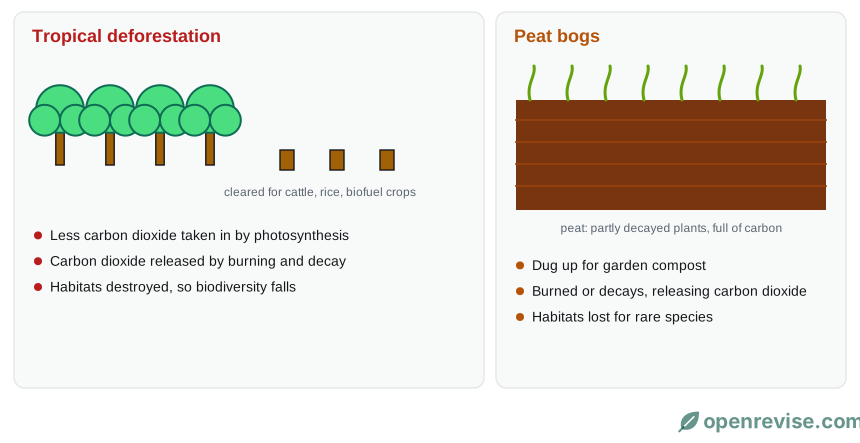
Large-scale deforestation in tropical areas has happened to:
- provide land for cattle and for rice fields
- grow crops for biofuels.
Its effects:
- Less carbon dioxide removed: fewer trees carry out photosynthesis.
- More carbon dioxide released: the trees are often burned, and the wood that is left decays as microorganisms respire.
- Loss of biodiversity: many species lose their habitat, and some become extinct.
Test yourself on this lesson
5 exam questions · 11 marks · with mark schemes and model answers
Found a mistake?