7.9 Decomposition
How temperature, water and oxygen affect the rate of decay by microorganisms, how gardeners make compost, how biogas is made by anaerobic decay (AQA), how food is preserved by slowing decay (Edexcel), and how to calculate the rate of decay.
What decomposition is
Key terms
- Decomposition (decay): the breakdown of dead organisms and waste by microorganisms.
- Compost: decayed plant material used as a natural fertiliser.
- Biogas: a gas, mainly methane, made by anaerobic decay, used as a fuel.
Decomposers (bacteria and fungi) secrete enzymes that break down dead material. They absorb the small molecules and use them in respiration, releasing carbon dioxide and returning mineral ions to the soil.
Factors that affect the rate of decay
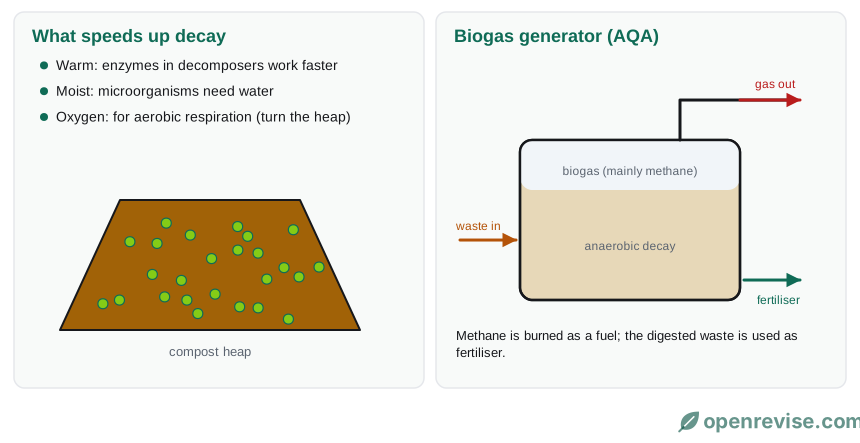
- Temperature: warmth speeds up decay, because the decomposers' enzymes work faster. Too hot and the enzymes are denatured; cold slows decay down.
- Water: microorganisms need moisture to grow and reproduce. Dry conditions slow decay.
- Availability of oxygen: most decomposers respire aerobically, so they need oxygen. Without it, decay is slow (anaerobic decay).
Gardeners make compost by giving decomposers the best conditions: a heap that is warm, kept damp and turned often to let in air. The compost is used as a natural fertiliser.
Biogas (AQA)
Anaerobic decay produces methane gas. Biogas generators use this: animal waste and plant material are put into a sealed tank, bacteria break it down without oxygen, and the methane is collected and burned as a fuel. The remaining material is used as fertiliser.
Preserving food (Edexcel)
Food is preserved by slowing the growth of decomposers: refrigeration and freezing (cold), drying (removes water), canning and vacuum packing (no oxygen, and heat kills microbes), and adding salt, sugar or vinegar (draws water out of microbes or makes it too acidic).
Calculating the rate of decay
Example: 80 g of grass cuttings decay to 50 g in 15 days. Rate = 30 ÷ 15 = 2 g per day.
Test yourself on this lesson
6 exam questions · 13 marks · with mark schemes and model answers
Found a mistake?