7.10 Required practical: temperature and the rate of decay
AQA required practical 10: investigating how temperature affects the rate of decay of fresh milk by measuring the time taken for lipase to lower the pH, shown by phenolphthalein turning colourless, and calculating rate.
The aim
To find out how temperature affects the rate of decay of fresh milk. This is AQA required practical 10 (Biology only).
Key terms
- Lipase: an enzyme that breaks down lipids (fats) into fatty acids and glycerol.
- Phenolphthalein: an indicator that is pink in alkaline solutions and colourless below about pH 8.3.
Why it works
Milk contains fat. When milk "goes off", microorganisms break the fat down with lipase, making fatty acids. The fatty acids lower the pH. In this practical we add lipase directly and use an indicator to see when the pH has fallen.
Method
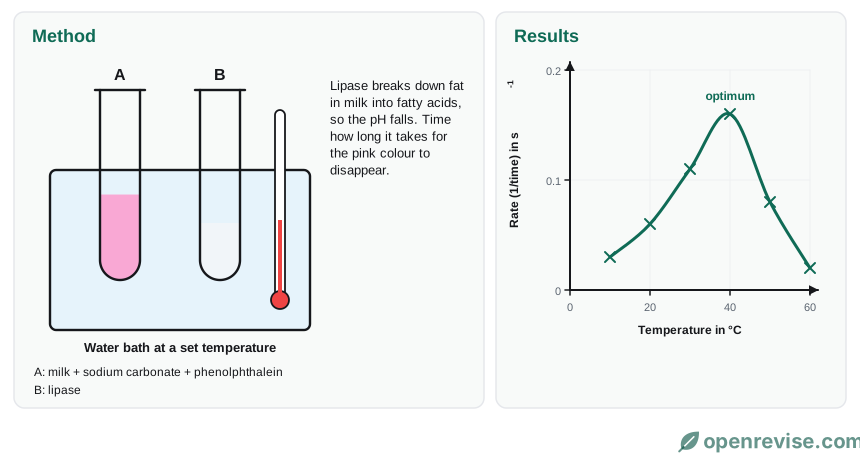
- Put 5 cm3 of milk, 7 cm3 of sodium carbonate solution (to make it alkaline) and 5 drops of phenolphthalein in a test tube. The mixture is pink.
- Put 1 cm3 of lipase solution in a second tube.
- Stand both tubes in a water bath at the chosen temperature until they reach it.
- Add the lipase to the milk, start a stopwatch and stir.
- Stop the clock when the pink colour disappears, because the fatty acids have lowered the pH.
- Repeat at different temperatures, such as 10, 20, 30, 40 and 50 °C, and repeat each temperature.
Results
The rate increases with temperature up to an optimum (about 40 °C), then falls because the lipase is denatured.
Variables and improvements
- Independent variable: temperature. Dependent variable: time for the colour to change.
- Control variables: volumes and concentrations of milk, sodium carbonate, lipase and indicator.
- Judging the colour change is subjective: compare against a tube of the same colour, or use a pH meter or data logger to measure pH directly.
Test yourself on this lesson
5 exam questions · 9 marks · with mark schemes and model answers
Found a mistake?