7.7 The water cycle
How water is cycled by evaporation, transpiration, condensation and precipitation, why the water cycle provides fresh water for plants and animals on land, and (Edexcel) how potable water is obtained, including by desalination.
The water cycle
Key terms
- Evaporation: liquid water turning into water vapour, using energy from the Sun.
- Transpiration: loss of water vapour from plant leaves.
- Condensation: water vapour cooling and turning into liquid droplets, forming clouds.
- Precipitation: water falling from clouds as rain, snow, sleet or hail.
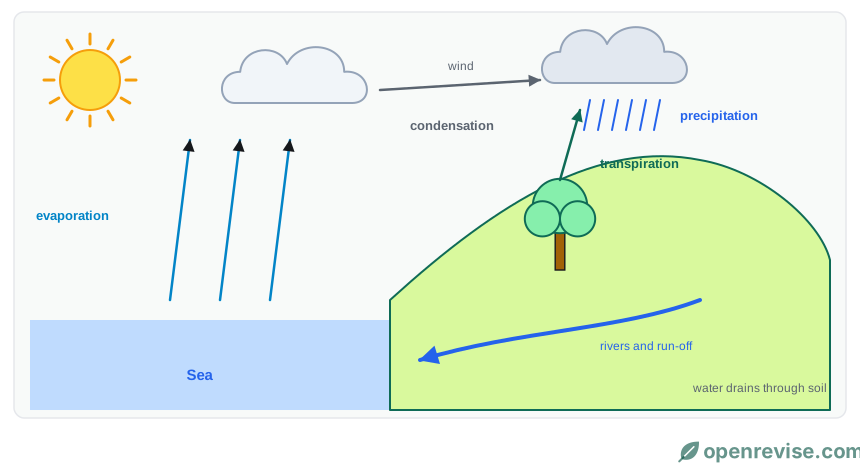
- Energy from the Sun makes water evaporate from the sea, lakes and rivers. Plants lose water vapour by transpiration, and animals lose water in sweat, breath and urine.
- The water vapour rises, cools and condenses to form clouds.
- Water falls as precipitation (rain, snow, hail).
- It flows over the land in rivers and through the soil, back to the sea. Plants take it up through their roots.
The water cycle provides fresh water for plants and animals on land before it drains into the sea. Evaporation leaves the salt behind, so precipitation is fresh water.
Making water safe to drink (Edexcel)
Potable water is water that is safe to drink. In the UK, rain water collects in reservoirs and is made potable by:
- sedimentation: large particles settle out
- filtration: the water passes through beds of sand and gravel
- chlorination: chlorine kills microorganisms.
In dry countries with little fresh water, desalination removes the salt from sea water, by distillation or reverse osmosis. This needs a lot of energy, so it is expensive.
Test yourself on this lesson
5 exam questions · 10 marks · with mark schemes and model answers
Found a mistake?