6.22 Classification and the three domains
How living things are classified: Linnaeus's system of kingdom, phylum, class, order, family, genus and species, binomial names, evolutionary trees, and Carl Woese's three-domain system based on genetic analysis.
Linnaeus
Key terms
- Classification: sorting living things into groups based on their similarities.
- Binomial name: the two-part scientific name of a species (genus then species), such as Panthera leo.
- Evolutionary tree: a diagram showing how scientists think organisms are related, from current classification data and fossils.
- Domain: the largest group in the three-domain system.
Carl Linnaeus classified living things into kingdom, phylum, class, order, family, genus and species, based on their structure and characteristics. Organisms are named by the binomial system of genus and species: for example, Homo sapiens for humans.
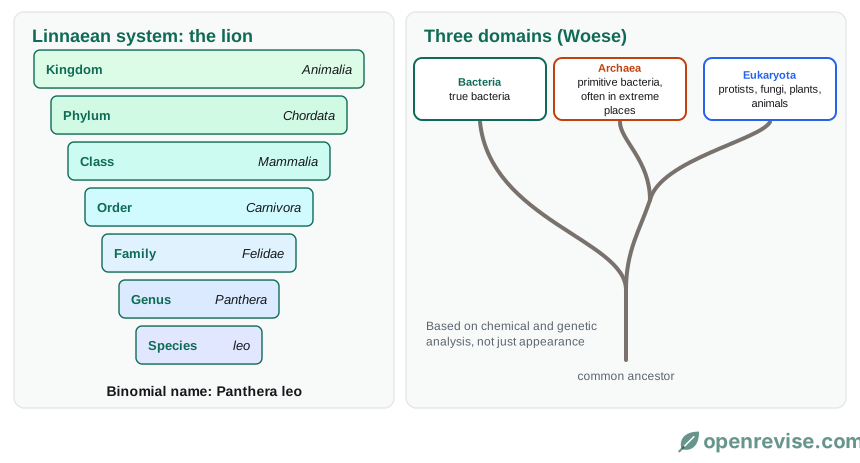
A memory aid for the order: King Philip Came Over For Great Soup.
Why classification has changed
As evidence of internal structures became more developed (thanks to better microscopes) and our understanding of biochemical processes progressed, new models of classification were proposed. Comparing DNA shows how closely related organisms really are, which is sometimes different from how they look.
The three-domain system
Following chemical analysis, Carl Woese proposed the three-domain system, which divides organisms into:
- Archaea: primitive bacteria, usually living in extreme environments such as hot springs and salt lakes
- Bacteria: true bacteria
- Eukaryota: protists, fungi, plants and animals.
Evolutionary trees
Evolutionary trees show how closely related organisms are. Species that share a more recent common ancestor are more closely related. For living organisms the tree is based on classification data such as DNA; for extinct organisms it is based on fossils.
Test yourself on this lesson
6 exam questions · 10 marks · with mark schemes and model answers
Found a mistake?