5.2 The nervous system and neurones
How the nervous system carries electrical impulses from receptors to the CNS and on to effectors, and how sensory, relay and motor neurones are adapted to do it.
AQA
Edexcel
OCR
3 min read
What the nervous system does
Key terms
- Central nervous system (CNS): the brain and spinal cord. It coordinates the body's responses.
- Neurone: a nerve cell. Neurones carry information as electrical impulses.
- Nerve: a bundle of many neurones wrapped together.
- Sensory neurone: carries impulses from receptors to the CNS.
- Relay neurone: carries impulses from sensory neurones to motor neurones, inside the CNS.
- Motor neurone: carries impulses from the CNS to effectors.
- Myelin sheath: a fatty layer around many axons that insulates them and speeds up impulses.
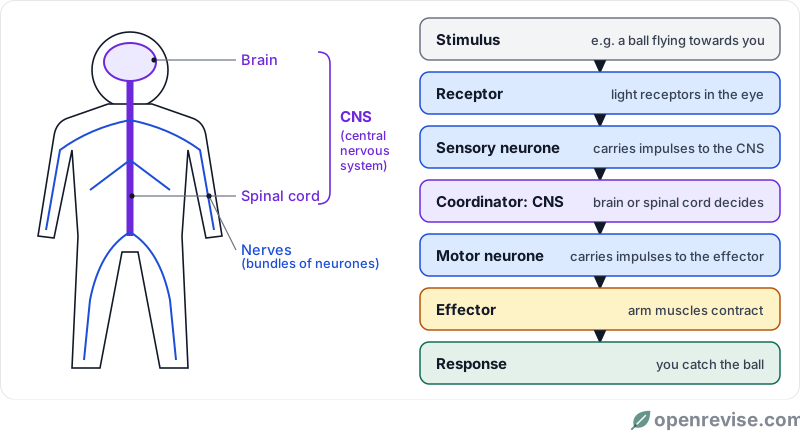
The nervous system lets you react to your surroundings and coordinate your behaviour. Information always follows the same route:
stimulus → receptor → coordinator → effector → response
- Receptors detect a stimulus. Receptors are often grouped in sense organs.
- Information passes along sensory neurones as electrical impulses to the CNS.
- The CNS (the brain or spinal cord) is the coordinator: it processes the information and coordinates a response.
- Impulses travel along motor neurones to the effectors.
- The effectors respond: muscles contract or glands secrete (release) substances, such as hormones or saliva.
| Sense organ | Receptors detect |
|---|---|
| Eyes | Light |
| Ears | Sound, and changes in position (balance) |
| Nose | Chemicals in the air (smells) |
| Tongue | Chemicals in food and drink (tastes) |
| Skin | Touch, pressure, pain and temperature |
Neurones
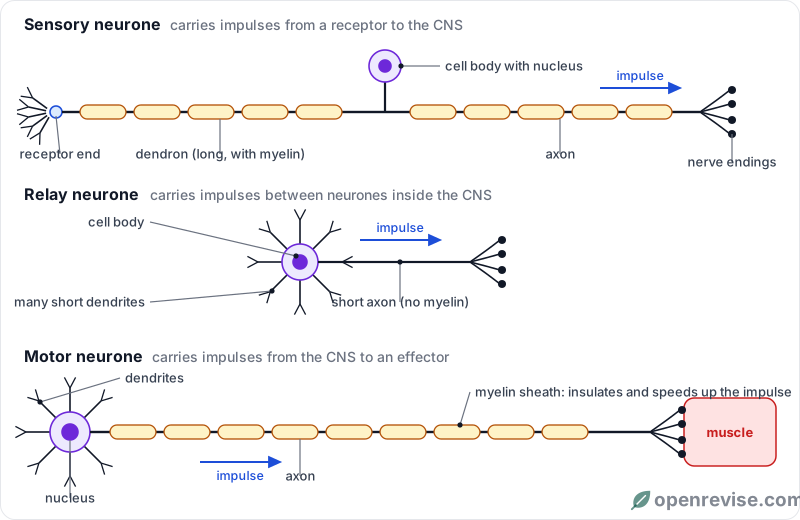
Neurones are cells adapted to carry electrical impulses quickly over long distances. They have the same basic parts as other animal cells (a nucleus, cytoplasm and a cell membrane), plus some special features:
- Dendrites: short branches that receive impulses from other neurones. Having many lets one neurone connect with lots of others.
- Cell body: contains the nucleus and most of the cytoplasm.
- Axon: a long, thin fibre that carries impulses away from the cell body. One axon can be over a metre long, so a single cell can reach from your spine to your toe.
- Dendron: in a sensory neurone, the long fibre that carries impulses from the receptor towards the cell body.
- Myelin sheath: a fatty layer that insulates the axon (and dendron). Impulses jump between the gaps in the sheath, so they travel much faster.
- Nerve endings (axon terminals): branched ends that pass the impulse on to other neurones or to an effector, across a synapse.
| Feature | Sensory neurone | Relay neurone | Motor neurone |
|---|---|---|---|
| Carries impulses from | A receptor | A sensory neurone | The CNS |
| Carries impulses to | The CNS | A motor neurone | An effector |
| Where it is | From receptors into the CNS | Inside the CNS | From the CNS out to muscles and glands |
| Shape | Long dendron and axon, cell body part-way along | Short, with many dendrites | Cell body in the CNS, long axon |
| Myelin sheath | Yes | Usually no | Yes |
How the nervous system produces a coordinated response
The nervous system can coordinate the whole body because:
- it reaches all parts of the body, through nerves branching from the brain and spinal cord;
- it has many different receptors, each sensitive to a particular stimulus;
- its neurones have many links (synapses) with each other, so information from several receptors can be combined and sent to several effectors;
- the CNS processes all this information and sends impulses to exactly the effectors that are needed, so they work together.
Test yourself on this lesson
7 exam questions · 17 marks · with mark schemes and model answers
Found a mistake?