5.24 Auxin and tropisms
How unequal amounts of auxin make shoots grow towards light and roots grow towards gravity, and what gibberellins and ethene do in plants.
Plant hormones
Key terms
- Tropism: a growth response of a plant towards or away from a stimulus.
- Phototropism: a growth response to light. Shoots grow towards light (positive phototropism).
- Gravitropism (geotropism): a growth response to gravity. Roots grow towards gravity (positive); shoots grow away from it (negative).
- Auxin: a plant hormone made in the tips of shoots and roots that controls the rate of cell elongation.
Plants do not have a nervous system, but they still respond to their environment. They produce hormones that coordinate and control their growth and their responses to light (phototropism) and gravity (gravitropism, also called geotropism). These responses help the plant survive: shoots grow towards light for photosynthesis, and roots grow down into the soil to anchor the plant and absorb water and mineral ions.
The main hormone is auxin. It is made in the tips of shoots and roots and spreads backwards from the tip. Unequal distributions of auxin cause unequal growth rates in plant roots and shoots, which makes them bend.
Auxin works differently in shoots and roots
- In shoots, auxin stimulates cell elongation (growth).
- In roots, auxin inhibits cell elongation.
Phototropism: shoots grow towards light
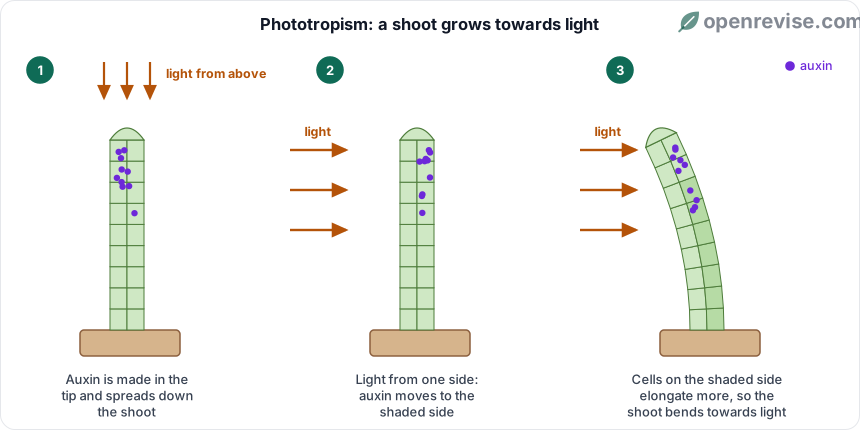
- Auxin is made in the shoot tip and moves down the shoot.
- When light comes from one side, auxin moves to the shaded side of the shoot.
- More auxin on the shaded side makes those cells elongate faster.
- The shaded side grows longer than the lit side, so the shoot bends towards the light.
Gravitropism: roots grow down, shoots grow up
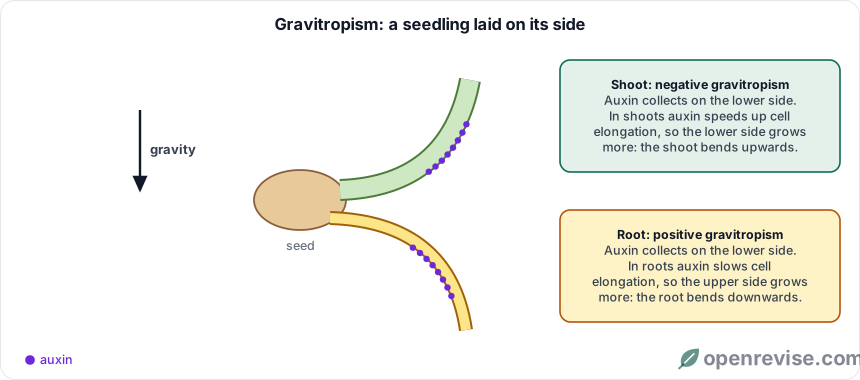
When a seedling is lying on its side, gravity makes auxin collect on the lower side of both the shoot and the root.
- Shoot: extra auxin on the lower side speeds up elongation there, so the lower side grows faster and the shoot bends upwards (away from gravity: negative gravitropism).
- Root: extra auxin on the lower side slows down elongation there, so the upper side grows faster and the root bends downwards (towards gravity: positive gravitropism).
| Response | Shoot | Root |
|---|---|---|
| To light (phototropism) | Grows towards it (positive) | Grows away from it (negative) |
| To gravity (gravitropism) | Grows away from it (negative) | Grows towards it (positive) |
| Effect of auxin on cell elongation | Speeds it up | Slows it down |
| Side with more auxin | Grows faster | Grows slower |
Other plant hormones
- Gibberellins are important in initiating seed germination. They also make stems grow longer, help flowers form and affect fruit growth.
- Ethene is a gas that controls cell division and the ripening of fruit. It also causes flowers to open and leaves to fall (shedding of leaves) in autumn.
You do not need to know how gibberellins and ethene work, only what they do.
Test yourself on this lesson
6 exam questions · 15 marks · with mark schemes and model answers
Found a mistake?