5.25 Investigating plant growth responses
How to investigate the effect of light or gravity on newly germinated seedlings: methods, variables, measurements, biological drawings and evaluation.
The investigation
Key terms
- Control experiment: a set-up that is the same in every way except for the factor being tested, used for comparison.
- Biological drawing: a clear, labelled line drawing of a specimen, made in pencil, showing what you observed.
- Mean: the total of a set of values divided by the number of values.
This practical shows how plant shoots respond to light and roots to gravity. It is AQA's required practical 8: "investigate the effect of light or gravity on the growth of newly germinated seedlings". Edexcel and OCR suggest the same investigation of tropisms (OCR PAG B6), so any board can ask about it.
Results are recorded in two ways: as length measurements and as careful, labelled biological drawings.
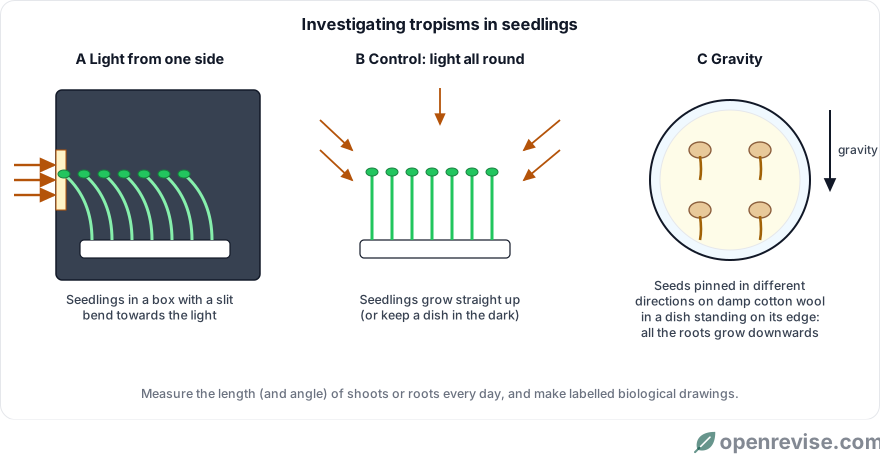
Method 1: the effect of light on shoots
- Put damp cotton wool in three Petri dishes and spread the same number of cress (or mustard) seeds on each, say 10.
- Leave them in the same warm place, with light all round, until the seeds germinate and the shoots are a few mm tall.
- Measure the height of each seedling with a ruler. Record the results.
- Put one dish in a box with a slit in one side, so light only comes from one direction. Put one dish in a box in complete darkness. Leave one dish in light from all round (or from above) as a control.
- Leave them for several days. Each day, add the same volume of water to each dish, and measure the height of each seedling.
- At the end, make a labelled biological drawing of a typical seedling from each dish.
Method 2: the effect of gravity on roots
- Soak bean or pea seeds in water overnight, then let them germinate until the roots are a few mm long.
- Pin the seeds onto damp cotton wool in a Petri dish, with the roots pointing in different directions (up, down and sideways).
- Stand the dish on its edge, in the dark (so light cannot affect the result).
- After a few days, observe and draw the roots. Measure how far each root has grown, and its direction.
You can also use a clinostat: a slowly turning disc that rotates the seedlings, so gravity acts on all sides equally. Roots on a clinostat grow straight out, which shows that it is gravity that makes them bend down.
Variables
- Independent variable: the direction of light (or the direction of gravity, by changing the position of the seeds).
- Dependent variable: the direction of growth and the length of the shoots or roots.
- Control variables: the type of seed, the number of seeds, the volume of water, temperature, the time left to grow, and the same light source and distance.
Results
| Dish | Day 0 | Day 5 | Direction of growth |
|---|---|---|---|
| Light from one side | 5 | 31 | Bent towards the slit |
| Light from above (control) | 5 | 28 | Straight up |
| Darkness | 5 | 52 | Straight up, tall and thin, yellow leaves |
- Seedlings lit from one side bend towards the light (positive phototropism).
- Seedlings in the dark grow taller but thin and yellow: they are elongating fast to try to reach light, and cannot make chlorophyll without light.
- Roots grow downwards whichever way they started (positive gravitropism).
To measure a curved shoot or root accurately, lay a piece of thread along it, mark the length, then measure the thread with a ruler.
Making a good biological drawing
- Use a sharp pencil, with clear, smooth, continuous lines and no shading.
- Draw only what you can see, large enough to show the detail.
- Use a ruler for label lines; they must touch the part being labelled and must not cross.
- Add a title, and a scale or magnification.
Evaluating
- Use many seedlings in each dish and calculate a mean, so one unusual seedling does not distort the results.
- Make sure the only light comes through the slit: check the box for gaps.
- Seeds may be treated with fungicide: wash your hands after handling them.
Test yourself on this lesson
6 exam questions · 15 marks · with mark schemes and model answers
Found a mistake?