5.23 Treating infertility
How hormones are used to treat infertility: fertility drugs containing FSH and LH, clomifene, and the steps of IVF, with the benefits, risks and ethical issues.
Infertility
Key terms
- Infertility: being unable to become pregnant after trying for a year or more.
- Fertility drug: a drug containing hormones (FSH and LH) that stimulates eggs to mature and be released.
- IVF (in vitro fertilisation): eggs are fertilised by sperm outside the body, in a laboratory, and the embryos are put into the woman's uterus.
- Assisted reproductive technology (ART): any treatment that helps people to have a baby, such as fertility drugs and IVF.
Some women cannot become pregnant because they do not produce enough FSH or LH, so their eggs do not mature or are not released. Other causes include blocked oviducts, or a low sperm count or poorly moving sperm in the man. Hormones are used in modern reproductive technologies to treat infertility.
Fertility drugs
A woman can be given a fertility drug containing FSH and LH. These hormones stimulate eggs to mature in her ovaries and then be released. She may then become pregnant in the normal way.
Clomifene is a drug taken as a tablet by women who do not ovulate regularly. Normally, oestrogen inhibits the release of FSH and LH from the pituitary gland. Clomifene blocks this effect, so the pituitary releases more FSH and LH, which stimulates eggs to mature and be released (ovulation). The couple can then try to conceive naturally.
IVF
If fertility drugs alone do not work (for example, if the oviducts are blocked), the couple may try in vitro fertilisation. "In vitro" means "in glass": fertilisation happens in a laboratory dish.
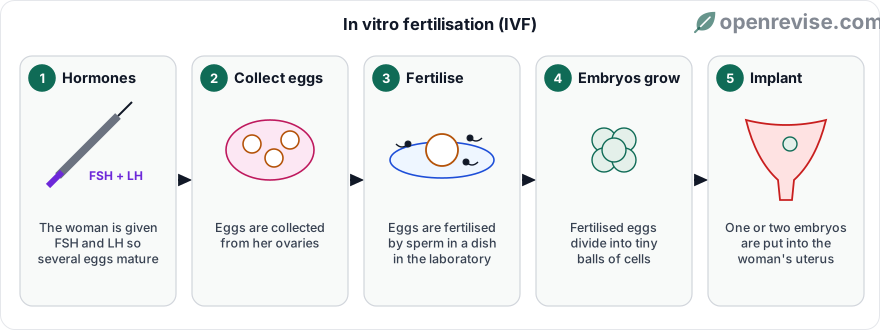
- The mother is given FSH and LH to stimulate the maturation of several eggs.
- The eggs are collected from the mother's ovaries, using a fine needle.
- The eggs are fertilised by sperm from the father in the laboratory. If the sperm cannot swim well, a single sperm can be injected into each egg (ICSI).
- The fertilised eggs develop into embryos.
- At the stage when they are tiny balls of cells, one or two embryos are inserted into the mother's uterus (womb). If one implants, she is pregnant.
Developments in microscopy have made IVF possible, because scientists can see and handle eggs, sperm and early embryos in detail.
Evaluating fertility treatment
Fertility treatment gives a woman the chance to have a baby of her own. However:
- it is very emotionally and physically stressful: the woman has hormone injections, egg collection and an anxious wait, often over several cycles;
- the success rates are not high: in the UK roughly one embryo transfer in three leads to a birth for women under 35, and far fewer for older women;
- it can lead to multiple births (twins or triplets) if more than one embryo implants, which is a risk to both the babies and the mother: babies are more likely to be born early with a low birth weight;
- it is expensive, and the NHS only funds a limited number of cycles;
- fertility drugs can over-stimulate the ovaries, which can be dangerous.
| Type of issue | Examples |
|---|---|
| Social | Who should pay? Should there be age limits? Is it fair that the NHS funds different numbers of cycles in different areas? |
| Ethical | Spare embryos are usually frozen or destroyed, and some people believe an embryo has a right to life. Embryos can be screened for genetic disorders, which some people fear could lead to "designer babies". |
| Medical | Risks of multiple pregnancy; ovarian hyperstimulation from fertility drugs; stress |
From the patient's point of view, IVF is a chance to have a child but is costly, stressful and may fail. From the doctor's point of view, the aims are a healthy pregnancy and mother, so doctors now usually transfer only one embryo to reduce multiple births.
Test yourself on this lesson
6 exam questions · 18 marks · with mark schemes and model answers
Found a mistake?