5.26 Uses of plant hormones
How people use auxins (weedkillers, rooting powders, tissue culture), gibberellins (dormancy, flowering, bigger and seedless fruit) and ethene (ripening) in farming and food.
Hormones in farming and gardening
Key terms
- Selective weedkiller: a weedkiller containing auxin that kills broad-leaved weeds but not narrow-leaved crops such as wheat or grass.
- Rooting powder: a powder containing auxin that makes cuttings grow roots quickly.
- Seed dormancy: a resting state in which a seed will not germinate, even in good conditions.
- Parthenocarpic fruit: fruit that grows without fertilisation, so it has no seeds.
Plant growth hormones are used in agriculture (farming) and horticulture (growing fruit, vegetables and flowers) to control how plants grow.
Auxins
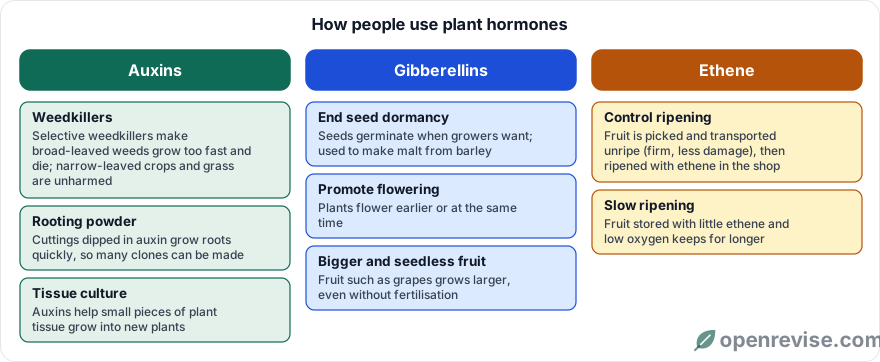
- Weedkillers. Selective weedkillers contain high concentrations of auxin. Broad-leaved weeds such as dandelions absorb more of it than narrow-leaved crops and grasses. The auxin makes the weeds grow so fast and so abnormally that they die, while the crop or lawn is unharmed. This reduces competition, so crop yields increase.
- Rooting powders. A cutting (a piece of stem with leaves) is dipped in rooting powder containing auxin before planting. It quickly grows roots, so growers can produce many clones of a plant with good features cheaply.
- Tissue culture. Auxins (with other hormones) are added to the growth medium to make small pieces of plant tissue grow roots and shoots, producing large numbers of identical plants.
Gibberellins
- Ending seed dormancy. Gibberellins make seeds germinate even when they otherwise would not, so growers can make all their seeds germinate at the same time. Brewers use gibberellins to make barley germinate for malting.
- Promoting flowering. Gibberellins make plants flower earlier, or at the same time, even without the usual conditions (such as cold or long days).
- Increasing fruit size. Gibberellins make fruit such as grapes grow larger. They can also produce seedless fruit, because the fruit develops without the flowers being fertilised.
Ethene
- Controlling ripening. Ethene is a gas that makes fruit ripen. Fruit such as bananas can be picked while unripe and firm, so it is less easily damaged during storage and transport. Ethene is then added just before it goes on sale, so it arrives ripe.
- Slowing ripening. Keeping fruit cool, with low oxygen and with ethene removed, slows ripening so fruit can be stored for longer. This is why one ripe banana can make the fruit in a bowl ripen faster: it gives off ethene.
| Hormone | Use | Benefit |
|---|---|---|
| Auxin | Selective weedkiller | Kills weeds so crops have less competition; higher yield |
| Auxin | Rooting powder | Quick, cheap clones of plants with useful features |
| Auxin | Tissue culture | Large numbers of identical plants |
| Gibberellins | End seed dormancy | All seeds germinate together; malting barley |
| Gibberellins | Promote flowering | Flowers ready for sale at the right time |
| Gibberellins | Increase fruit size, seedless fruit | Bigger, easier-to-eat fruit |
| Ethene | Control ripening | Less damage in transport; fruit ripe when sold |
Weedkillers and biodiversity
Using auxin weedkillers increases crop yields, but it also has costs. Removing weeds removes food and habitats for insects, birds and other animals, and wild flowers that pollinators such as bees depend on. This can reduce biodiversity on farms. Weedkillers may also drift onto hedgerows or wash into rivers. Farmers have to balance a bigger harvest against the effects on wildlife, for example by leaving field margins unsprayed.
Test yourself on this lesson
6 exam questions · 15 marks · with mark schemes and model answers
Found a mistake?