6.1 Sexual and asexual reproduction
How sexual reproduction (gametes, fertilisation, variation) differs from asexual reproduction (one parent, mitosis, clones), the advantages and disadvantages of each, and organisms that can reproduce both ways.
AQA
Edexcel
OCR
1 min read
Two ways to reproduce
Key terms
- Gamete: a sex cell (sperm and egg in animals; pollen and egg cells in flowering plants).
- Fertilisation: the fusion of a male and a female gamete.
- Clone: an organism genetically identical to its parent.
- Variation: differences between individuals of the same species.
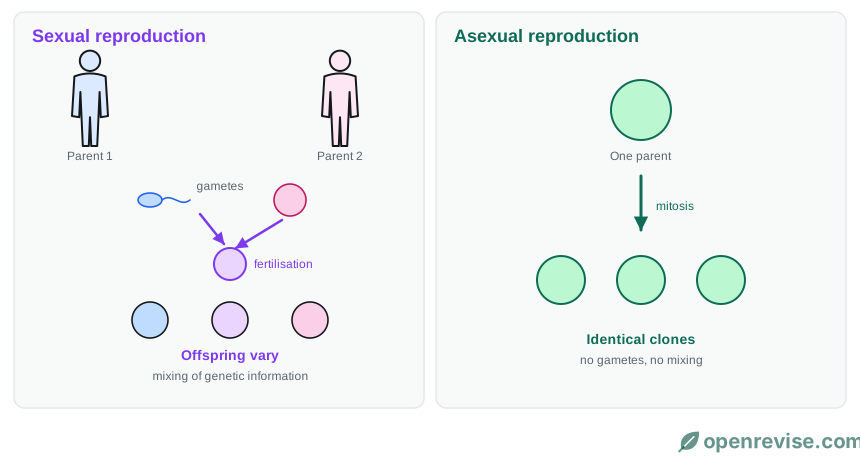
Sexual reproduction
- Involves the fusion of male and female gametes.
- The gametes are made by meiosis.
- There is mixing of genetic information, so the offspring show variation.
Asexual reproduction
- Involves one parent and no fusion of gametes.
- There is no mixing of genetic information.
- Cells divide by mitosis, so the offspring are genetically identical clones.
- Examples: bacteria dividing by binary fission, strawberry plants sending out runners, daffodils growing from bulbs, potatoes growing from tubers.
Advantages and disadvantages
| Type | Advantages | Disadvantages |
|---|---|---|
| Sexual | Variation, so some individuals may survive a change in the environment or a new disease; natural selection can act; selective breeding is possible | Needs a mate, takes more time and energy, fewer offspring |
| Asexual | Only one parent needed; faster and uses less energy; many offspring quickly when conditions are good | No variation, so a change in the environment or a new disease could wipe out the whole population |
Organisms that do both (AQA)
- The malaria parasite reproduces asexually in the human host and sexually in the mosquito.
- Many fungi reproduce asexually by spores, but also sexually to give variation.
- Many plants make seeds sexually, and also reproduce asexually by runners or bulbs.
Test yourself on this lesson
6 exam questions · 11 marks · with mark schemes and model answers
Found a mistake?