5.14 Controlling body temperature
How the thermoregulatory centre in the brain and the skin keep body temperature near 37 °C, using sweating, vasodilation, vasoconstriction and shivering.
Why temperature is controlled
Key terms
- Thermoregulatory centre: the part of the brain (in the hypothalamus) that monitors and controls body temperature.
- Vasodilation: the widening of blood vessels (arterioles) that supply the skin capillaries, so more blood flows near the skin surface.
- Vasoconstriction: the narrowing of blood vessels (arterioles) that supply the skin capillaries, so less blood flows near the skin surface.
- Shivering: rapid, automatic contraction and relaxation of skeletal muscles, which releases energy from respiration.
Human enzymes work best at about 37 °C. If the body gets too hot, enzymes start to denature; if it gets too cold, reactions slow down. Either way, cells stop working properly. Body temperature is therefore controlled by a negative feedback system.
Detecting temperature changes
- The thermoregulatory centre in the brain (in the hypothalamus) contains receptors sensitive to the temperature of the blood flowing through it.
- The skin contains temperature receptors that detect the external temperature. They send nervous impulses to the thermoregulatory centre.
The thermoregulatory centre processes this information and sends impulses to the effectors: sweat glands, the muscles in the walls of arterioles that supply the skin, and skeletal muscles.
The skin
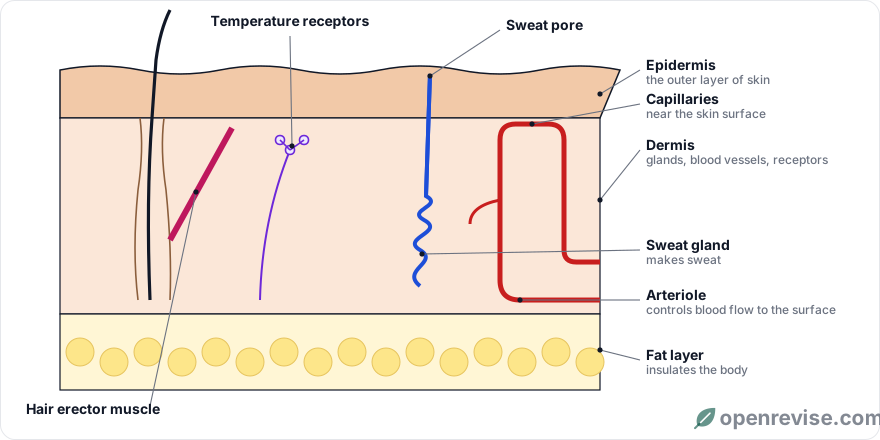
- The epidermis is the outer layer of the skin. Sweat reaches the surface through pores in it.
- The dermis, underneath, contains the sweat glands, blood vessels (arterioles and capillaries), temperature receptors and the hair erector muscles.
- The fat layer under the dermis insulates the body.
When the body is too hot
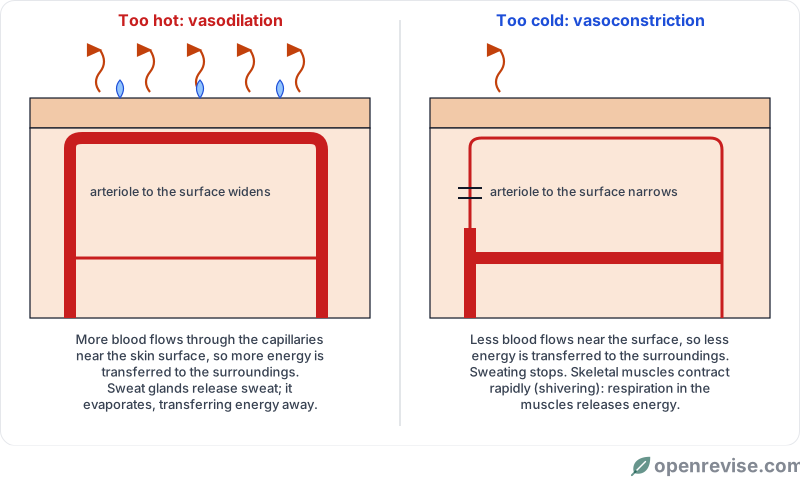
- Sweat glands produce more sweat. The water in sweat evaporates from the skin, and evaporation transfers energy from the skin to the environment, cooling it.
- Vasodilation: the arterioles that supply the skin capillaries widen, so more blood flows through the capillaries near the skin surface. More energy is transferred from the blood to the surroundings by radiation, so the skin looks red.
When the body is too cold
- Vasoconstriction: the arterioles that supply the skin capillaries narrow, so less blood flows near the skin surface. Less energy is transferred to the surroundings, and the warm blood stays deeper in the body.
- Sweating stops, so no energy is lost by evaporation of sweat.
- Shivering: skeletal muscles contract and relax rapidly. This needs more respiration, which releases energy that warms the body.
- (Hairs may also stand up, trapping a layer of air, but this does little in humans.)
| Response | Too hot | Too cold |
|---|---|---|
| Sweat glands | Produce more sweat, which evaporates | Stop producing sweat |
| Arterioles to skin capillaries | Dilate (widen): vasodilation | Constrict (narrow): vasoconstriction |
| Blood flow near the skin surface | Increases | Decreases |
| Skeletal muscles | Relaxed | Shiver (contract rapidly) |
| Energy transfer to the surroundings | Increases | Decreases |
These responses are an example of negative feedback: a rise in temperature triggers responses that lower it, and a fall triggers responses that raise it.
Test yourself on this lesson
7 exam questions · 17 marks · with mark schemes and model answers
Found a mistake?