5.15 Water, urea and osmosis in the body
How water, ions and urea leave the body, why cells are damaged if body fluids become too dilute or too concentrated, and how the liver turns excess amino acids into urea.
Why water balance matters
Key terms
- Osmosis: the diffusion of water from a dilute solution to a more concentrated solution through a partially permeable membrane.
- Osmoregulation: controlling the water and ion content of the body.
- Urea: a waste substance made in the liver from excess amino acids, and removed in urine.
- Deamination: removing the amino (nitrogen-containing) group from excess amino acids, in the liver. It produces ammonia.
The cells of your body are surrounded by tissue fluid, and red blood cells float in plasma. If the concentration of these fluids changes, water moves into or out of the cells by osmosis. If body cells lose or gain too much water, they do not function efficiently.
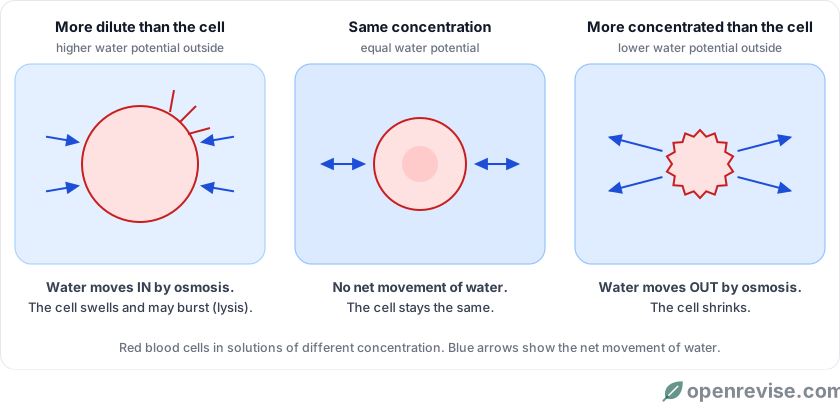
- If the fluid around cells becomes more dilute than the cytoplasm (it has a higher water potential), water moves into the cells by osmosis. Animal cells swell and may burst (lysis), because they have no cell wall.
- If it is the same concentration, there is no net movement of water.
- If the fluid becomes more concentrated than the cytoplasm (a lower water potential), water moves out of the cells. The cells shrink and cannot work properly.
So the body must keep the water and ion content of its fluids within narrow limits. This is osmoregulation.
How water, ions and urea leave the body
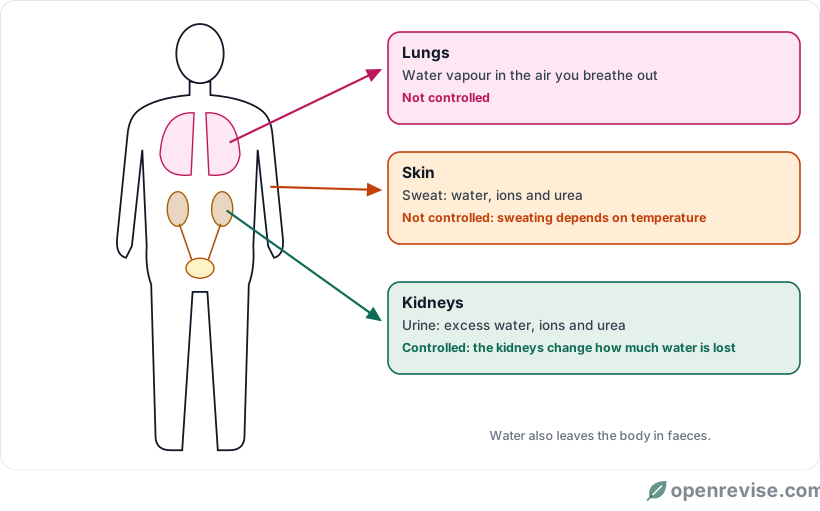
| Route | What is lost | Is it controlled for water balance? |
|---|---|---|
| Lungs, when you breathe out | Water (as water vapour) | No |
| Skin, in sweat | Water, ions and urea | No (sweating is controlled by temperature) |
| Kidneys, in urine | Excess water, ions and urea | Yes |
There is no control over water, ion or urea loss by the lungs or the skin. The kidneys are the organs that adjust the balance: they remove the excess water, ions and urea from the blood, making urine. If you have lost a lot of water by sweating, the kidneys make less urine and keep more water in the blood.
Where urea comes from
Your body cannot store protein or amino acids. When you eat more protein than you need, the excess amino acids must be removed safely.
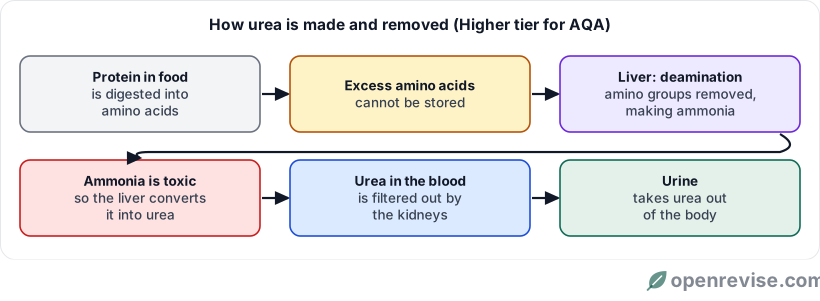
- Proteins in food are digested into amino acids, which are absorbed into the blood.
- Amino acids the body does not need go to the liver.
- In the liver they are deaminated: the nitrogen-containing amino group is removed, forming ammonia.
- Ammonia is toxic, so it is immediately converted into urea, which is much less harmful.
- Urea is carried in the blood plasma to the kidneys, which filter it out into the urine.
The rest of each amino acid can be used for respiration or turned into carbohydrate or fat.
Test yourself on this lesson
6 exam questions · 16 marks · with mark schemes and model answers
Found a mistake?