5.16 How the kidneys make urine
The urinary system, and how the kidneys make urine by filtering the blood and selectively reabsorbing glucose, some ions and water, with data on what is in plasma, filtrate and urine.
The urinary system
Key terms
- Kidney: an organ that filters the blood and controls the water and ion content of the body, producing urine.
- Filtration: small molecules are forced out of the blood into the kidney tubules.
- Selective reabsorption: useful substances (all the glucose, some ions and the water the body needs) are taken back from the tubules into the blood.
- Urine: the liquid made by the kidneys, containing urea, excess ions and excess water.
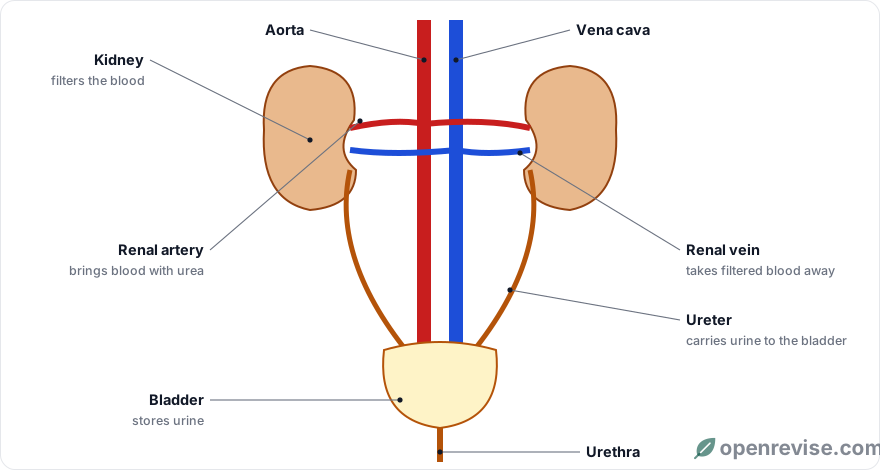
| Part | Job |
|---|---|
| Renal artery | Brings blood containing urea and other substances to the kidney |
| Kidney | Filters the blood and makes urine |
| Renal vein | Takes the filtered (cleaned) blood away from the kidney |
| Ureter | Carries urine from each kidney to the bladder |
| Bladder | Stores urine |
| Urethra | Carries urine out of the body |
How urine is made
Each kidney contains about a million tiny tubules. The kidneys produce urine in two main stages.
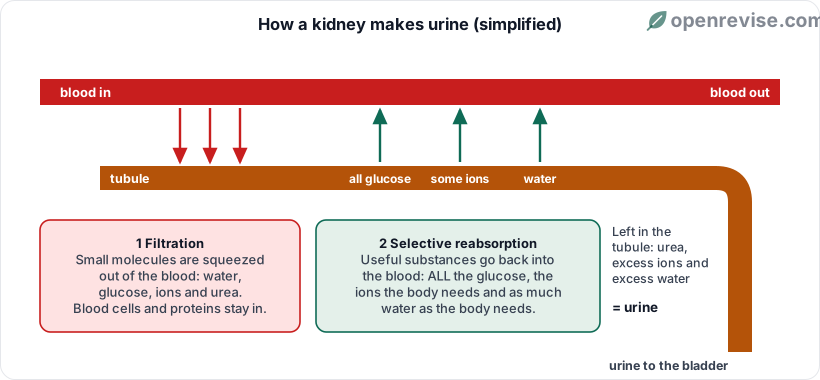
1. Filtration. Blood arrives at high pressure. Small molecules are squeezed out of the blood into the kidney tubules: water, glucose, ions and urea. Blood cells and large protein molecules are too big, so they stay in the blood.
2. Selective reabsorption. As the filtered liquid flows along the tubule, the useful substances are taken back into the blood:
- all of the glucose (by active transport);
- some ions, as many as the body needs;
- as much water as the body needs.
3. Urine. What is left in the tubule (urea, excess ions and excess water) is urine. It flows down the ureter to the bladder.
By changing how much water and how many ions are reabsorbed, the kidneys keep the water and ion content of the blood constant. Urea is not reabsorbed (or only a little), so it is removed.
Reading kidney data
Exam questions often give a table like this one, showing the concentration of substances in the blood plasma, in the liquid that has just been filtered (the filtrate) and in the urine.
| Substance | Blood plasma | Filtrate | Urine |
|---|---|---|---|
| Water | 920 | 980 | 960 |
| Protein | 80 | 0 | 0 |
| Glucose | 1.0 | 1.0 | 0 |
| Ions (e.g. sodium) | 3.3 | 3.3 | 6.0 |
| Urea | 0.3 | 0.3 | 20.0 |
What it shows:
- Protein is in the plasma but not the filtrate: protein molecules are too large to be filtered.
- Glucose is filtered (same concentration in filtrate as plasma) but there is none in the urine: all of it is reabsorbed.
- Urea is far more concentrated in urine than in the filtrate (about 67 times: 20.0 ÷ 0.3), because most of the water is reabsorbed while the urea is not.
- Ions are more concentrated in urine than in the filtrate: some, but not all, are reabsorbed.
Test yourself on this lesson
6 exam questions · 16 marks · with mark schemes and model answers
Found a mistake?