5.4 Investigating reaction time
How to plan and carry out a ruler-drop investigation into a factor that affects human reaction time, convert distances into times, and evaluate the results.
Reaction time
Key terms
- Reaction time: the time between a stimulus and the response to it.
- Independent variable: the variable you change.
- Dependent variable: the variable you measure.
- Control variables: variables kept the same so that the test is fair.
- Repeatable: you get similar results when you repeat the experiment yourself, with the same method and equipment.
A reaction to a ruler being dropped is not a reflex: you have to see the ruler move and decide to catch it, so the impulse goes through the conscious part of the brain. Your reaction time is how long that takes, usually about 0.15 to 0.30 seconds.
Planning the investigation
Pick one factor to change (the independent variable). Good choices:
- dominant hand compared with non-dominant hand;
- before and after a caffeine drink, such as cola or coffee (caffeine is a stimulant and shortens reaction time);
- with and without a distraction, such as music or someone talking;
- practice: the first five catches compared with the last five.
The dependent variable is the reaction time, found from the distance the ruler falls.
Control variables include: the same catcher for every test, the same ruler, the same starting position of the fingers (level with 0 cm, the same gap each time), the same height above the table, the catcher sitting the same way with their arm resting on the table edge, and the same person dropping the ruler.
Method: the ruler-drop test
- The catcher sits with their forearm resting on the edge of a table and their hand over the edge.
- A partner holds a 30 cm ruler vertically, with the 0 cm mark level with the top of the catcher's thumb.
- The partner drops the ruler without warning, at a random moment.
- The catcher catches the ruler as fast as they can, between thumb and finger.
- Record the distance, in cm, level with the top of the thumb.
- Repeat at least five times, then change the independent variable (for example, use the other hand) and repeat.
- Calculate the mean distance for each condition and convert it into a reaction time.
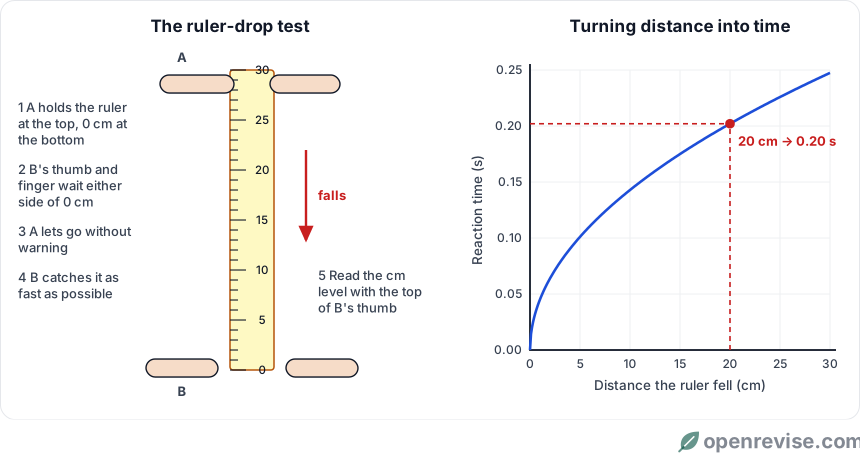
Turning distance into time
The shorter the distance, the faster the reaction. Because the ruler speeds up as it falls, distance is not proportional to time, so you use a conversion table or graph, or this equation (you do not need to remember it):
where t is the reaction time in s, d is the distance in m and g = 9.8 m/s².
| Distance (cm) | 5 | 10 | 15 | 20 | 25 | 30 |
|---|---|---|---|---|---|---|
| Reaction time (s) | 0.10 | 0.14 | 0.17 | 0.20 | 0.23 | 0.25 |
Worked example. The ruler falls 18 cm. Convert to metres: 0.18 m. Then t = \sqrt{2 \times 0.18 \div 9.8} = \sqrt{0.0367} = 0.19 s.
Results
| Catch | 1 | 2 | 3 | 4 | 5 | Mean |
|---|---|---|---|---|---|---|
| Dominant hand | 17 | 19 | 18 | 16 | 20 | 18 |
| Non-dominant hand | 24 | 26 | 31 | 25 | 27 | 26.6 (or 25.5 without the anomaly) |
The 31 cm catch is much further from the others, so it is probably an anomaly (perhaps the catcher was not paying attention). Leave anomalies out when you calculate the mean, and say that you have done so.
Plot the means as a bar chart, because the independent variable (which hand) is categoric. You can add range bars to show how spread out the repeats were.
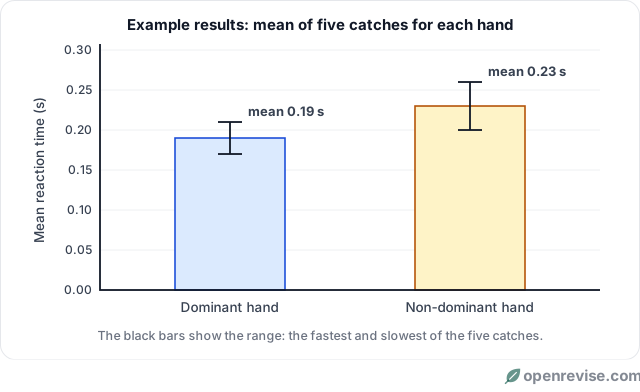
Conclusion: the mean reaction time with the dominant hand (about 0.19 s) was shorter than with the non-dominant hand (about 0.23 s). The ranges do not overlap, so the difference is probably real.
Evaluating the method
- Practice effect: the catcher gets better with practice, so later catches may be faster. Do a few practice catches first, or alternate between conditions.
- Warning cues: the catcher may watch the dropper's hand or guess the timing. Drop at random intervals.
- Reading the distance: the ruler is only marked in cm and mm, and the thumb is wide, so readings are not very precise. Always read from the same part of the thumb.
- Better technology: an online or app reaction test measures time directly in milliseconds, which is more precise and removes the conversion step.
- Caffeine: use a safe amount of caffeine, only with volunteers' consent, and never for anyone who should avoid it. Leave the same time after drinking it each time.
Test yourself on this lesson
7 exam questions · 15 marks · with mark schemes and model answers
Found a mistake?