5.3 Synapses and reflex arcs
How impulses cross synapses using neurotransmitters, and how a reflex arc produces a fast, automatic response that protects the body.
Synapses
Key terms
- Synapse: the junction between two neurones, where there is a tiny gap.
- Neurotransmitter: a chemical released by one neurone that diffuses across a synapse and starts an impulse in the next neurone.
- Reflex action: an automatic and rapid response to a stimulus that does not involve the conscious part of the brain.
- Reflex arc: the pathway of neurones that an impulse follows in a reflex action.
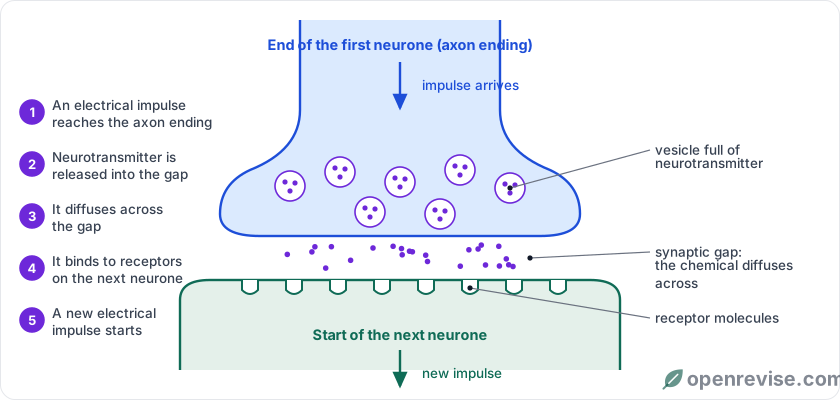
Neurones do not touch each other. Where two neurones meet there is a very small gap called a synapse. An electrical impulse cannot jump this gap, so it is passed across by a chemical:
- An electrical impulse arrives at the end of the axon of the first neurone.
- This causes the release of a chemical called a neurotransmitter into the gap.
- The neurotransmitter diffuses across the gap.
- It binds to receptor molecules on the membrane of the next neurone.
- This starts a new electrical impulse in the second neurone.
Because of how synapses work:
- Impulses only travel one way. The neurotransmitter is only released from one side of the synapse, and the receptors are only on the other side.
- Synapses slow impulses down slightly, because diffusion is slower than an electrical impulse. Fewer synapses in a pathway means a faster response.
- They connect neurones together. One neurone can pass impulses to many others, or receive from many others. This is how the CNS combines information.
Many drugs and poisons work at synapses. Some block the receptors, some stop the neurotransmitter being released, and some (such as caffeine) make impulses easier to start.
Reflex actions
Most of your actions are voluntary: you decide to do them, using the conscious part of your brain. A reflex action is different. It is automatic and rapid, and it does not involve the conscious part of the brain, so you do not have to think about it.
Reflexes are important because they protect the body from harm. A slower, thought-out response could come too late.
| Reflex | Stimulus | Response | How it helps |
|---|---|---|---|
| Withdrawal reflex | Touching something hot or sharp | Arm muscles pull the hand away | Less damage to the skin and tissues |
| Blinking | Object moving towards the eye | Eyelids close | Protects the cornea |
| Pupil reflex | Bright light | Pupils get smaller | Stops bright light damaging the retina |
| Coughing | Particles in the airway | Muscles force air out | Keeps the airways clear |
| Knee jerk | Tap below the kneecap | Thigh muscle contracts | Helps keep balance and posture |
The reflex arc
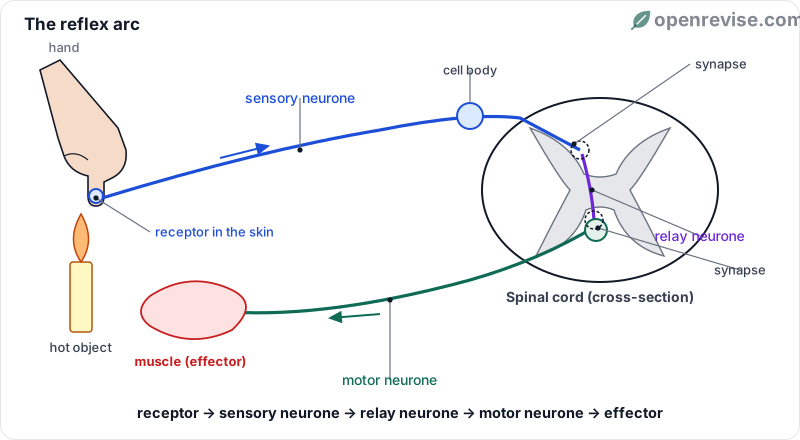
The pathway an impulse takes in a reflex is called a reflex arc. In the withdrawal reflex, it goes through the spinal cord:
- A receptor in the skin detects the stimulus (heat).
- An electrical impulse travels along a sensory neurone to the spinal cord.
- At a synapse, a neurotransmitter passes the impulse to a relay neurone in the spinal cord.
- At another synapse, the impulse passes to a motor neurone.
- The impulse travels along the motor neurone to the effector, a muscle in the arm.
- The muscle contracts and the hand moves away from the heat.
A reflex arc is fast because:
- the impulse does not go to the conscious part of the brain, so no time is spent deciding;
- it passes through only a few neurones and synapses (here, just two synapses);
- the sensory and motor neurones are long and have myelin sheaths, so impulses travel quickly.
Test yourself on this lesson
7 exam questions · 18 marks · with mark schemes and model answers
Found a mistake?