5.5 The brain
The main regions of the brain (cerebral cortex, cerebellum, medulla, hypothalamus and pituitary gland) and what each one controls.
A brain of billions of neurones
Key terms
- Cerebral cortex: the wrinkled outer layer of the cerebrum. It is responsible for consciousness, intelligence, memory and language.
- Cerebrum: the largest part of the brain, split into the left and right cerebral hemispheres.
- Cerebellum: the region at the back of the brain that coordinates muscle activity and balance.
- Medulla: the region at the base of the brain (the medulla oblongata) that controls unconscious activities such as heartbeat and breathing.
- Hypothalamus: a small region at the base of the brain that controls body temperature and water balance, and controls the pituitary gland.
- Pituitary gland: a pea-sized gland below the hypothalamus that releases many hormones.
The brain controls complex behaviour. It is made of billions of interconnected neurones, and different regions carry out different functions. The brain and spinal cord together form the central nervous system.
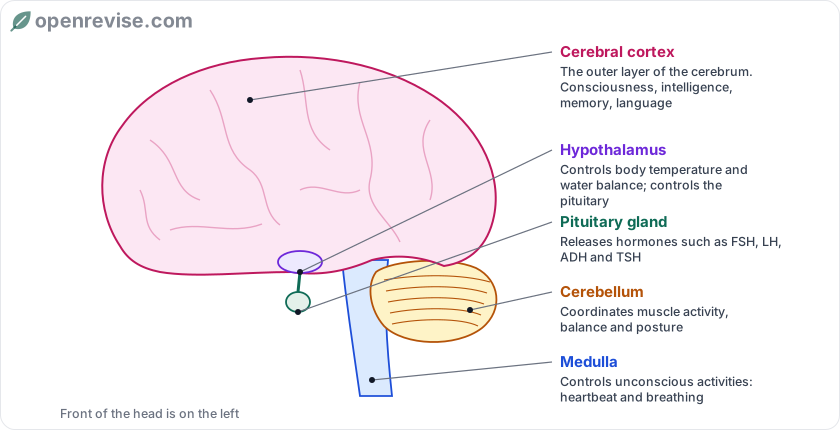
The regions and their jobs
| Region | Where it is | What it does |
|---|---|---|
| Cerebrum and cerebral cortex | The large, wrinkled top part, in two halves (cerebral hemispheres) | Consciousness, intelligence, memory, language, thinking and decision making; voluntary movement; interpreting information from the senses, such as vision and hearing |
| Cerebellum | At the back, under the cerebrum | Coordinates muscle activity, so movements are smooth and precise; balance and posture |
| Medulla (medulla oblongata) | At the base, joining the spinal cord | Controls unconscious activities: heart rate, breathing rate, swallowing |
| Hypothalamus | At the base of the cerebrum, above the pituitary | Thermoregulatory centre (body temperature); monitors the water content of the blood; controls the pituitary gland |
| Pituitary gland | Hangs below the hypothalamus | The "master gland": releases hormones such as FSH, LH, TSH and ADH into the blood |
More about the cerebrum
The cerebrum is split into a left and a right cerebral hemisphere, joined in the middle. Each hemisphere controls the muscles on the opposite side of the body: the left hemisphere controls the right side. The cortex is deeply folded, which gives it a very large surface area to hold billions of neurones.
Different areas of the cortex have different jobs. For example, one area at the back processes information from the eyes, an area at the side processes hearing, and a strip across the top controls voluntary movement. Many tasks, such as memory and language, use several areas working together.
How the regions work together
Imagine catching a ball. Your cerebral cortex sees the ball and decides to catch it. Your cerebellum coordinates your arm and hand muscles so the movement is smooth and accurate, and keeps you balanced. All the while, your medulla keeps your heart beating and your breathing going, without you thinking about it.
Test yourself on this lesson
7 exam questions · 17 marks · with mark schemes and model answers
Found a mistake?