3.1 Pathogens and how diseases spread
What pathogens are (bacteria, viruses, fungi and protists), how each makes us ill, how communicable diseases spread by air, water, direct contact and vectors, and how their spread can be reduced.
AQA
Edexcel
OCR
2 min read
Pathogens
Key terms
- Pathogen: a microorganism that causes disease.
- Communicable disease: a disease that can be passed from one person, animal or plant to another.
- Vector: an organism, such as a mosquito, that carries a pathogen from one host to another without getting the disease itself.
- Toxin: a poison made by a pathogen, which damages tissues.
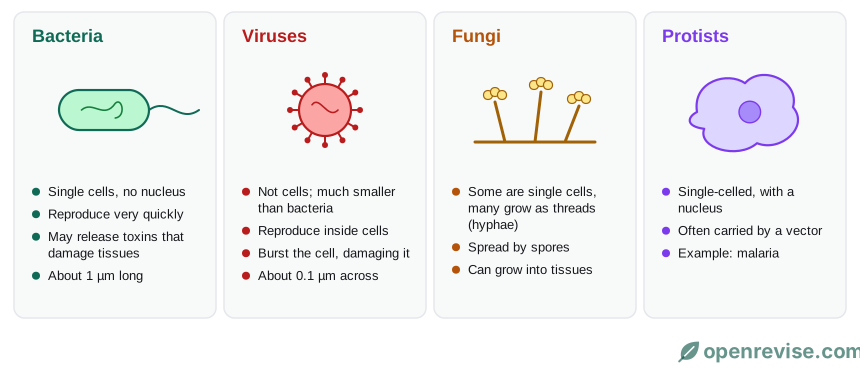
Pathogens can infect both animals and plants. There are four main types.
How pathogens make us ill
- Bacteria reproduce rapidly inside the body. Some produce toxins that damage tissues and make us feel ill.
- Viruses live and reproduce inside cells. They take over the cell to make copies of themselves, then the cell bursts open, releasing the new viruses. This damages the cells.
- Fungi and protists can also damage tissues as they grow and reproduce.
How communicable diseases spread
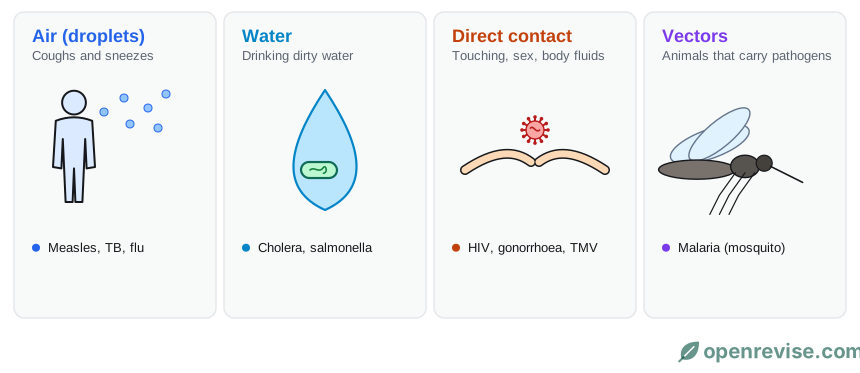
| Route | How | Example |
|---|---|---|
| Air | Droplets from coughs and sneezes are breathed in | Measles, tuberculosis, influenza |
| Water | Drinking or bathing in dirty water | Cholera |
| Direct contact | Touching an infected person or surface, sexual contact, body fluids | HIV, gonorrhoea, athlete's foot |
| Contaminated food | Eating food that contains pathogens or was prepared unhygienically | Salmonella |
| Vectors | An animal carries the pathogen to a new host | Malaria (mosquitoes) |
Reducing the spread
- Hygiene: washing hands, cleaning surfaces, cooking food thoroughly and covering the mouth when coughing or sneezing.
- Isolating infected people (or removing infected plants), so they cannot pass the pathogen on.
- Destroying or controlling vectors, for example using insecticides or removing the standing water where mosquitoes breed.
- Vaccination, so people do not become infected and cannot pass the disease on.
- Clean water supplies and sewage treatment.
Test yourself on this lesson
6 exam questions · 12 marks · with mark schemes and model answers
Found a mistake?