2.20 Plants in extreme environments
Edexcel: how leaf size and shape, the waxy cuticle and the number and position of stomata help plants such as cacti, marram grass and pine trees to survive hot, dry, windy or cold places by reducing water loss.
The problem
Plants lose water by transpiration through their stomata. In hot, dry or windy places water evaporates quickly and is hard to replace. In very cold places, the water in the soil may be frozen, so the plant cannot take it up. Plants that live in these extreme environments are adapted to reduce water loss.
Key terms
- Xerophyte: a plant adapted to live where water is scarce, such as a cactus.
- Sunken stomata: stomata that sit in pits in the leaf surface, where humid air is trapped.
- Waxy cuticle: the waterproof layer on the outside of a leaf.
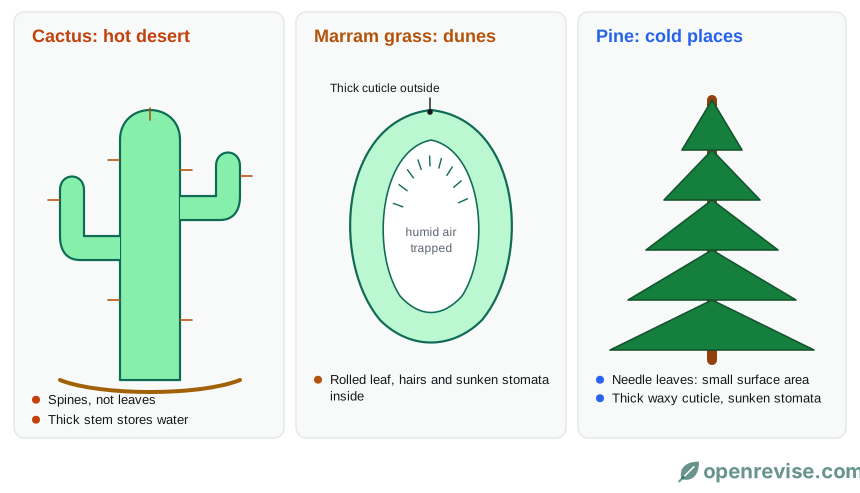
Leaf size and shape
- Small leaves, needles or spines have a small surface area, so less water evaporates. A cactus has spines instead of leaves; they also protect it from animals.
- Some plants roll their leaves, like marram grass on sand dunes. The stomata are on the inside of the roll, where moist air is trapped, so the concentration gradient of water vapour is shallow.
The cuticle
A thick waxy cuticle waterproofs the leaf or stem and reflects some sunlight, so less water evaporates through the surface.
Stomata
- Fewer stomata mean fewer places for water vapour to escape.
- Sunken stomata and hairs around the stomata trap a layer of humid air, which reduces the concentration gradient, so water vapour diffuses out more slowly.
- Some desert plants open their stomata only at night, when it is cooler.
Other adaptations
- A cactus has a thick, fleshy stem that stores water and does the photosynthesis.
- Desert plants have either long roots to reach deep water or wide, shallow roots to absorb rain quickly before it evaporates.
- Conifers such as pine keep needle leaves through the winter, so they can photosynthesise whenever conditions allow.
| Adaptation | Example | How it reduces water loss |
|---|---|---|
| Small or needle leaves | Pine, cactus spines | Smaller surface area for evaporation |
| Rolled leaves | Marram grass | Traps humid air around the stomata |
| Thick waxy cuticle | Cactus, pine | Waterproof, less evaporation from the surface |
| Few or sunken stomata, hairs | Marram grass, cactus | Humid air trapped, shallower gradient for diffusion |
Test yourself on this lesson
5 exam questions · 11 marks · with mark schemes and model answers
Found a mistake?