6.21 Cloning plants and animals
How plants are cloned by cuttings and tissue culture, and animals by embryo transplants and adult cell cloning (as with Dolly the sheep), with the uses, benefits and risks of cloning.
Separate only
AQA
Edexcel
2 min read
Cloning plants
Key terms
- Clone: an organism genetically identical to its parent.
- Tissue culture: growing new plants from small groups of cells on a growth medium.
- Cuttings: gardeners take a cutting from a good parent plant (a short piece of stem with leaves), dip it in rooting hormone and plant it. It grows into a clone. This is quick and cheap.
- Tissue culture: small groups of cells from a parent plant are grown on a sterile growth medium containing nutrients and plant hormones. Each group grows into a new plant. This is used to make many clones quickly, to preserve rare plant species, and by commercial nurseries. It is also used in medical research and plant breeding programmes (Edexcel), because it produces genetically identical plants for fair testing.
Cloning animals (AQA)
- Embryo transplants: cells are split apart from a developing animal embryo before they become specialised, and the identical embryos are transplanted into host mothers. Used to make many copies of a prize cow.
- Adult cell cloning:
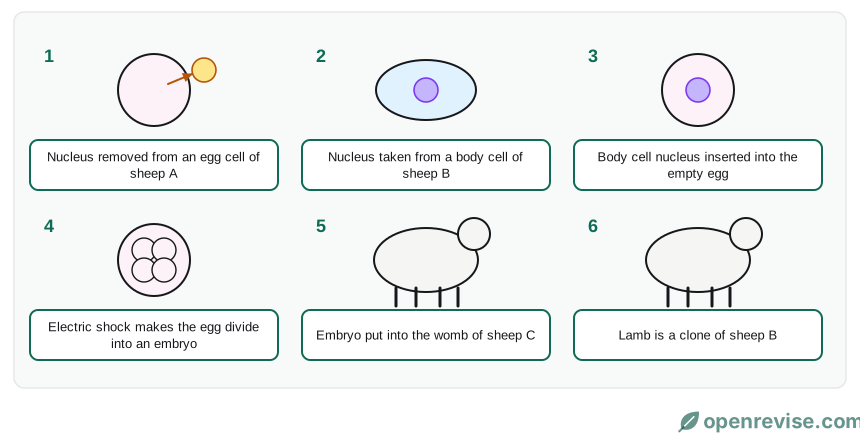
- The nucleus is removed from an unfertilised egg cell.
- The nucleus from an adult body cell, such as a skin cell, is inserted into the egg.
- An electric shock stimulates the egg cell to divide to form an embryo.
- The embryo cells contain the same genetic information as the adult skin cell.
- When the embryo has developed into a ball of cells, it is inserted into the womb of an adult female to continue its development.
This was how Dolly the sheep was made in 1996.
Benefits and risks
| Benefits | Risks |
|---|---|
| Copies of animals with useful characteristics, such as high milk yield | Reduces variation, so a disease could affect all the clones |
| Could save endangered species | Cloned animals may be less healthy or age faster |
| Research into making organs for transplants | Ethical concerns about using animals and the possibility of cloning humans |
Test yourself on this lesson
5 exam questions · 11 marks · with mark schemes and model answers
Found a mistake?