6.3 DNA and the genome
DNA as a polymer of two strands in a double helix, nucleotides and complementary base pairs (A-T, C-G), how DNA is packed into chromosomes, genes as sections of DNA that code for proteins, and the genome.
DNA
Key terms
- DNA: deoxyribonucleic acid, the genetic material, a polymer made of two strands forming a double helix.
- Chromosome: a long, coiled molecule of DNA found in the nucleus.
- Gene: a small section of DNA on a chromosome that codes for a particular sequence of amino acids, to make a specific protein.
- Genome: the entire genetic material of an organism.
- Nucleotide: the repeating unit of DNA, made of a sugar, a phosphate group and one of four bases.
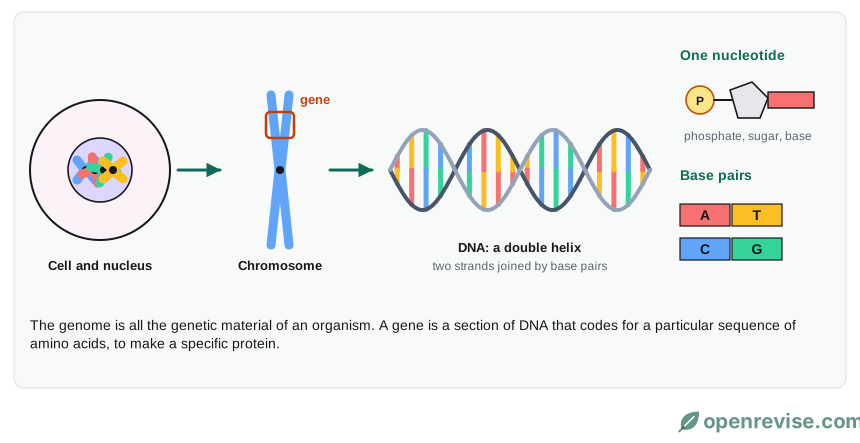
The genetic material in the nucleus of a cell is made of DNA. DNA is a polymer made of two strands coiled into a double helix. It is packed into structures called chromosomes. Each chromosome carries many genes.
The structure of DNA
- DNA is made of repeating units called nucleotides.
- Each nucleotide has a sugar, a phosphate group and one of four bases: A (adenine), T (thymine), C (cytosine) and G (guanine).
- The sugar and phosphate groups form the "backbone" of each strand.
- The bases on the two strands join in complementary pairs: A with T and C with G. They are held together by weak hydrogen bonds.
So if one strand reads ATGC, the other reads TACG.
Genes and the genome
A gene is a short section of DNA that codes for one protein, by coding for a particular sequence of amino acids. The whole set of an organism's genetic material is its genome.
Studying the human genome helps scientists to:
- search for genes linked to different types of disease
- understand and treat inherited disorders
- trace human migration patterns from the past.
Test yourself on this lesson
6 exam questions · 12 marks · with mark schemes and model answers
Found a mistake?