6.2 Meiosis
How meiosis in the reproductive organs halves the chromosome number to make four genetically different gametes, how fertilisation restores the full number, and the difference between haploid and diploid cells.
Why gametes need half the chromosomes
Key terms
- Meiosis: a type of cell division that makes gametes with half the number of chromosomes, all genetically different.
- Diploid: a cell with two sets of chromosomes (46 in humans), such as a body cell.
- Haploid: a cell with one set of chromosomes (23 in humans), such as a gamete.
Human body cells have 23 pairs of chromosomes (46). If gametes had 46 too, a fertilised egg would have 92. So gametes are made by meiosis, which halves the number. When a sperm (23) fertilises an egg (23), the new cell has the full 46.
How meiosis works
Meiosis happens in the reproductive organs: the testes and ovaries in humans, and the anthers and ovaries in flowering plants.
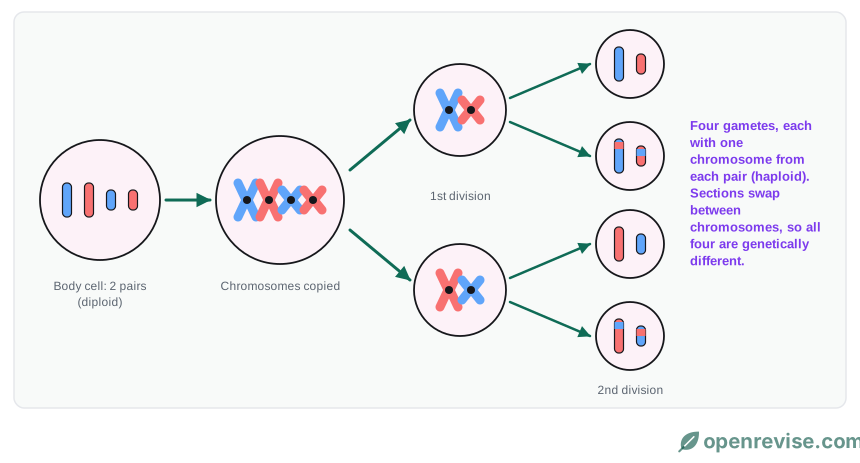
- Copies of the genetic information are made: each chromosome is copied.
- The cell divides twice.
- This forms four gametes, each with a single set of chromosomes.
- All the gametes are genetically different from each other, because the chromosomes are shuffled into different combinations.
After fertilisation
The fertilised egg (zygote) divides by mitosis to form an embryo. As the embryo develops, its cells differentiate into the different types of cell.
| Feature | Mitosis | Meiosis |
|---|---|---|
| Used for | Growth, repair, asexual reproduction | Making gametes |
| Number of divisions | One | Two |
| Cells made | Two | Four |
| Chromosome number | Same as parent (diploid) | Half (haploid) |
| Genetically | Identical | All different |
Test yourself on this lesson
6 exam questions · 13 marks · with mark schemes and model answers
Found a mistake?