6.4 Extracting DNA from fruit
Edexcel: how to extract DNA from fruit such as strawberries using detergent, salt, filtering, protease and ice-cold ethanol, and why each step is needed.
Edexcel
2 min read
The aim
Edexcel (3.6) asks you to describe how to extract DNA from fruit. Strawberries work well because their cells have many copies of each chromosome.
Key terms
- Detergent: breaks down the membranes around the cell and the nucleus, releasing the DNA.
- Salt: makes the DNA strands clump together.
- Protease: an enzyme that breaks down the proteins wrapped around the DNA.
- Ice-cold ethanol: DNA is insoluble in it, so the DNA comes out of solution (precipitates).
Method
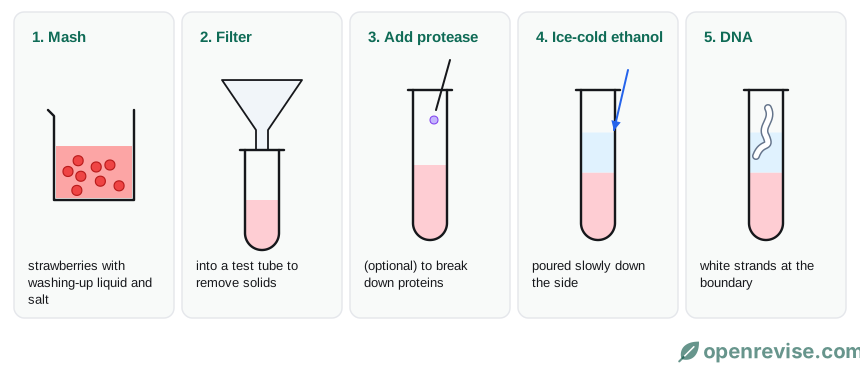
- Mash the fruit in a mixture of washing-up liquid (detergent), salt and water. Mashing breaks up the cell walls.
- Warm the mixture gently in a water bath for a few minutes, then filter it to remove the solid bits.
- Add a few drops of protease (such as pineapple juice or a biological washing powder) to break down the proteins attached to the DNA.
- Pour ice-cold ethanol slowly down the side of the tube, so it forms a layer on top.
- White, stringy DNA appears at the boundary between the two layers. It can be lifted out with a glass rod.
Why each step matters
| Step | Reason |
|---|---|
| Mashing | Breaks up the cell walls |
| Detergent | Breaks down the cell membrane and nuclear membrane, so the DNA is released |
| Salt | Makes the DNA clump together |
| Protease | Breaks down proteins attached to the DNA |
| Ice-cold ethanol | DNA is insoluble in cold ethanol, so it precipitates out where you can see it |
Test yourself on this lesson
5 exam questions · 8 marks · with mark schemes and model answers
Found a mistake?