6.6 Mutations and genetic variants
What mutations are, why most have no effect on the protein, how a change in a coding region can change the shape of a protein such as an enzyme, and how variants in non-coding DNA can switch genes on or off.
Mutations
Key terms
- Mutation: a change in the base sequence of DNA.
- Genetic variant: a different version of a gene, produced by a mutation.
- Coding DNA: the parts of DNA that code for proteins.
- Non-coding DNA: parts of DNA that do not code for proteins but can switch genes on and off.
Mutations happen continuously, by chance, when DNA is copied. They can be made more likely by ionising radiation and some chemicals. A mutation produces a genetic variant.
Most mutations have no effect
- Many mutations happen in DNA that does not code for a protein.
- Some change a triplet to another that codes for the same amino acid.
- Some change one amino acid, but the protein still folds in the same way and works normally.
When a mutation changes a protein
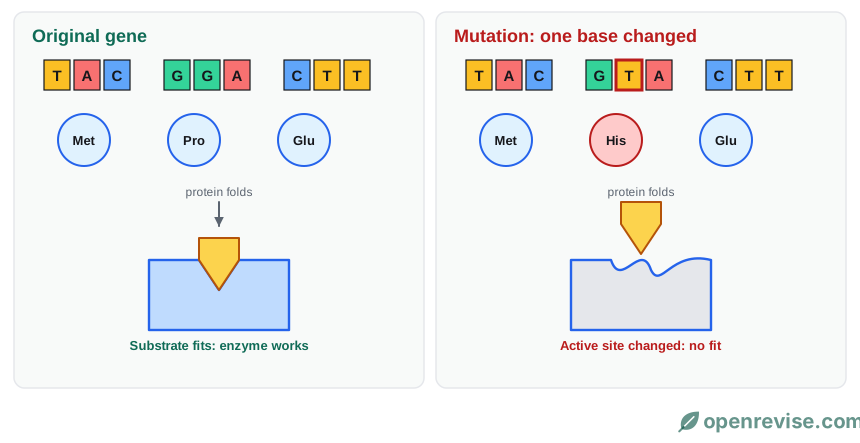
A few mutations change the amino acid sequence enough to change how the protein folds, and so its shape:
- an enzyme may have an active site that no longer fits its substrate, so it does not work
- a structural protein, such as collagen, may lose its strength.
Very rarely a mutation gives a protein that works better, which can be an advantage. This is the source of new variation that natural selection acts on.
Variants in non-coding DNA
Some non-coding parts of DNA can switch genes on and off. A variant here can change whether a gene is expressed, and so whether the protein is made at all. In Edexcel's terms, a mutation in the non-coding DNA in front of a gene can stop RNA polymerase binding, so less (or no) mRNA is made.
How much do mutations matter?
Most genetic variants have no effect on the phenotype, some influence it, and a very few determine it, such as the variants that cause cystic fibrosis.
Test yourself on this lesson
5 exam questions · 10 marks · with mark schemes and model answers
Found a mistake?