6.5 Protein synthesis
How the base sequence of a gene codes for a protein: the triplet code, transcription of DNA into mRNA in the nucleus, translation at the ribosome with carrier molecules (tRNA), and folding of the amino acid chain into a protein.
Higher only
Separate only
AQA
Edexcel
OCR
2 min read
The genetic code
Key terms
- Triplet: a sequence of three bases that codes for one amino acid.
- Transcription: copying the base sequence of a gene into a molecule of messenger RNA (mRNA).
- Translation: using the mRNA code at a ribosome to join amino acids in the right order.
- mRNA: messenger RNA, a single-stranded copy of a gene that carries the code to the ribosome.
- tRNA: transfer RNA, carrier molecules that bring specific amino acids to the ribosome.
A gene is a sequence of bases. Every three bases (a triplet) code for one amino acid. The order of the triplets decides the order of amino acids in the protein, and that order decides the protein's shape and so its function.
Making a protein
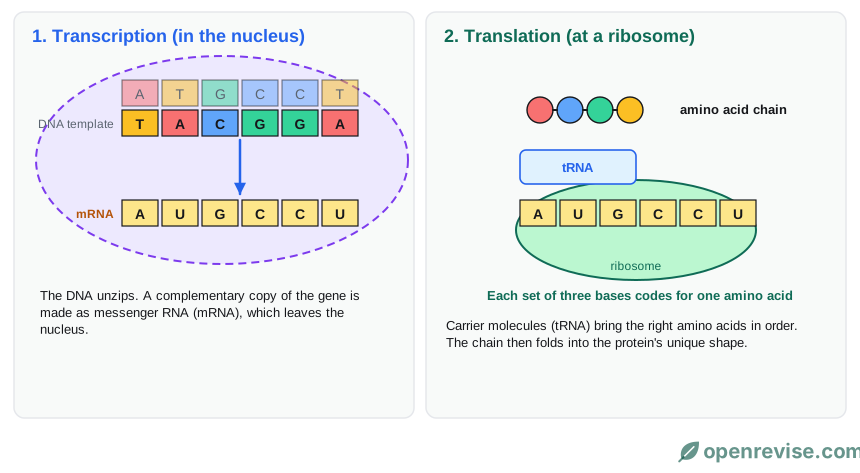
1. Transcription (in the nucleus)
- DNA is too big to leave the nucleus. The two strands of the gene separate.
- A complementary copy of the gene is made, as mRNA. In Edexcel's version, the enzyme RNA polymerase binds to the non-coding DNA in front of the gene and builds the mRNA.
- The mRNA leaves the nucleus and travels to a ribosome in the cytoplasm.
2. Translation (at the ribosome)
- The ribosome reads the mRNA three bases at a time (each triplet is a codon).
- Carrier molecules (tRNA) bring specific amino acids. Each tRNA has an anticodon that pairs with one codon.
- The amino acids are joined together in the order coded for, making a polypeptide chain.
3. Folding
The chain of amino acids folds into a unique shape, which lets the protein do its job.
Types of protein
- Enzymes, with an active site that fits a substrate.
- Hormones, which carry messages in the blood, such as insulin.
- Structural proteins, which are strong, such as collagen.
Test yourself on this lesson
6 exam questions · 13 marks · with mark schemes and model answers
Found a mistake?