6.18 Human evolution: fossils and stone tools
Edexcel: fossil evidence for human evolution (Ardi, Lucy and Leakey's Turkana Boy), how stone tools developed and are dated, and (Biology only) the pentadactyl limb as evidence for evolution.
Fossil evidence
Key terms
- Hominid: a member of the group that includes humans and their extinct ancestors.
- Pentadactyl limb: a limb with five digits, found in many vertebrates.
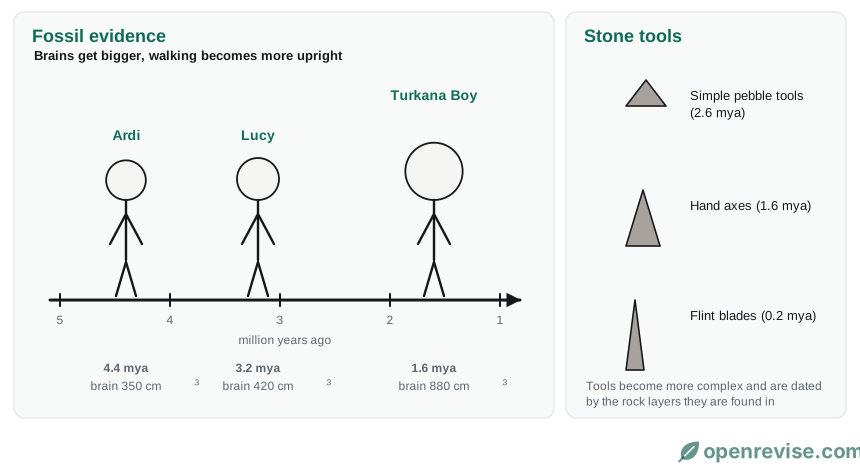
Fossils show that humans evolved over millions of years from ancestors shared with apes.
| Fossil | Age | Found | Features |
|---|---|---|---|
| Ardi (Ardipithecus ramidus) | 4.4 million years | Ethiopia, 1994 | Ape-like feet with a grasping big toe for climbing, but legs and pelvis suggest upright walking; brain about 350 cm3 |
| Lucy (Australopithecus afarensis) | 3.2 million years | Ethiopia, 1974 | Walked upright on arched feet, arms longer than ours; brain about 400-450 cm3 |
| Turkana Boy (Homo erectus), found by Richard Leakey's team | 1.6 million years | Kenya, 1984 | Tall, with a human-like skeleton, short arms and long legs; brain about 880 cm3 |
Over time, the brain gets bigger, walking becomes more upright, and arms get shorter compared with the legs.
Stone tools
Stone tools also show evolution. The oldest are simple pebble tools made by hitting one stone with another. Later, Homo erectus made shaped hand axes, and later still, Homo sapiens made fine flint blades. More complex tools suggest bigger, more developed brains.
Tools and fossils are dated by the rock layer they are found in: deeper layers are older. Scientists can also date the volcanic rock above and below them by radioactive dating.
The pentadactyl limb (Biology only)
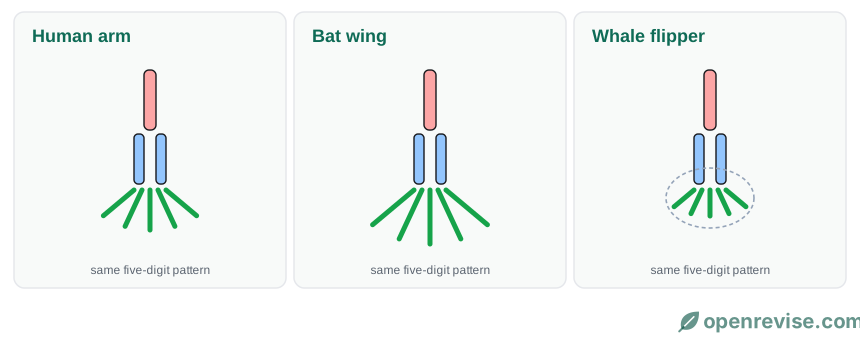
Mammals, birds, reptiles and amphibians all have limbs with the same basic pattern of bones ending in five digits, even though they are used for different jobs (grasping, flying, swimming). This suggests they all evolved from a common ancestor.
Test yourself on this lesson
5 exam questions · 8 marks · with mark schemes and model answers
Found a mistake?