2.7 Measuring the energy in food (calorimetry)
Edexcel core practical: burning a food sample under a boiling tube of water to measure the energy it contains, calculating energy with mass of water x 4.2 x temperature rise, and why the result is lower than the true value.
The aim
Food contains chemical energy. You can measure it by burning the food and using the heat to warm water. This method is called calorimetry. This is part of Edexcel core practical 1.14 (Biology only).
Key terms
- Calorimetry: measuring the energy released by a reaction from the temperature change of water.
- Specific heat capacity of water: 4.2 J of energy raises the temperature of 1 g of water by 1 °C.
Method
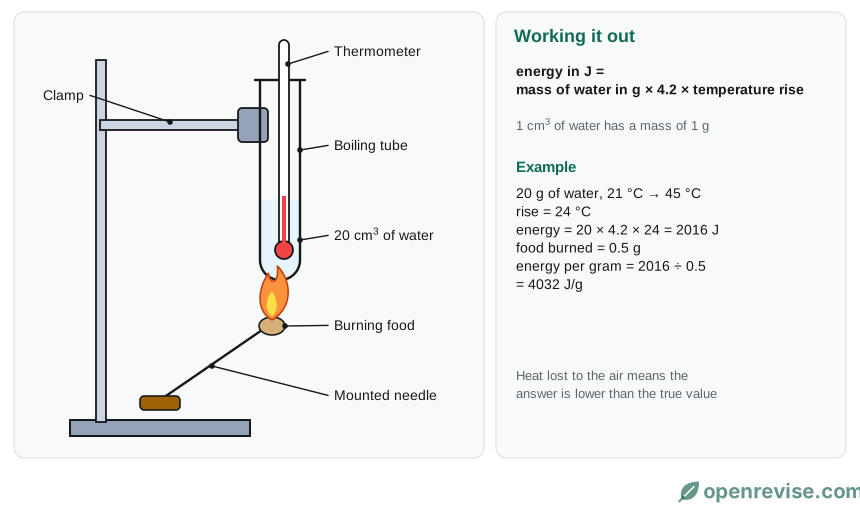
- Put 20 cm3 of water into a boiling tube held in a clamp. 1 cm3 of water has a mass of 1 g.
- Measure the starting temperature of the water.
- Find the mass of a small piece of food, such as a crisp or a nut, and put it on a mounted needle.
- Set light to the food using a Bunsen burner, then hold it straight under the boiling tube until it burns out. If it goes out, relight it, until it will not light again.
- Stir the water and measure the highest temperature it reaches.
- Repeat with the same mass of other foods, using fresh water each time.
Calculating the energy
To compare foods fairly, work out the energy per gram of food:
Example: 20 g of water warms from 21 °C to 45 °C, a rise of 24 °C. Energy = 20 × 4.2 × 24 = 2016 J. The food had a mass of 0.5 g, so energy per gram = 2016 ÷ 0.5 = 4032 J/g.
Why the result is too low
The value you get is always lower than the value on the food packet, because:
- much of the heat warms the air, the boiling tube and the clamp, not the water
- some food may not burn completely
- some energy is given out as light.
A calorimeter that surrounds the water with insulation, and burns the food in pure oxygen, gives a much more accurate value.
Test yourself on this lesson
6 exam questions · 12 marks · with mark schemes and model answers
Found a mistake?