2.8 The lungs and gas exchange
The structure of the lungs, from the trachea to the alveoli, and how alveoli are adapted for gas exchange: a large surface area, thin walls, a good blood supply and ventilation keep oxygen and carbon dioxide diffusing quickly.
AQA
Edexcel
OCR
2 min read
The structure of the lungs
Key terms
- Trachea: the windpipe. Rings of cartilage keep it open.
- Bronchi: the two tubes that branch from the trachea, one into each lung (one bronchus).
- Bronchioles: smaller tubes that branch from the bronchi.
- Alveoli: tiny air sacs at the ends of the bronchioles, where gas exchange happens.
- Gas exchange: oxygen moving into the blood and carbon dioxide moving out, by diffusion.
The lungs are in the thorax (chest), protected by the ribs. The intercostal muscles between the ribs and the diaphragm below the lungs move air in and out when we breathe.
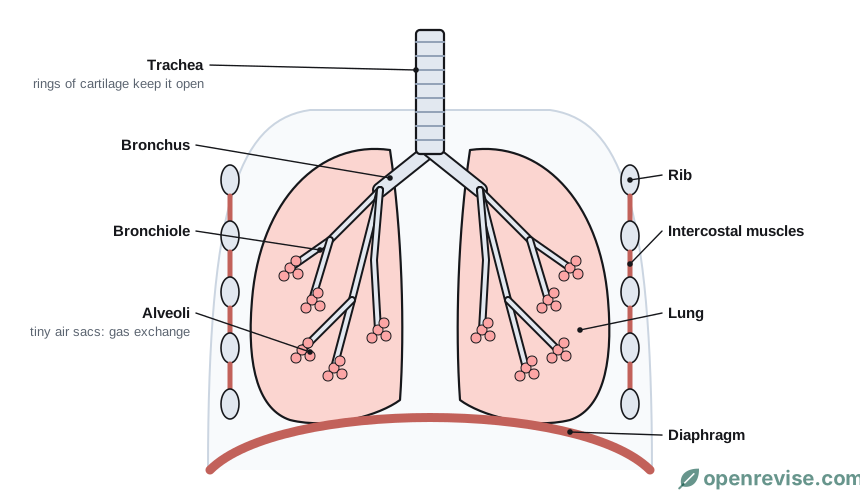
Air goes in through the mouth and nose, then down the trachea → bronchi → bronchioles → alveoli.
Gas exchange in the alveoli
Each alveolus is surrounded by a network of blood capillaries.
- Air in the alveoli has a high concentration of oxygen. Blood arriving in the capillaries has a low concentration, because body cells have used the oxygen in respiration. So oxygen diffuses from the alveoli into the blood.
- The blood has a high concentration of carbon dioxide, made by respiring cells. So carbon dioxide diffuses from the blood into the alveoli and is breathed out.
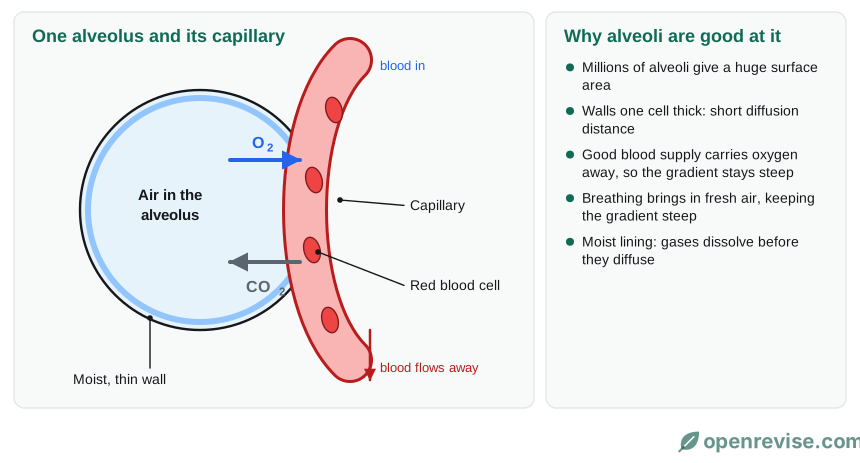
How alveoli are adapted
| Feature | How it helps |
|---|---|
| Millions of alveoli | A very large surface area for diffusion |
| Walls only one cell thick, next to capillary walls one cell thick | A short diffusion distance |
| A good blood supply | Oxygenated blood is carried away, keeping a steep concentration gradient |
| Breathing (ventilation) | Brings in fresh air and removes carbon dioxide, keeping the gradient steep |
| Moist lining | Gases dissolve before they diffuse across |
Test yourself on this lesson
6 exam questions · 13 marks · with mark schemes and model answers
Found a mistake?