2.6 Required practical: food tests
How to test foods for starch, reducing sugars, protein and lipids using iodine, Benedict's solution, biuret reagent and Sudan III or the ethanol emulsion test, with the colour changes, safety and how to prepare a food sample.
AQA
Edexcel
OCR
2 min read
The aim
To find out which food molecules a food contains. This is AQA required practical 4, Edexcel core practical 1.13 and part of OCR PAG B2.
Key terms
- Reagent: a chemical used to test for a substance.
- Positive result: the colour change that shows the substance is there.
- Reducing sugar: a sugar such as glucose or maltose that gives a positive Benedict's test.
Preparing the food sample
- Grind a small piece of food with a little distilled water using a pestle and mortar to make a paste.
- Mix with more water and stir, so the food molecules dissolve.
- Filter the mixture to remove any solid bits, and put the liquid into test tubes.
The four tests
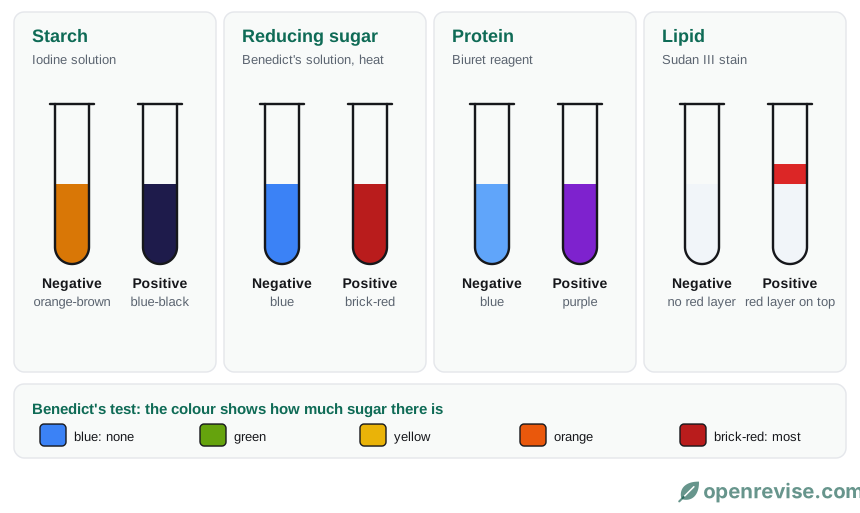
| Testing for | Reagent and method | Positive result |
|---|---|---|
| Starch | Add a few drops of iodine solution | Orange-brown turns blue-black |
| Reducing sugars | Add Benedict's solution and heat in a water bath at about 75 °C for 5 minutes | Blue turns green, yellow or brick-red |
| Protein | Add biuret reagent (or sodium hydroxide, then copper sulfate solution) | Blue turns purple |
| Lipids | Add a few drops of Sudan III stain and shake | A red-stained layer forms on top |
| Lipids (emulsion test) | Shake with ethanol, then pour into water | A cloudy white emulsion forms |
The Benedict's test is semi-quantitative: the further the colour moves from blue towards brick-red, the more reducing sugar there is. A result stays blue if there is none.
Safety
- Wear eye protection. Biuret reagent contains sodium hydroxide, which is corrosive.
- Heat Benedict's solution in a water bath, not directly in a flame, so it does not boil over.
- Ethanol is flammable: keep it away from flames.
Test yourself on this lesson
6 exam questions · 12 marks · with mark schemes and model answers
Found a mistake?