2.13 Coronary heart disease and its treatment
How fatty deposits in the coronary arteries cause coronary heart disease, and how it and other heart problems are treated: stents, statins, valve replacement, transplants, artificial hearts and lifestyle changes, with their advantages and disadvantages.
AQA
Edexcel
OCR
2 min read
What coronary heart disease is
Key terms
- Coronary arteries: arteries that supply the heart muscle with oxygenated blood.
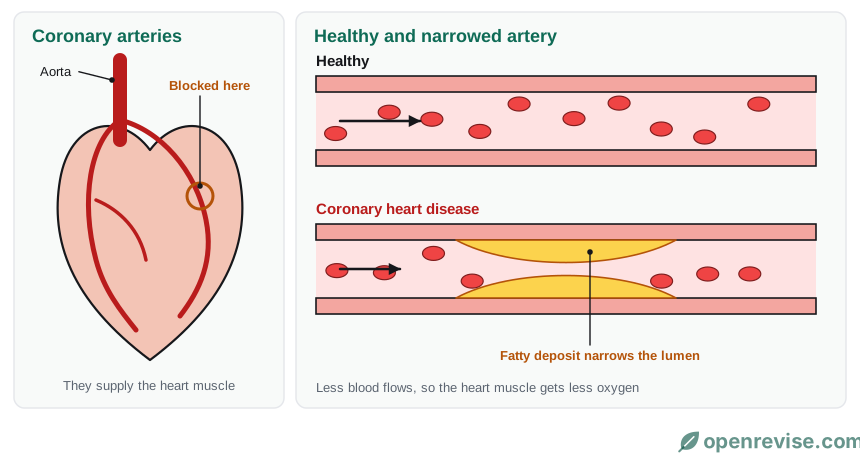
- Coronary heart disease (CHD): a disease in which layers of fatty material build up inside the coronary arteries, narrowing them.
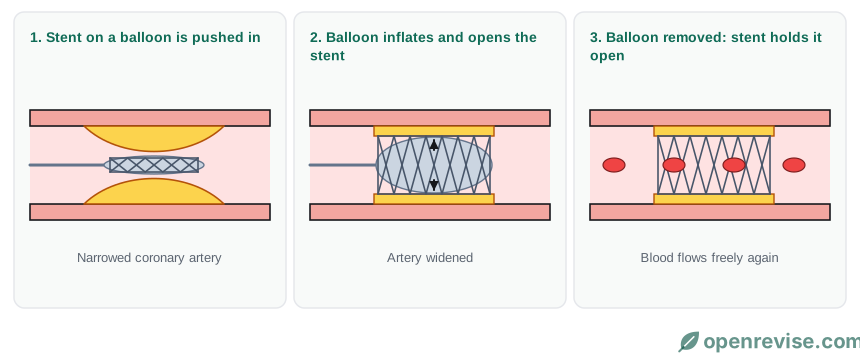
- Stent: a small mesh tube put inside an artery to hold it open.
- Statin: a drug that lowers the level of cholesterol in the blood.
The heart muscle needs a constant supply of oxygen for respiration. In coronary heart disease, fatty material (containing cholesterol) builds up in the walls of the coronary arteries. The lumen gets narrower, so:
- less blood can flow through the artery
- the heart muscle gets less oxygen
- this can cause chest pain, and if an artery is blocked completely, part of the heart muscle dies: a heart attack.
Treatments for coronary heart disease
| Treatment | Advantages | Disadvantages |
|---|---|---|
| Stents | Open the artery straight away; quick recovery; no major surgery | Risk of a blood clot or infection; the artery can narrow again |
| Statins | Lower blood cholesterol and slow the build-up of fatty material; no surgery | Must be taken for life; side effects such as liver problems; take time to work |
| Lifestyle changes (diet, exercise, stopping smoking) | Cheap; no side effects; lower the risk of other diseases | Slow to work; people may find them hard to keep up |
Other heart problems
- Faulty valves may not open fully, or may leak so blood flows backwards. They can be replaced with biological valves (from animals such as pigs, or from human donors) or mechanical valves. Mechanical valves last a long time, but the patient must take drugs to stop blood clots.
- Heart failure can be treated with a heart transplant, or a heart and lungs transplant, from a donor. There are not enough donors, and the patient must take drugs for life to stop the new heart being rejected.
- Artificial hearts can keep a patient alive while they wait for a transplant, or let the heart rest and recover. They are not rejected, but there is a risk of blood clots and infection.
Test yourself on this lesson
6 exam questions · 15 marks · with mark schemes and model answers
Found a mistake?