2.14 Health, lifestyle and risk factors
What health is, communicable and non-communicable diseases, how diseases interact, the main risk factors (diet, exercise, smoking, alcohol, carcinogens), correlation and causation, BMI and waist:hip ratio, and the costs of disease.
What health means
Key terms
- Health: a state of complete physical, mental and social well-being, and not just the absence of disease.
- Communicable disease: a disease caused by a pathogen that can be passed from one person to another.
- Non-communicable disease: a disease that cannot be passed on, such as heart disease, most cancers and type 2 diabetes.
- Risk factor: something about a person's lifestyle, or a substance in their body or environment, that makes a disease more likely.
How diseases interact
Diseases and other factors affect each other:
- a defect in the immune system makes a person more likely to catch communicable diseases
- some viruses living in cells can trigger cancers (for example, HPV can cause cervical cancer)
- immune reactions to a pathogen can trigger allergies, such as skin rashes or asthma
- severe physical illness can lead to mental illness, such as depression.
Diet, stress and life situations (such as poverty or where you live) also have a big effect on both physical and mental health.
Risk factors
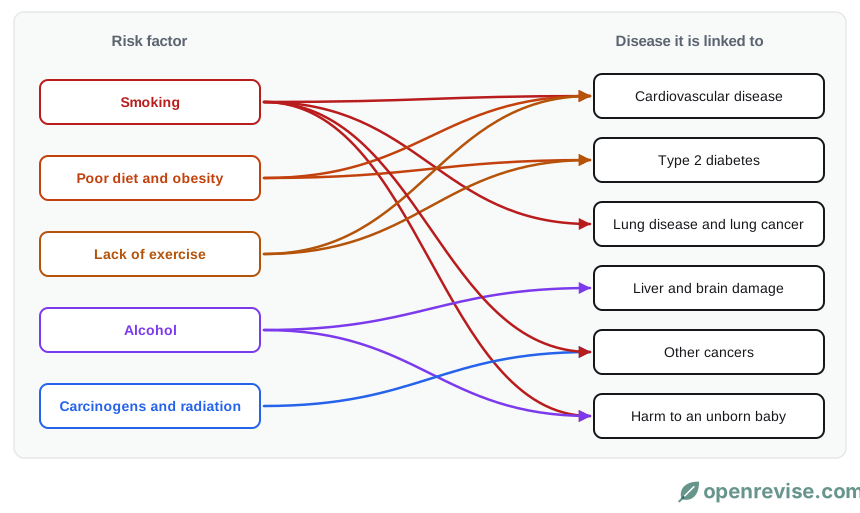
- Diet, obesity and lack of exercise increase the risk of cardiovascular disease and type 2 diabetes.
- Smoking causes lung disease and lung cancer, and damages the heart and blood vessels.
- Alcohol damages the liver and affects brain function.
- Smoking and alcohol in pregnancy harm the unborn baby.
- Carcinogens, including ionising radiation, increase the risk of cancer.
Many diseases are caused by several risk factors acting together.
Correlation and cause
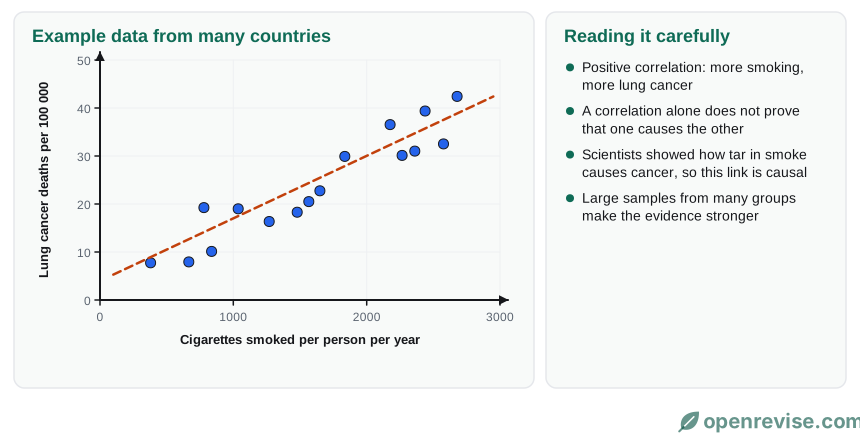
A correlation means two things change together. It does not prove that one causes the other. A risk factor is only accepted as a cause once scientists find a mechanism: for example, chemicals in tobacco smoke damage the DNA in lung cells.
Measuring obesity (Edexcel)
| BMI | Category |
|---|---|
| Below 18.5 | Underweight |
| 18.5 to 24.9 | Normal (healthy) weight |
| 25 to 29.9 | Overweight |
| 30 to 39.9 | Obese |
| 40 or more | Severely obese |
Example: mass 80 kg, height 1.75 m. BMI = 80 ÷ 1.752 = 80 ÷ 3.0625 = 26.1, which is overweight. BMI does not tell muscle from fat, so a very muscular athlete can have a high BMI. The waist:hip ratio (waist measurement ÷ hip measurement) shows fat stored around the middle, which is more closely linked to heart disease. A ratio above about 0.9 for men or 0.85 for women means a higher risk.
The cost of non-communicable diseases
Non-communicable diseases cost the NHS and other health services a lot of money for treatment. Families lose income when someone cannot work or needs care, and the whole country loses workers. In poorer countries, they also slow down economic development.
Test yourself on this lesson
7 exam questions · 16 marks · with mark schemes and model answers
Found a mistake?