2.15 Cancer
Cancer as uncontrolled cell growth and division caused by changes in cells, the difference between benign and malignant tumours, how cancers spread to form secondary tumours, and the lifestyle and genetic risk factors.
What cancer is
Key terms
- Tumour: a mass of abnormal cells, formed by uncontrolled cell division.
- Benign tumour: a growth of abnormal cells that stays in one area, usually inside a membrane, and does not invade other parts of the body.
- Malignant tumour: a cancer. Its cells invade neighbouring tissues and spread to other parts of the body in the blood.
- Secondary tumour: a new tumour formed where cancer cells from a malignant tumour settle in another part of the body.
- Carcinogen: a substance or agent that causes cancer.
Normally, cells divide by mitosis only when the body needs new cells, for growth or repair. Cancer is the result of changes in cells (mutations in their DNA) that lead to uncontrolled growth and division. The cells keep dividing and form a tumour.
Benign and malignant tumours
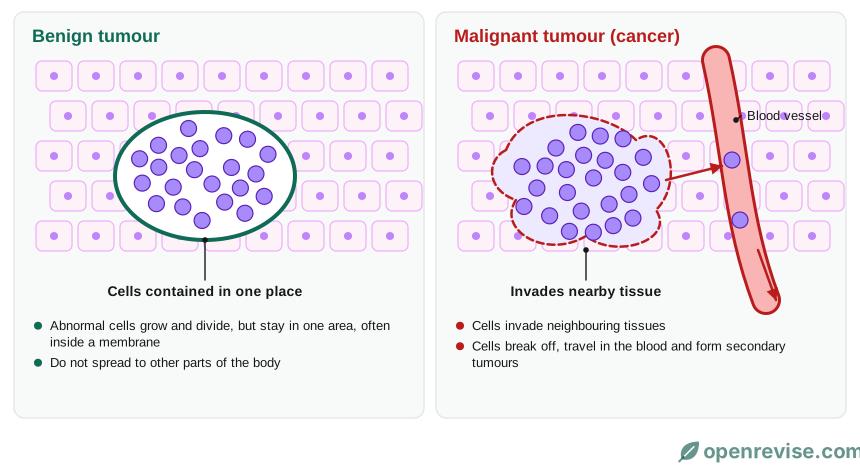
| Benign | Malignant |
|---|---|
| Stays in one place, usually inside a membrane | Invades neighbouring tissues |
| Does not spread around the body | Cells break off and travel in the blood to other parts of the body |
| Not cancer, but can still cause problems by pressing on organs, for example in the brain | Cancer: forms secondary tumours elsewhere in the body |
Risk factors for cancer
Scientists have found several causes of the changes in cells that lead to cancer.
- Lifestyle risk factors: smoking (lung, mouth and throat cancer), obesity, too much alcohol, and too much exposure to ultraviolet light from the Sun or sunbeds (skin cancer).
- Carcinogens in the environment, such as ionising radiation and some chemicals.
- Viruses: some viruses can cause cancer. For example, the human papillomavirus (HPV) can cause cervical cancer.
- Genetic risk factors: some people inherit faulty genes, such as the BRCA genes, that make some cancers, such as breast cancer, much more likely.
Treatment
Cancers are treated with surgery to remove the tumour, chemotherapy (drugs that stop cells dividing) and radiotherapy (radiation that kills cancer cells). Finding a cancer early, before it spreads, gives the best chance of a cure.
Test yourself on this lesson
6 exam questions · 11 marks · with mark schemes and model answers
Found a mistake?